Southern Portugal – Spring in the Algarve

After a quieter year last year, I was keen to get back to guiding full-time again, and my first opportunity came in March this year when I was asked to fill in for another guide on Greentours‘ spring tour of Southern Portugal. Whilst always a little daunting to fill someone else’s spot, and never a task you want to have to take for the sake of the other guide, sometimes these things come up, and so here I was. Thankfully, I was met by another co-leader who knew the tour well, and we had a wonderful week.

Having gathered the main group at the airport in Faro, we set out for our hotel near Alte. The weather was windy and overcast, but rain held off and so after settling in and having a brief introduction, we headed out for a walk before dinner. Immediately in the garden, we spotted our first orchids of the trip, a wonderful group of Ophrys bombyliflora and a couple of Serapias lingua, which we then found a whole lot more of in another section of the lawn. Iberian Green Frogs were calling, and one or two of the group got a fleeting glimpse of them before they dived for cover in the small pond. 

Heading out of a back gate and along the lane from the hotel, we were immediately struck by the wealth of spring wildflowers to be seen. Common species and those ubiquitous in the Mediterranean, such as Glebionis coronarium, Bituminaria bituminosa and Salvia verbenaca were noted along with a few less frequently seen and more localised like Carduncellus caeruleus, Centaurea pullata and Aristolochia baetica. 

My co-leader Hugo uncovered a locally endemic Maria’s Worm Lizard, Blanus mariae, not far from where we turned on to the track, and the group was able to get a good look at this extraordinary reptile which looks, as its name suggests, remarkably like a large Earthworm.

Returning carefully along the road, we found some more orchids too, with specimens of Ophrys fusca, Ophrys speculum and Ophrys lutea growing in the verges.

We returned to the hotel with time to warm up, relax and change before dinner. Hugo did not join us, but instead returned to Faro to collect the final two members of our party arriving on a later flight. 

The following day dawned bright and sunny despite the high winds and heavy rain overnight. We gathered for breakfast and then headed out for our first full day, optimistic at the prospect of what lay in wait for us. 

Black-eyed Blue

Our destination was Castelo de Paderne, situated on a hilltop commanding a view over a river valley below. The track on the way up to the castle had already looked promising, with orchids of several species sighted from the buses, so on parking we knew there would be plenty to find, and we were not disappointed. The species we had found on the roadside the evening before were numerous and joined by more Ophrys bombyliflora. Orchis italica was in profusion among stands of pink Cistus albidus, purple stands of Phlomis purpurea grew along the side of the track and among the Lavandula stoechas and Ulex europaeus there were yet more plants to be found, including Ophrys scolopax and Muscari neglectum. One of our group was particularly sharp-eyed in spotting the first of several Black-eyed Blues (Glaucopsyche melanops) on the Lavender too.

We walked back down the track we had driven up a short way to investigate some of the orchids seen from the vehicles to find Ophrys omegaifera ssp. dyris, Oprhys speculum ssp. lusitanica and a pair of Cephalathera longifolia in perfect condition. 

A close photo of Ophrys speculum ssp. lusitanica, a species endemic to the Iberian Peninsula with a stronghold in southern Portugal. The flower has a purple lip and characteristic elongated lobes.

Oprhys speculum ssp. lusitanica

Back by the vehicles, Hugo pointed out a dark form of Orchis italica growing near a lovely Paeonia broteroi and nearby, another group member found several Orchis anthropophora. A Blue Rock Thrush was admired on the top of the castle walls, and we saw Spanish Festoon and Western Dappled White butterflies below.

We had a brief snack before driving down into the valley below and parking up once more. We took our lunches with us for a walk along the river, where the vegetation was a little different. The river itself was high and fast-flowing after the recent rain, but the path was thankfully not affected.

The first section of the path yielded some attractive Aristolochia baetica, some pale Allium roseum specimens and with some lovely fresh Ophrys fusca, and then opened out to a small picnic area where most of us ate our lunches with Swallows and House Martins hawking for insects overhead. 
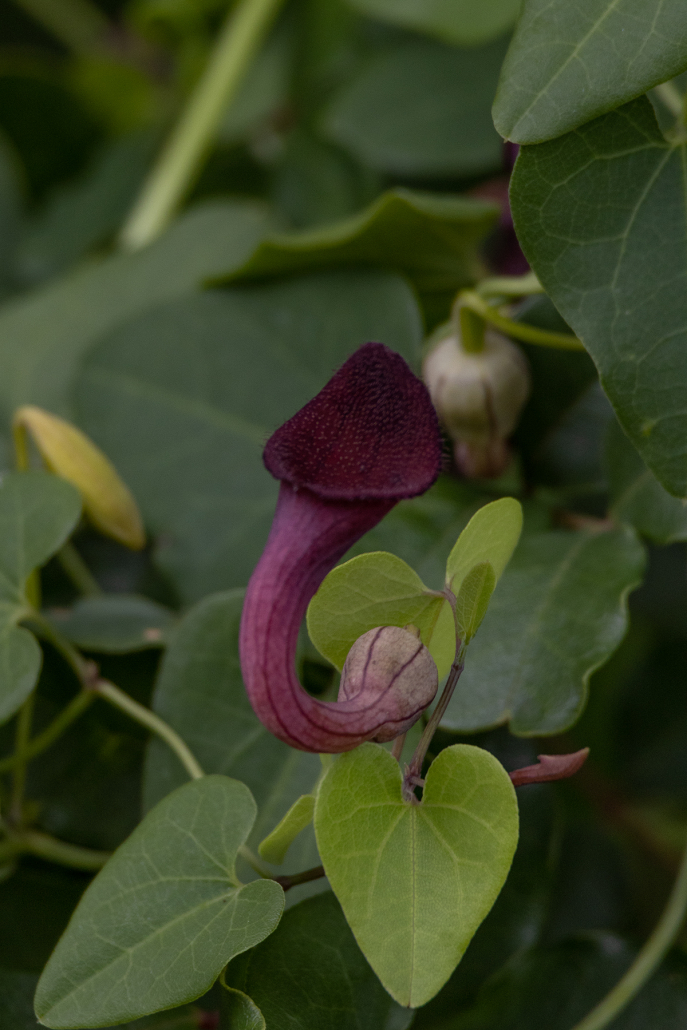
Aristolochia baetica

Having eaten, we marvelled from below at two Scilla peruviana in full bloom, high on the bank above us in a precarious position, and opted not to attempt to reach them. Instead, we took the onward path for several hundred metres to find more delights, including Tulipa sylvestris, Anemone palmata, Hyacinthoides hispanica and, at last, more Scilla peruviana beside the path at a more accessible height!
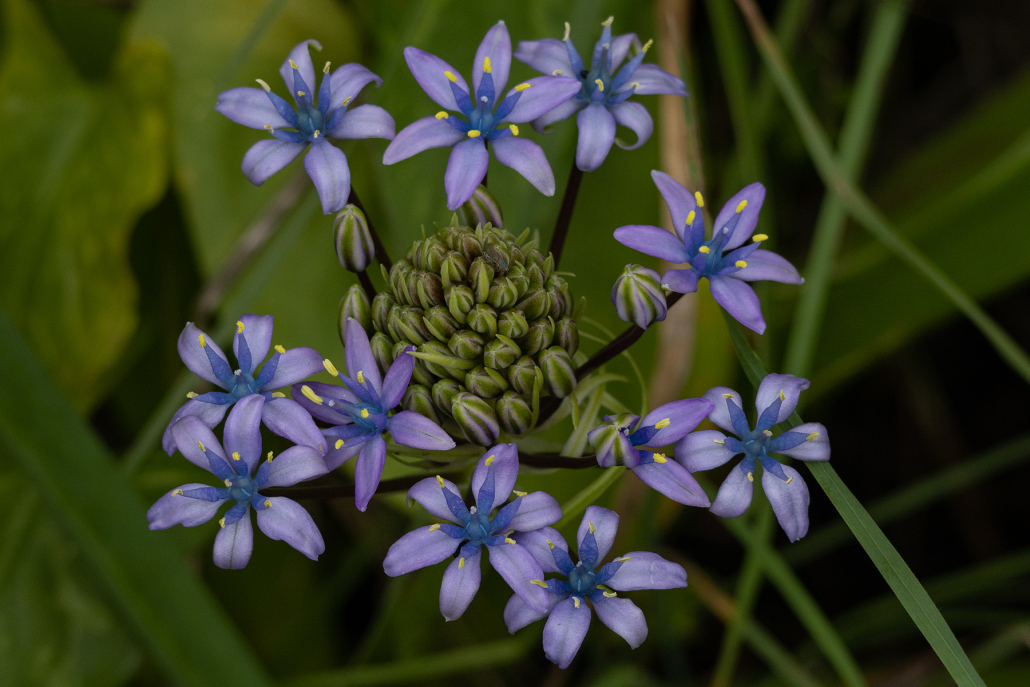
Scilla peruviana

On our way back to the vehicles we took a different path which was slightly damper in places, but were rewarded with a single Narcissus papyraceus still in flower and smelling delicious for those who got down to sniff it. In the time we had been away, the Moraea sisyrinchium had all opened too and provided a lovely sight on our return.

Our return to the buses was well timed just as the first shower arrived but there were a couple of extra bonuses for the birders among the group with a singing male Blue Rock Thrush on one of the pedestals of the bridge we were parked beneath, a Zitting Cisticola “zitting” from the field beyond and a beautiful male Woodchat Shrike spotted by one of the group while looking for the Cisticola.

Having enjoyed a good day, the weather was now on the turn and we headed for a coffee shop in Paderne for some refreshment and cake before making the return journey to the hotel in what had by now developed into a full-blown thunderstorm. We had timed our outing to perfection and retired a happy bunch to enjoy a relaxed evening.

Unfortunately the next morning we woke to rain and wind as forecast. With this unlikely to change, we opted to head out to some local sites rather than venture further afield so that should we need to return to the hotel, we could do so easily.

After breakfast, we drove the short distance to the start of the Rocha da Pena trail. This led us through a small village where Cymbalaria muralis was noted flowering in the wall and up a track bordered by typical matos shrubbery including several species of Cistus – C. albidus, C. monspelliensis and C. salviifolius, along with Rosmarinus officinalis, Rhamnus alaternus, Juniperus phoenicea and others. Amongst these, we found lots of evidence of Wild Boar and some interesting plants – some of which the Boar had not dug up!

The best of these were Orchis anthropophora, Ophrys scolopax, Ophrys sphegodes ssp. lusitanica, Ophrys lutea and Epipactis tremolsii. Hugo also found a spike of Limodorum abortivum although sadly, the flowers were not open yet.

On the way back to the hotel for lunch, we made a roadside stop as I had spotted what I thought were some Narcissus bulbocodium on the way. My suspicions were confirmed and the group was treated to a large patch of these beautiful Petticoat Daffodils in a brief moment of sunshine along with Anacamptis morio and a hybrid between the Man and Naked Man Orchid, Orchis x bivonae. Serin was singing nearby and the weather was seeming to pick up… until the next cloud rolled in.

Narcissus bulbocodium
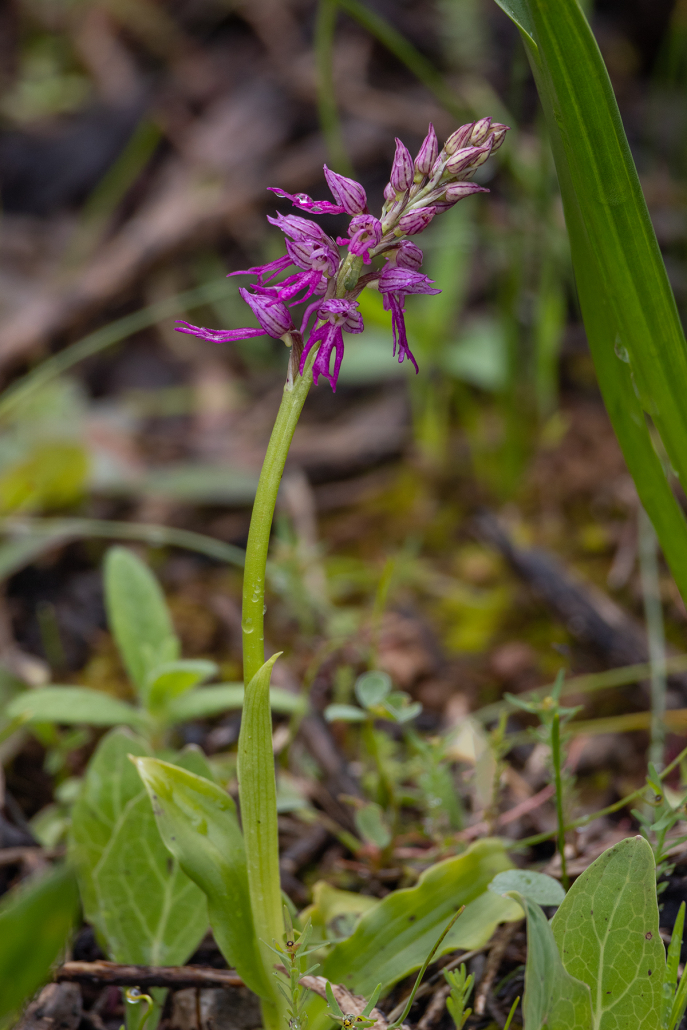
 

Orchis x bivonae

We headed back to the hotel for lunch and some dry clothes for some. In the afternoon, we headed out again with much more promising weather to the Fonte Benémola, spotting Crested Larks from the vehicles on the way. Once there we took another walk, this time along a more sheltered valley and in more pleasant conditions. 

We had views of several species we had found the day before such as Cephalanthera longifolia, Hyacinthoides hispanica and Anemone palmata, but also added some new ones to our list, such as Coronilla juncea, Rumex intermedius and, at the end, Ophrys tenthredinifera, spotted by an eagle-eyed guest on the side of the road. There were some other great bird sightings too, including Bonelli’s Eagle, Lesser Spotted Woodpecker, and Crag Martin. Iberian Green Woodpecker and Cetti’s Warbler were among those heard calling while Serins seemed to be displaying all around us as we walked.

We took a different route back and enjoyed another delicious meal after our checklist in the evening, deciding that the day had not been as much of a washout as we had worried it might be after all.

Thankfully the next day dawned brighter and we set out after breakfast in hope that the weather would continue for the rest of the day. We made a brief stop in Alte on our way while Hugo ran an errand and the rest of the group found a local donkey called Baltazar, botanised along the verges and bird-watched in a small square for a few minutes to while away the time.

We were soon moving on and drove down towards the coast at Quinta do Lago where the sun was shining and the temperature on arrival read a balmy 16˚c in the car park. We took a few minutes for some birding right there having heard a Wryneck calling, and soon located a Black-headed Weaver and three Iberian Magpies in a tree above us too. 

Having gathered what we would need for the day we set out and within feet were stopped again by our first view over the tidal lagoon. The wind here brought the temperature back down rather dramatically and we put a layer or two back on as we watched a Spoonbill feeding. There were a variety of other waders and Red-rumped Swallows zipped overhead along with House Martins as we turned to walk over the bridge towards the dunes and beach beyond. This would offer better views of the birds and some of the coastal flora.

We hadn’t got very far when some impressive and pristine spikes of Cistanche phelypaea were noticed beneath us. A number of waders were then picked up through a variety of lenses and scopes, including Dunlin and Ringed Plover, but just as we were settling in to our strides a torrential downpour caught us off guard! We hurried on to the shelter of a cafe on the far side of the bridge which provided relief, and it soon passed, proving to be the only substantial rain of the day, with only a couple of light showers thereafter.

Making certain that the weather wasn’t going to turn on us again, we headed out to the dunes and found some of the typical coastal plants of the area including Paronychia argentea, Medicago marina, Malcolmia littorea and the leaves of Calystegia soldanella and Pancratium maritimum before retracing our steps. On our way back over the bridge we had better luck with the weather and were able to enjoy the birds and plants more. We noted Turnstones, Kentish Plover, Grey Plover, Little Stint and Whimbrel among others plus spotting Aetheorhiza bulbosa in flower which we had previously missed.
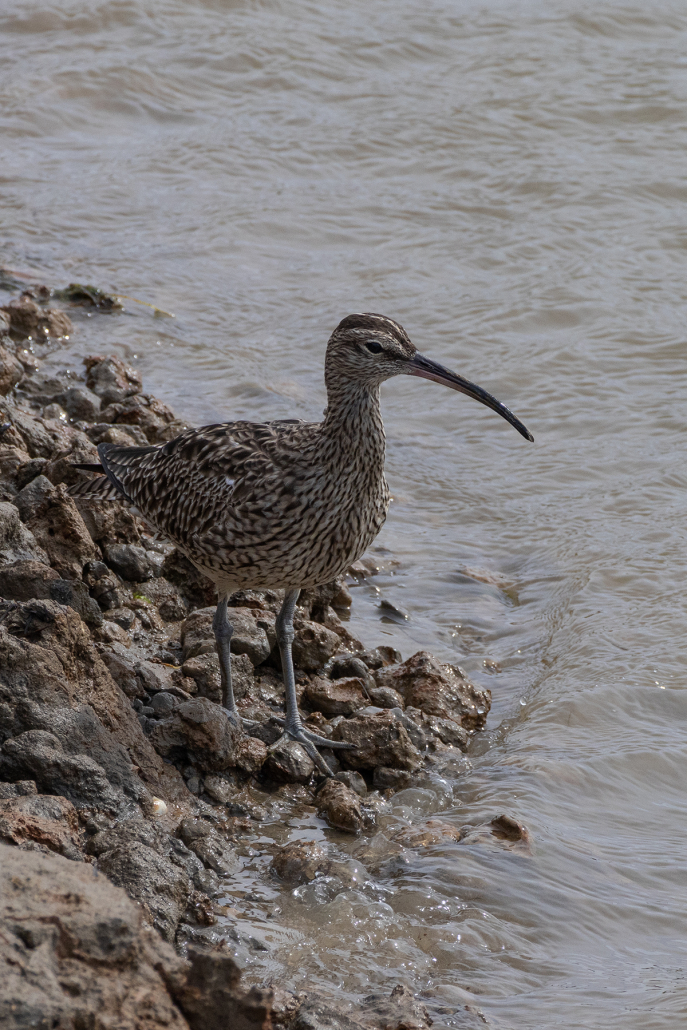
Whimbrel

Following the boardwalk along the coast we then joined a sandy path bordered by pines where Cistus ladanifer and Asparagus albus grew. A number of new plants for the trip were noted but the highlight was surely the hundreds if not thousands of Three-leaved Snowflake, Acis tricophylla.
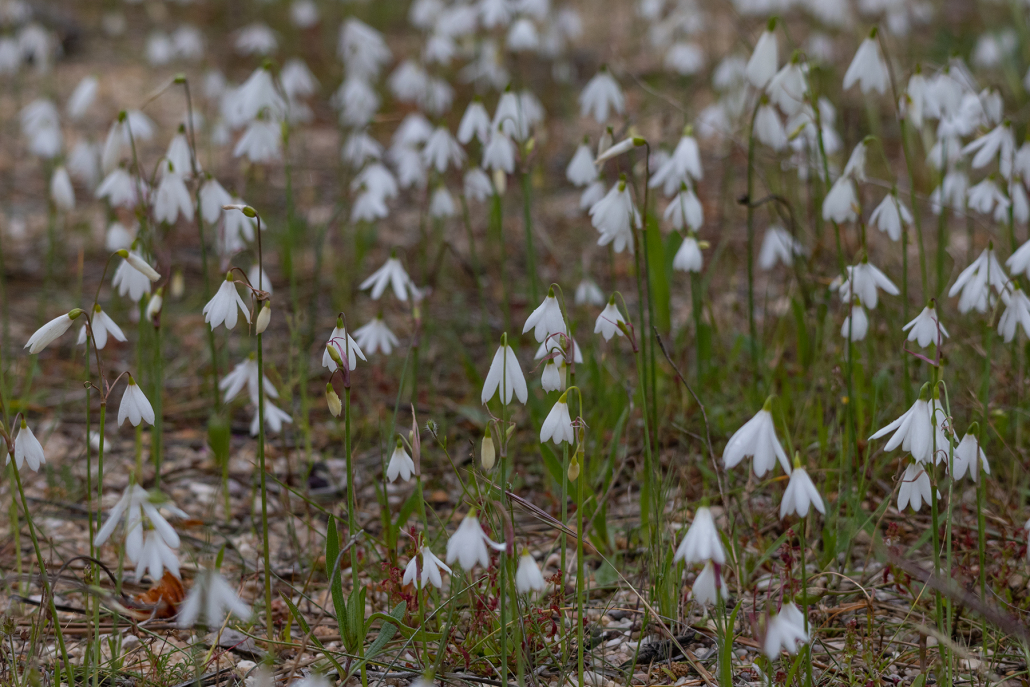
Three-leaved Snowflake, Acis tricophylla

The lagoon here seemed initially to have little of interest but we soon found Audouin’s Gull, Purple Gallinule and Little Bittern on it proving that with patience you may see more than you initially think possible. 

Purple Gallinule

Walking on, we found two species of Lupin growing side by side, L. micranthus and L. luteus, and beyond this a Spanish Festoon butterfly took to the wing in the sun. A hardy party decided to push on to try to see Flamingos and were rewarded by not only the birds they sought, but also an Osprey with a fish, while the rest of the group turned for home.

On our way back to Alte we collected Hugo’s colleague, Lara, who would be joining us for 24 hours. We looked forward to getting to know her better over dinner.

The following morning was bright and sunny, and the haze from the previous days had gone so that, from breakfast, we could see the sea from our elevated position. We were in good spirits and set out northwards for a day on the plains of Alentejo near the town of Castro Verde in search of the elusive Great Bustard. 

Our first stop was at a conservation centre which afforded good views over the surrounding countryside. On the way down the track to reach it, we counted numerous Corn Buntings and Stonechats, plus a few Red-legged Partridges. We picked up a pair of Lesser Kestrel on arrival and a large flock of Glossy Ibis in flight. There was masses of Erodium moschatum growing here like a carpet. We managed to identify Calandra Lark on the way back up the track to the road too.

Moving on, we visited a derelict farm where a White Stork had built a nest on the roof of a small tower that still stood. There were Collared Doves and House Sparrows round the building too and we watched a pair of Montagu’s Harriers over the hillside for some time. One of our party found a Painted Lady taking shelter from the wind in the building complex, and we noted Anthemis arvensis and Carduus tenuiflorus flowering.

Driving on, we made a brief impromptu stop for a Spanish Imperial Eagle next to the road. Our next stop was also a little unplanned since, with all the recent rainfall, a river had come over the bridge we were meant to cross. There was a small lake here though, created by a weir, and we stopped to look at the birds on it which included Great Crested Grebe, Shoveler and Spoonbill. There was also a Water Crowfoot flowering in the shallows.

Following the riverbank downstream a short way there were a few plants to note including Onobrychis humilis and Nonea versicaria, and we found some wonderful newts; Iberian Ribbed Newt and Southern Marbled Newt, beneath streamside stones that were carefully turned and replaced. One of our group also found a juvenile Iberian False Smooth Snake which posed obligingly for photos.
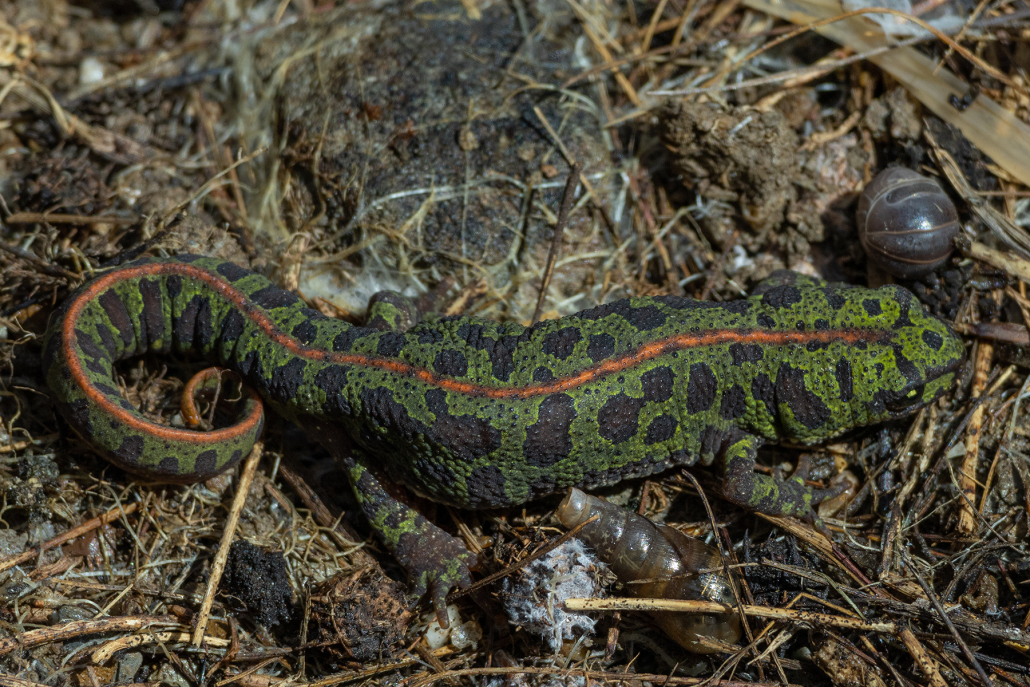
Southern Marbled Newt

From here we took the decision to head back to the village we had just passed for lunch where there were picnic tables. This proved an excellent decision because as we were eating we had fantastic views of a Booted Eagle which sailed low overhead and moments later, we found a Black Redstart.

Having eaten, we headed back to Castro Verde with the idea of getting a coffee while Hugo refuelled his van. Unfortunately the coffee shops were all closed, but we amused ourselves watching a Large White butterfly battle the wind and following a couple of chattering Iberian Magpies in the hopes of some photographs. 

Continuing on without our coffee, we were at last rewarded with fleeting views of Great Bustard. One of our guests spotted the first and we turned around to try and get better views as they disappeared into a gully. Heading out onto the road from the track we were on, we were rewarded by much clearer views of a different bird on the other side of the road, and from there on we saw several more. 

Although time was pushing on now, we opted for one last hurrah; finding Sandgrouse down another track just a few minutes further ahead. The effort was worth it, although the views were distant and fleeting – a flock of around a dozen flew past, looking similar to Golden Plover in breeding plumage in flight. 

We headed back to Alte pleased that the weather had held out for us, with only a brief shower while we were driving back and a steady wind to contend with most of the day. There was one last delight in store for my bus, a pair of Black-winged Kites just below Alte and close to the road giving excellent views, especially when one of the group spotted that one of them had perched in a tree.

Lara had been with us all day and had proven invaluable at helping spot some of the elusive birds we had been looking for, but it was now time for her to get a train back to Lisbon. We were sad to see her go after such a short period with us, but grateful for her time.

The next day we set out in sunshine after breakfast and headed uphill to take in a different site on our way to the coast. We stopped at a roadside site first where we found a good number of Anacamptis morio and a particularly sought-after species, Dipcadi serotinum. On looking around more though, there was plenty more to note including Ophrys bombyliflorum, Ophrys speculum ssp. lusitanica, Tuberaria major and Bellardia trixago in its white and pink form. There was also another Ribbed Newt and a large centipede, Scolopendra cingulata and one of the group saw a Black-eyed Blue butterfly.

Tuberaria major

Our next stop was at the Salgados coastal lagoon where Bellis annua, Linum bienne and Cotula coronopifolia were growing in abundance among shrubby Retama monosperma. We walked round to get a better view of the birds on the lagoon where highlights included Caspian Tern, Black-winged Stilt and Avocet. 

Further round, there were Iberian Marsh Frogs calling and flowers on the way to a small blind area included Anagallis monelli, Rumex bucephalophorus and Linaria resupinatum. Watching the water from here, several Marsh Harriers were seen along with Purple Heron and Glossy Ibis, the latter giving particularly good views. 

Walking back we found the locally endemic Linaria algarviana, occuring only in Southern Portugal, and observed a small flock of Swallows resting briefly in a Fig tree before climbing into the vehicle and retracing our route into the nearest town to find a cafe. We enjoyed a coffee, cake or ice cream for some before heading up towards Monchique where we found a woodland edge spot to enjoy our packed lunches.

Linaria algarviana

There was some excitement when Hugo found a juvenile Fire Salamander and many of the group got good photo opportunities. There was birdsong all around us here, some familiar species like Chaffinch, others less so like Iberian Green Woodpecker and Iberian Chiffchaff which has quite a different song. Having eaten, we walked down the road a short way noting some of the plant life here. Among the highlights were Erica scoparia, Euphorbia characias, Oenanthe crocata and Scilla monophyllos. 
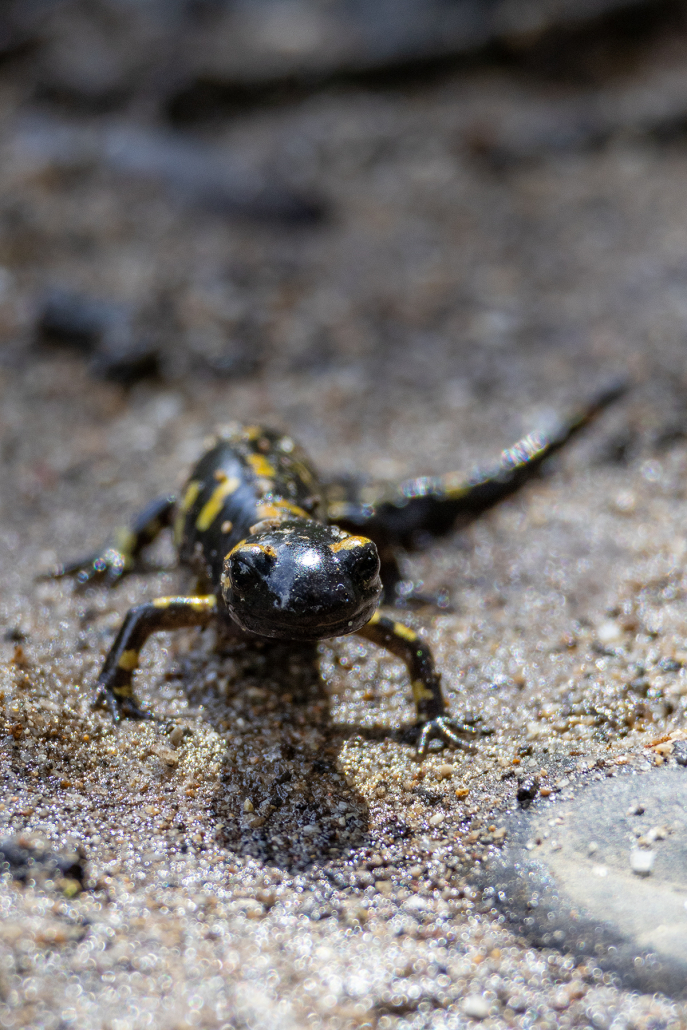
Fire Salamander

With time marching on, we continued on up the mountain to our final stop near the summit where we got out to search for Neotinea maculata and other flowers. We only found the leaves of the orchid but we did succeed in finding more of the Scilla monophyllos along with Romulea bulbocodium, as well as both Tuberaria lignosa and Paeonia broteroi in bud. Blue Rock Thrush, Rock Bunting and Linnet were all seen up here too.

It was soon time to turn for home and the return journey took us on a slightly different route which made it more interesting. We had some good views on the way and passed a field that was yellow with Lupinus luteus in flower.

Another sunny morning greeted us the next day and we headed out for our longest drive of the holiday, towards the westernmost tip of southern Portugal. Our first stop was for conveniences on the edge of Vila do Bispo, but even here there were things to spot, the most noticeable being butterflies on the wing more than one at a time for the first time all week and we added Red Admiral to our list, along with Large White for the day.

Moving on, we passed several impressive specimens of Scilla peruviana as we took a dirt track turning. We slowed a number of times to look for birds and eventually found some Thekla Larks and a Little Owl. A little further on, we stopped at a spot which looked more promising botanically and found some lovely species including Halimium calycinum, Armeria pungens and Serapias parviflora. One of the group also found Gennaria diphylla in a nice little colony and we noted a few singing birds such as Iberian Chiffchaff.

Our next stop was near the Cape of St Vincent where we found some more interesting plants. Here the locally endemic Cistus palhinhae grew in the place of the similar Cistus ladanifer that we had been seeing elsewhere. There was an attractive pink Antirrhinum majus ssp. cirrhigerum, and a locally endemic brassica, Biscutella vicentina as well as Allium subvillosum and Cerinthe gymnandra. We had lunch here and took advantage of the cafe on site for additional pastries and ice creams, enjoying them in the sun and watching the odd Red-billed Chough fly over along with White Wagtails in the car park.

From here we called in to the lighthouse on the cape itself, albeit briefly, and were treated to a few different plants including Pallenis maritima and Daucus halophilus as well as some good views of a Blue Rock Thrush and a Shag on the cliff face below. 

Our final stops of the day were near the village of Budens, where we found the first of the two to be full of species we had noted earlier in the week in terms of flowers but sadly lacking in the Narcissi we sought there. Hugo did however find a large ground beetle in the genus Scarites and an Iberian Scorpion. 

At the very last stop, we came across a small brick building full of Moorish Geckos and a guest also found an Iberian Three-toed Skink nearby. There was a last-hurrah in plant terms too, with a final addition to the orchid list in the form of a Pyramidal Orchid with its flower bud just about to burst. Other flowers noted here included Rosa pouzinii and Cachrys sicula.

We were treated to a wonderful sunset as we made our list in the evening and enjoyed each other’s company as a full group one final time over dinner, knowing that we would start to head our separate ways in the morning. 

We were treated to full sunshine on our final morning. Two of the group had an early departure and Hugo took them to the airport while the rest of the group had breakfast. Another would be travelling to Lisbon and on north by train and so, on his return from the airport Hugo offered to drive him to Lisbon rather than take the train for the first part of the journey as well. This left the rest of the group to return to the airport together with me since they were all needing to be there around the same time, everyone being on the same flight with the exception of one whose flight was only slightly earlier. 

We set out in leisurely fashion, intending to make a stop on the way for a last hurrah of wildlife on the way. We stopped at some salt pans near the airport where we were able to keep an eye on the van and our luggage while milling around looking at the coastal flora including dozens of spikes of Cistanche phelpypaea and enjoy the birdlife including a handful of Greater Flamingos for those who hadn’t made the trek at Quinta do Lago. The majority of other species were ones we had seen before but with time on our hands we were able to enjoy them to their fullest and we also added Iberian Yellow Wagtail to the list with a couple perching nicely for us atop the low vegetation.


Cistanche phelypaea
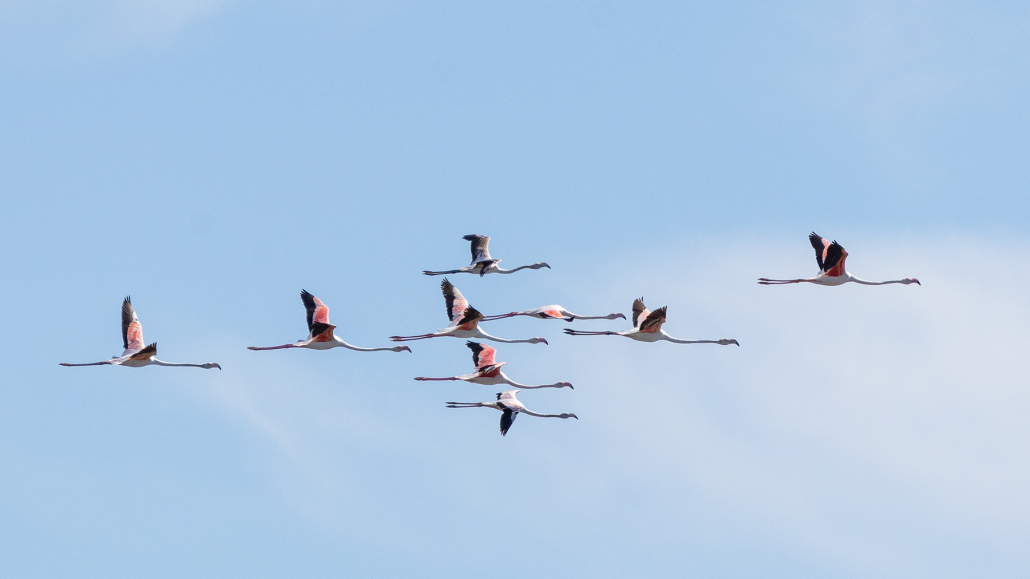
 

Greater Flamingos

It was soon time to head round to the airport and say our farewells. We had experienced a week of variable weather but despite this, southern Portugal had delivered all we had set out for and more. We had enjoyed some wonderful wildflowers, a great variety of birdlife and some fabulous company.
Desert adventures in California

I wrote about a trip to America way back in 2015 but on that occasion we headed up the California coast and into Yosemite. One of my first trips with my new camera would be another to this part of the world, but instead of revisiting those same spots, wonderful though they were, we decided to head for the desert. In hindsight, which of course is 20:20, this might not have been our smartest move with our trip being in the height of summer for a dear friend’s wedding in LA first, but we stuck to our guns and were rewarded in surprising ways.

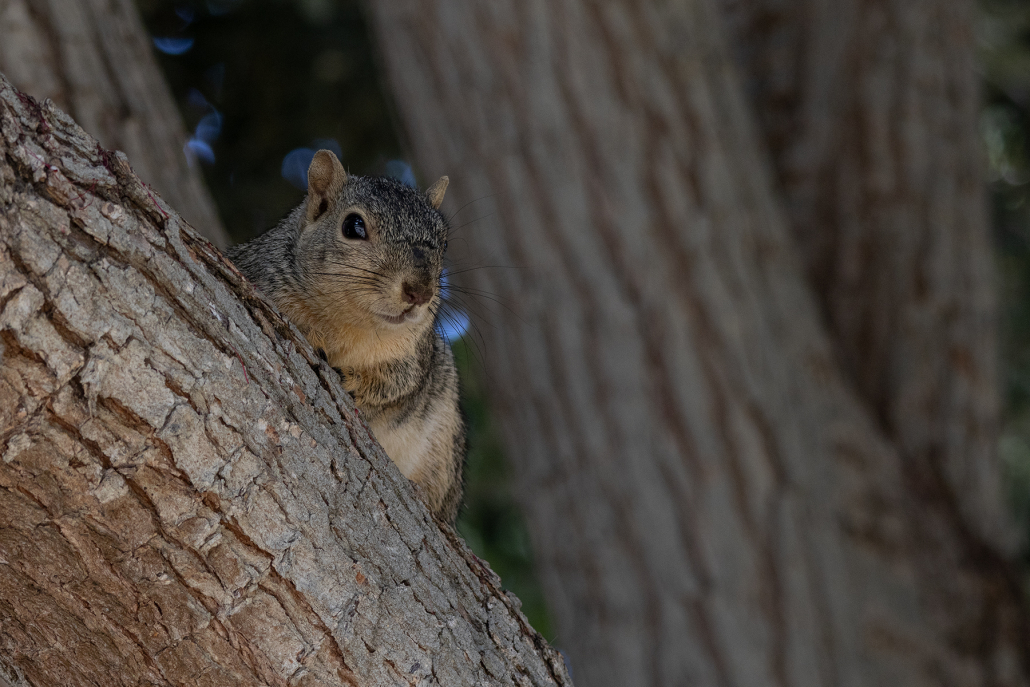
Before we get into the desert though, we had a day or two to explore our immediate surroundings around Marina del Ray in Los Angeles before the wedding and between catch ups with friends. Our first stop was the unassuming Burton Chace Park, from where we had a view over the wider marina area and could see one or two distant California Sea Lions lounging on the backs of boats. There were a few butterflies slitting around the Agapanthus but I thought it imprudent to disturb a class taking place to get photos so instead, I focused quite literally on the squirrels. These were a species I’d not met before though fairly ubiquitous in the LA area from what I’ve read. The Eastern Fox Squirrel, Sciurus niger, which are larger and more richly coloured than the Grey Squirrels we are familiar with but seem to have a similar cheekiness about them.

An Eastern Fox Squirrel lounges on a branch, just the top half of its body visible. It seems to have a slightly cheeky expression, if such a thing can be given to an animal!

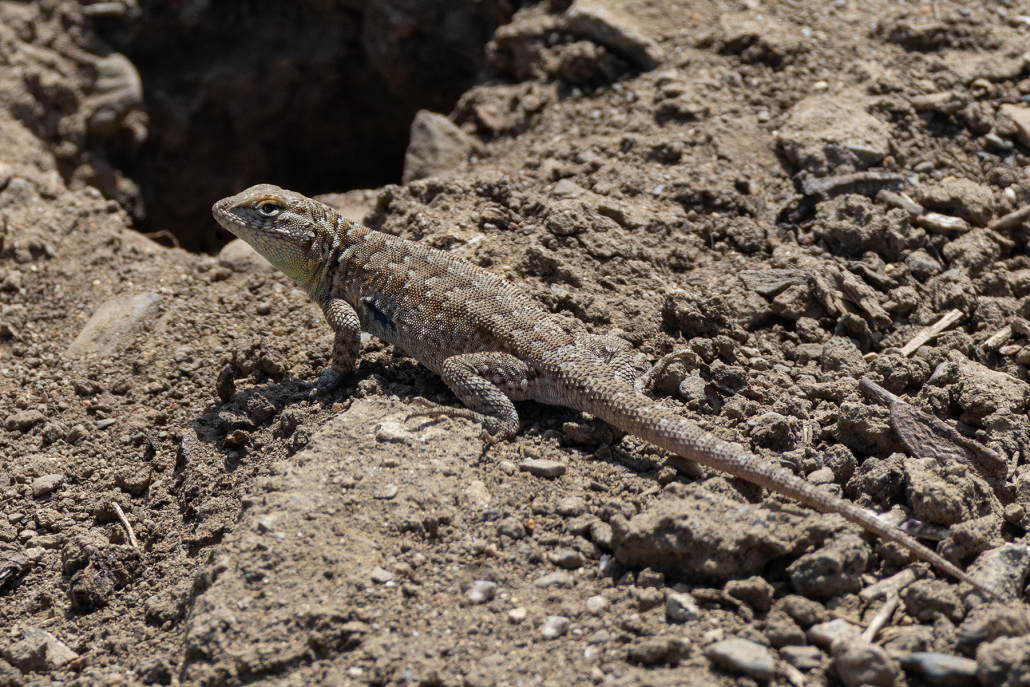
Having stopped for a brief refreshment, our next point of call was just down the road at the Ballona Wetlands where we would walk a short trail. We had some fleeting views of pretty red House Finches here but most movement was on the ground and the result of scuttling lizards which appeared to be every few feet. We saw a couple of Western Fence Lizards which we had come across on our previous visit with dark blue-green keeled scales. Alongside these though were some others which were new to us, the more subtly marked Western Side-blotched Lizard, Uta stansburiana ssp. elegans.

A pale brown, mottled Western Side-blotched Lizard stands in front of a small hole in the ground, facing to the left and showing the camera its side. It looks at the camera warily.

As we continued on with our walk, we had several stately fly-pasts from Brown Pelicans and then suddenly we were in a butterfly hot spot. A flowering shrub attracted a Camberwell Beauty, known in the US as a Mourning Cloak, Nymphalis antiopa. Sadly, it was a little tattered around the edges, particularly on the hindwings, but since this is an elusive butterfly in Europe I was happy to record its presence.

A dark maroon butterfly with a creamy yellow border to its wings and blue spots where the two colours meet sits in the top left corner of the image. It is in a bush with slightly glossy green leaves and reddish stems, but it is there for the flowers which are just opening and are creamy white masses of small round buds, giving the impression of froth on the ends of the branches.

Then mere moments later, a pristine Anise Swallowtail, Papilio zelicaon, fluttered round our feet and settled on the Hottentot Fig leaves beside the path. Not only was it exceedingly fresh and utterly beautiful, it was offering us the best views imaginable.

A stunningly fresh Anise Swallowtail butterfly with a pale yellow background, black markings around the edges and bright blue and red patches along the tails that make the trailing edge of its hindwings, sits centrally in the image on the grey-green spiky succulent leaf of a Hottentot Fig plant.

Before we moved on, we also saw a slightly scruffy Lesser Goldfinch. This was another new bird species to me and one I was not expecting to find in such a downtown or coastal location.

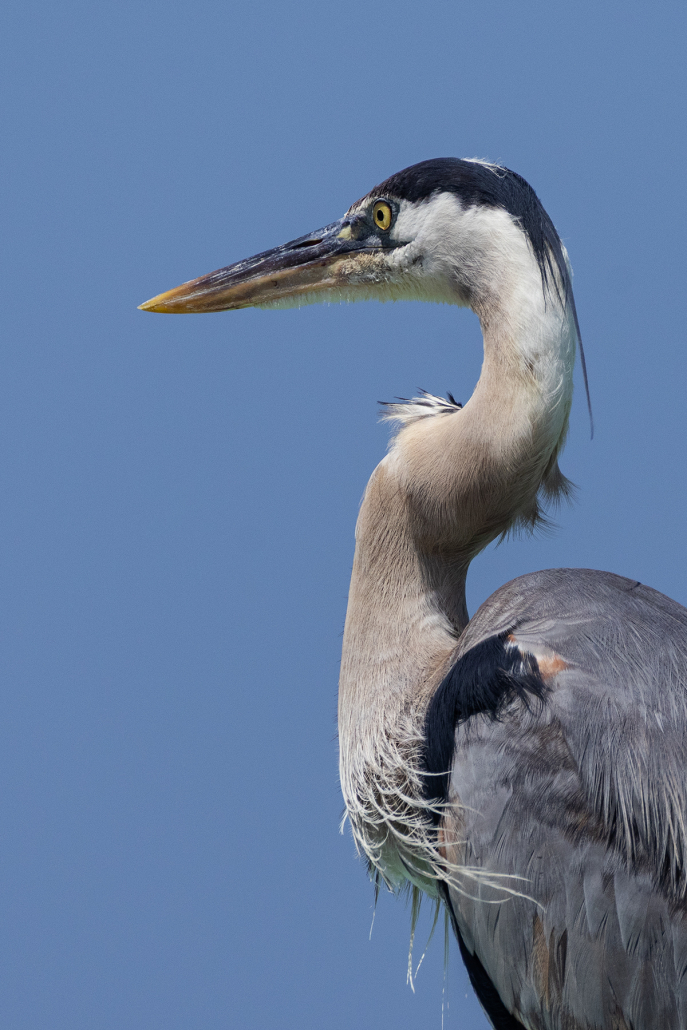
Our last stop was over the road at the Fisherman’s Village, mostly for a refreshment on a warm day. We also found wildlife here though (after all, it’s almost everywhere if you look!) with more Pelicans and Sea Lions, Western Gulls, and no fewer than 3 species of Heron all vying for space along the waterfront. There were a couple of Snowy Egrets looking elegant in their breeding finery, some Black-crowned Night Herons including a couple of streaky brown juveniles masquerading as a different species, but the most numerous were Great Blue Herons, Ardea herodias, and some of these were at eye level on moored boats allowing for more unusual portrait-style shots.

An adult Great Blue Heron, with slate grey plumage on its back and a long mushroom coloured neck leading up to a smart black-capped head with a sharp grey and yellow beak and beady yellow eye. This photograph is taken against a blue sky and has a portrait-like quality with no other elements in the image.

That was all we had time for before the wedding though – and what a wedding – a friend of mine for quarter of a century getting married on Santa Monica Beach is definitely something to remember and cherish for a long time! Party over though, we were kindly driven back towards the airport by some friends and picked up a hire car for the desert part of our adventure. We had a few more days to squeeze in some more exploring and we headed inland to our next base near Palm Springs.

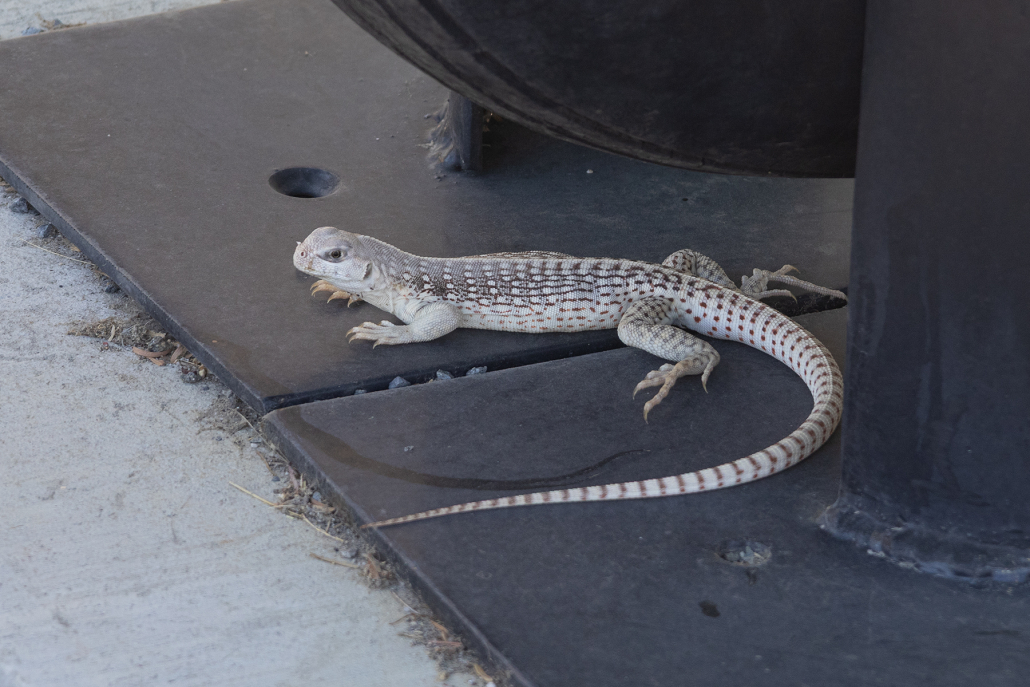
Being with my husband for the trip meant that not every outing was purely for wildlife but even a visit to the Palm Springs Air Museum (a great day out for anyone interested in aviation or military history, with knowledgeable and engaging staff and volunteers) had a lot to offer. Not only were there some great aircraft, some of which had distinctly wild sounding names like the Nighthawk which looked like something straight out of a movie, but in the outdoor exhibit I came across a real surprise. Beneath one of the planes was a Desert Iguana, Dipsosaurus dorsalis. I’d have liked a closer shot or better background but the location made it impossible so I made the best of the situation.

A Desert Iguana, looking little like other iguanas but rather, a large, smooth, pale lizard with dark spots lies curled facing to the left on the metal plate to which an aircraft is mounted for display. The wheel is just visible behind the lizard.

While we were in the area, we also opted to take some short hikes. This was mostly because of the heat, the thermometer was hitting 45˚c easily most days so we were getting out early to explore while it was cooler and limiting our excursions and our energy expenditure so as not to risk heat stroke. One of the trails we explored though was the lovely Andreas Canyon. This is only just over a mile loop and going early meant that we had it almost entirely to ourselves. The canyon winds alongside a perennial creek and provides a literal oasis from the surrounding desert environment. This means that all manner of creatures visit to drink or bathe, or live in its vicinity. The first half of the trail was in the shade of the cliffs at the water’s edge, and there were a few small birds like Blue-gray Gnatcatcher and Verdin flitting amongst the rocks and bushes here while Ravens called from the clifftops above us. Against the water itself though I came across a number of dragonflies including striking orange Flame Skimmers. The ones that caught my eye though were a little more like the Demoiselles we have at home, a large damselfly size and metallic hues, shimmering in the light. These, I later learnt, were American Rubyspots, Hetaerina americana, and I had fun composing several different shots although the following was my favourite.

A dainty damselfly with wings that have a reddish stain near where they meet the body sits on the leaf of a reed, both facing the right. The light from behind has a soft golden glow and the image is not quite a silhouette as a result.

The second half of the walk was above the canyon in the drier, cactus-studded desert edge as the path wound back downhill towards the stand of California Fan Palms around the car park. There were far fewer signs of life up here as the day warmed up but back near the car, we glimpsed several lizards darting for cover and an Abert’s Towhee, larger relatives of Sparrows with reddish brown plumage, hopping around the picnic bench.

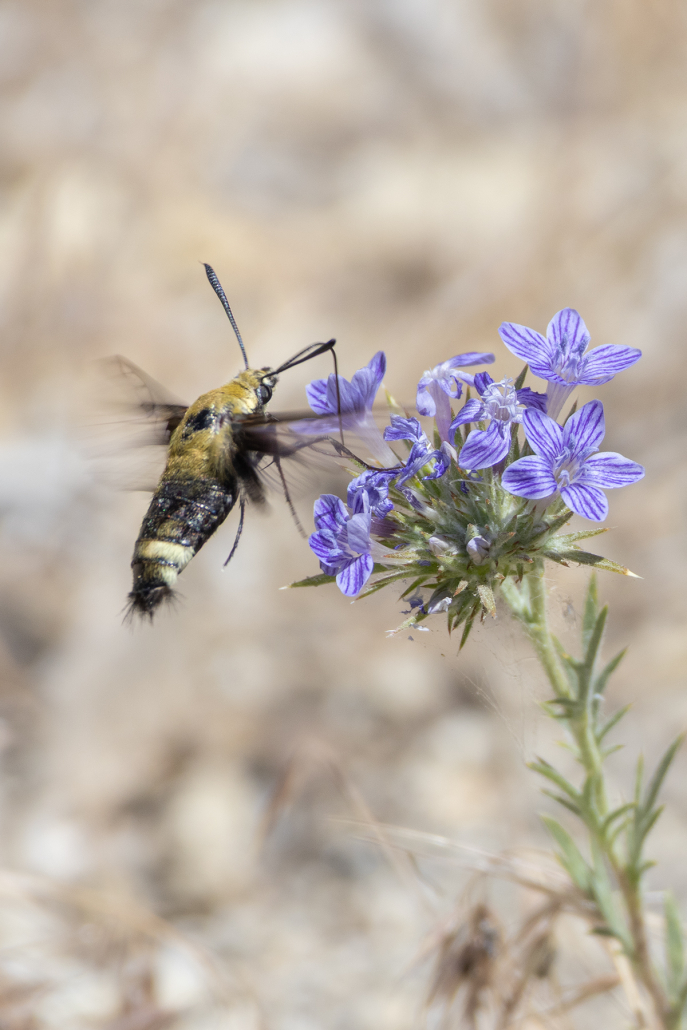
On another day, we headed further afield, not only to make the most of our time in the area and visit a different habitat, but also in the vague hope that gaining some altitude might bring a bit of respite from the relentless heat of the desert. We drove into the San Bernardino National Forest and, stopping at one of several viewpoints, were rewarded with a few wildflowers that had in turn attracted a variety of pollinators. The first to catch my eye was the California Clearwing, Hemaris thetis, which is similar to the related Narrow-bordered Bee Hawkmoth which we encounter in the UK and across Europe. This was nectaring on a pretty blue-flowered plant called Giant Woollystar, Eriastrum densifolium.

A clear-winged day-flying moth with a furry yellow and black body hovers in front of a blue and white striped flower to feed, its proboscis outstretched.

Mere feet away, several butterflies fluttered among some Buckwheat plants. There were American Lady, Coronis Fritillary and Gray Buckeye, Junonia grisea, the latter being the only one to hang around long enough to have a photo taken.

A brown, orange and white butterfly with a black eye-spot sits in the top left corner of the image, sipping on nectar from one of many white buttons of small flowers bathed in bright sunshine.

Driving on a short way, we stopped for longer at Lake Fulmor. Pulling into the carpark we spotted a stunning California Sister, one of the larger butterflies with largely black wings, a white stripe down the middle of each and a vivid orange wingtip to each forewing. It fluttered at high speed overhead and into a nearby tree. Our attention was soon diverted though, first by a Turkey Vulture soaring high above and then by a pair of Acorn Woodpeckers chasing one another round a tree trunk.

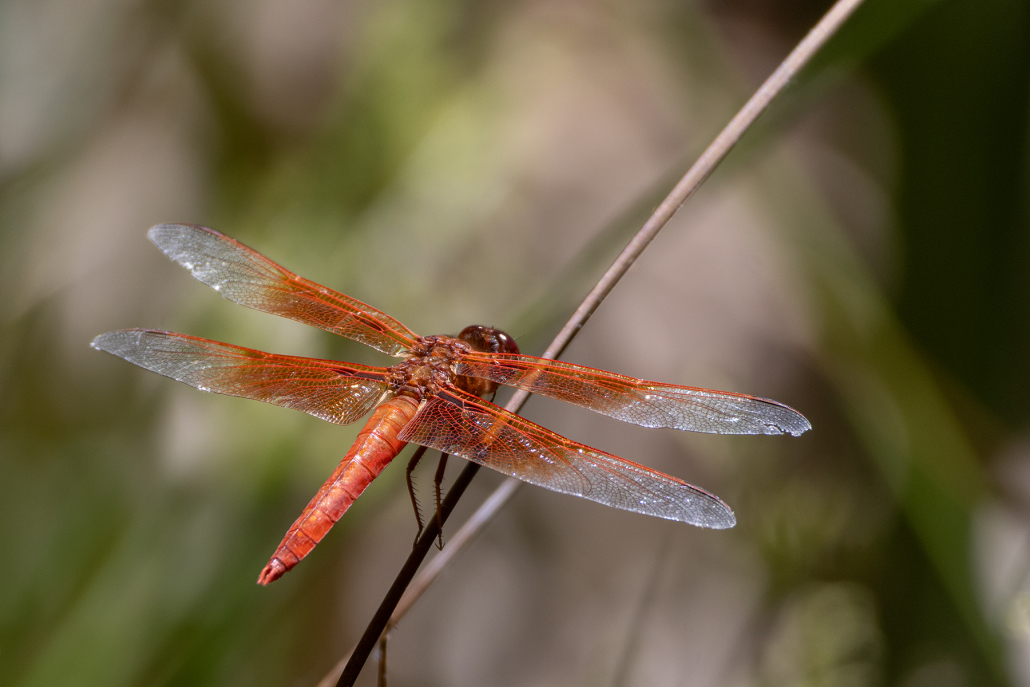
We were keen to explore further and set out. The lake was close to the edge of the road and we were soon walking the path along the shore where dragonflies darted among the reeds. There were several species we hadn’t seen before including Blue Dasher and a couple of damselflies too, Tule Bluet and Pacific Forktail. I was pleased though to get an image of the Flame Skimmer, Libellula saturata, which we had seen earlier in the week.

An orange dragonfly with orange patches that extend along the inner half of its wings sits, facing away from the camera on a reed stem which cuts diagonally across the image. The background is out of focus and the whole scene is bathed in sunlight.

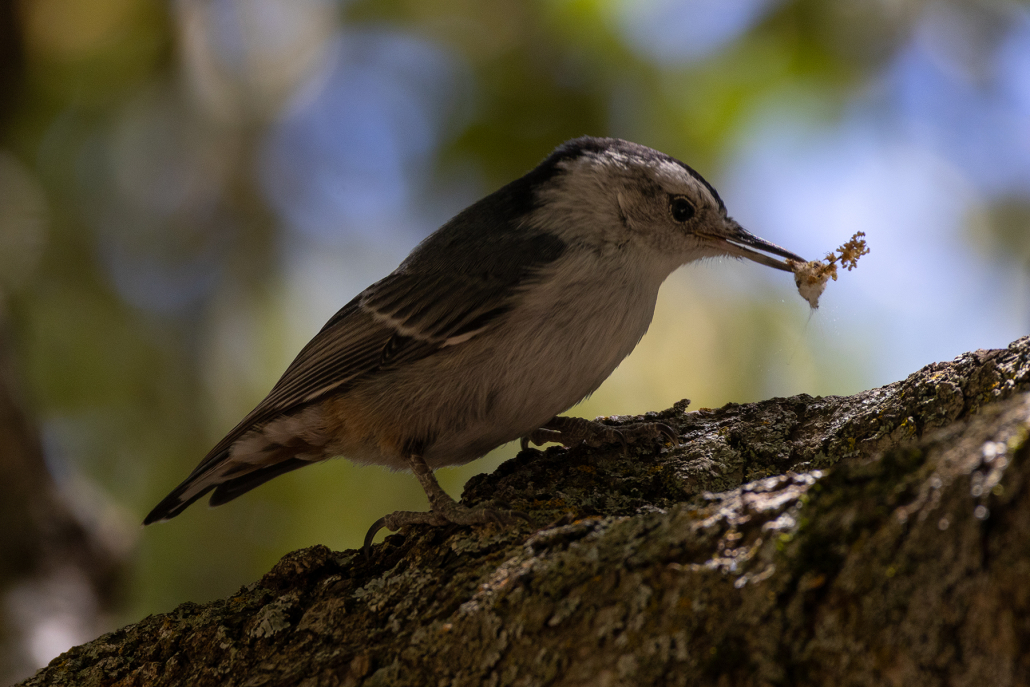
A short way further on we had a wonderful close encounter with a White-breasted Nuthatch, Sitta carolinensis, which went about its way seemingly oblivious to our presence. We watched quietly as it foraged around our heads in the branches of a tree which overhung the path we were on, smiles on our faces the entire time.

A small bird with a grey back and white breast and face eats a morsel of food it has picked out of the bark of the tree branch it sits on. The background is the dappled green of a leafy tree canopy and blue of the sky beyond.

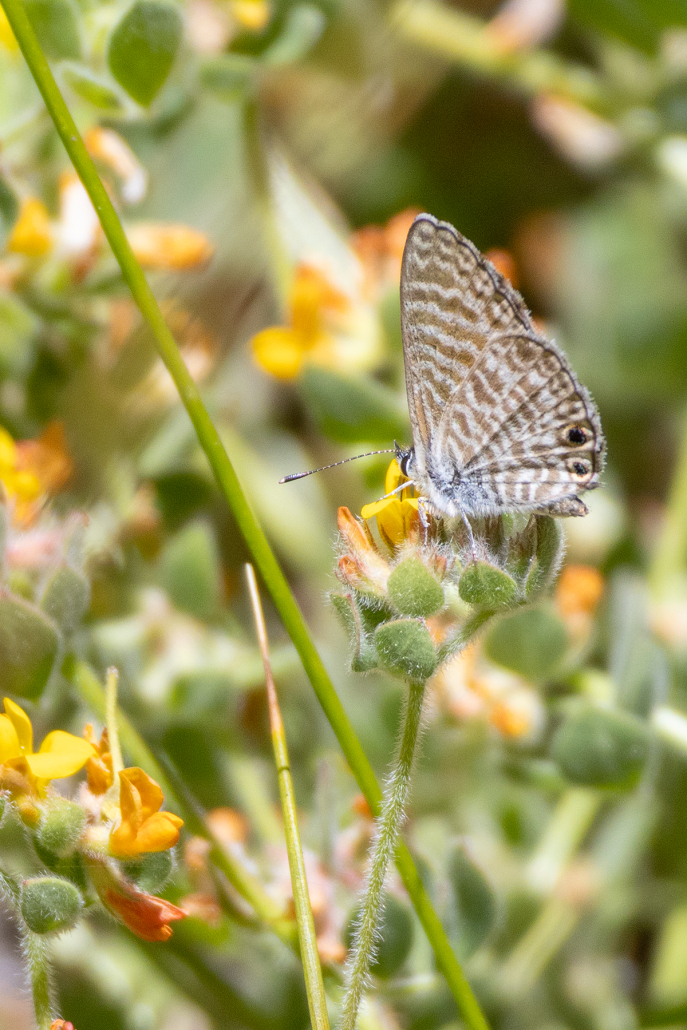
Further on, the path opened out a little and among the flowers that lined the banks, we found a few more butterflies. The first was the Marine Blue, Leptotes marina, looking similar to its European relative, the Long-tailed Blue.

A small butterfly with intricate brown and white markings and two dark lunules at the back of the hindwing feeds on small yellow flowers of the pea family. It faces to the left and slightly away from the camera.

Another beautiful species that we came across was the Mylitta Crescent, Phyciodes mylitta. This particular individual seemed especially small but perhaps I was just expecting larger species after the one from earlier in the day.

A vibrant orange butterfly with scribbled black markings and a row of black dots along the trailing edge of each hindwing sits square in the middle of the picture with its wings spread. It is perched on a single piece of dry grass which stretches horizontally across the frame and the dull green background is thrown out of focus.

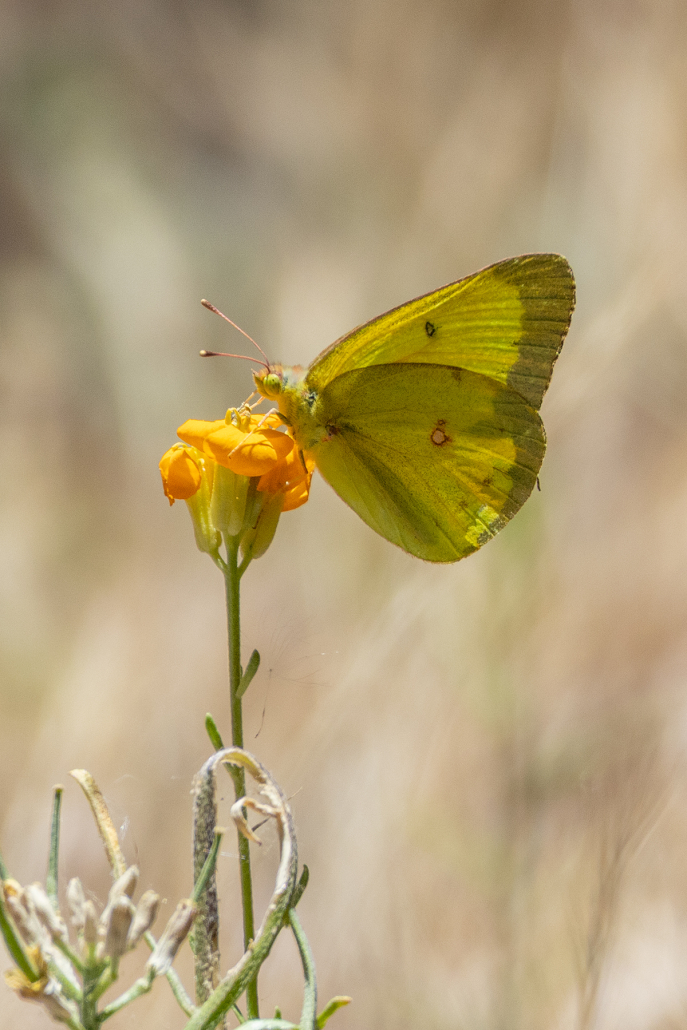
By now we had reached the head of the small lake and although there were a few butterflies coming down to the damp sand at the waters edge here, there was no way of reaching them so we decided to follow the trail that wound back the way we had come but lead away from the water and up a slight hill. This worked in our favour as we passed some different flora which was appealing to a different range of butterflies. The first flowers we came across were the last few on the stem and belonged to the Western Wallflower, also known as the Sanddune Wallflower or Prairie Rocket, Erysimum capitatum. This native member of the cabbage family was being enjoyed by a beautiful yellow butterfly called Harford’s Sulphur, Colias harfordii, a relative of the Clouded Yellow which we occasionally find as a migrant to British shores but is common across Europe.

A yellow butterfly nectars on a a vibrant orange flower, the last on the stem. The butterfly is side on to the camera, facing left and has its wings closed, the sun is bright and the entire scene gives an impression of a hot landscape behind despite the rest being out of focus.

Beyond, we found a lovely patch of vibrant red San Gabriel Beardtongue, Penstemon labrosus, which was fleetingly visited by a hummingbird as we approached. We were delighted at the brief view we had, although I couldn’t be certain I thought it might have been an Anna’s Hummingbird which we had seen several of on our previous trip. I had wanted to see more but wasn’t sure whether they would be here or not.

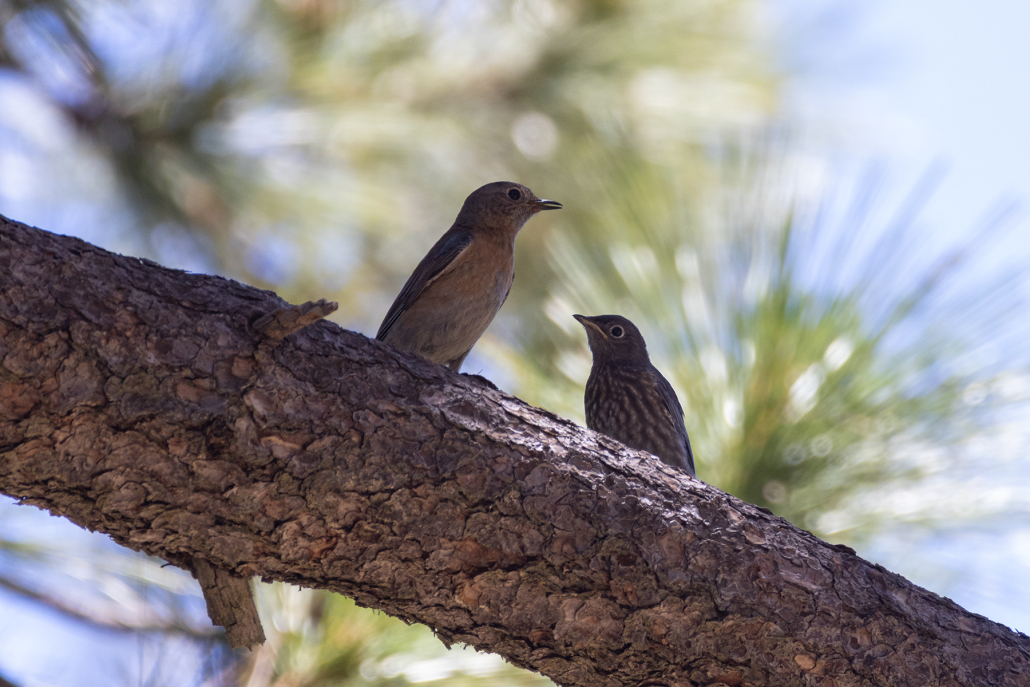
Our attention was quickly taken by another bird, or more specifically, a pair. In a nearby tree, I saw some movement and it transpired to be a female Western Bluebird, Sialia mexicana, feeding what appeared to be a recently fledged juvenile.

Two birds sit facing one another on a branch. The bird on the left is the adult female, with just discernible blue plumage on her back and a pinky grey breast, while the one on the right is her chick, brown and streaky, sitting lower than her. She has just finished feeding her youngster. The background is dappled foliage against blue sky.

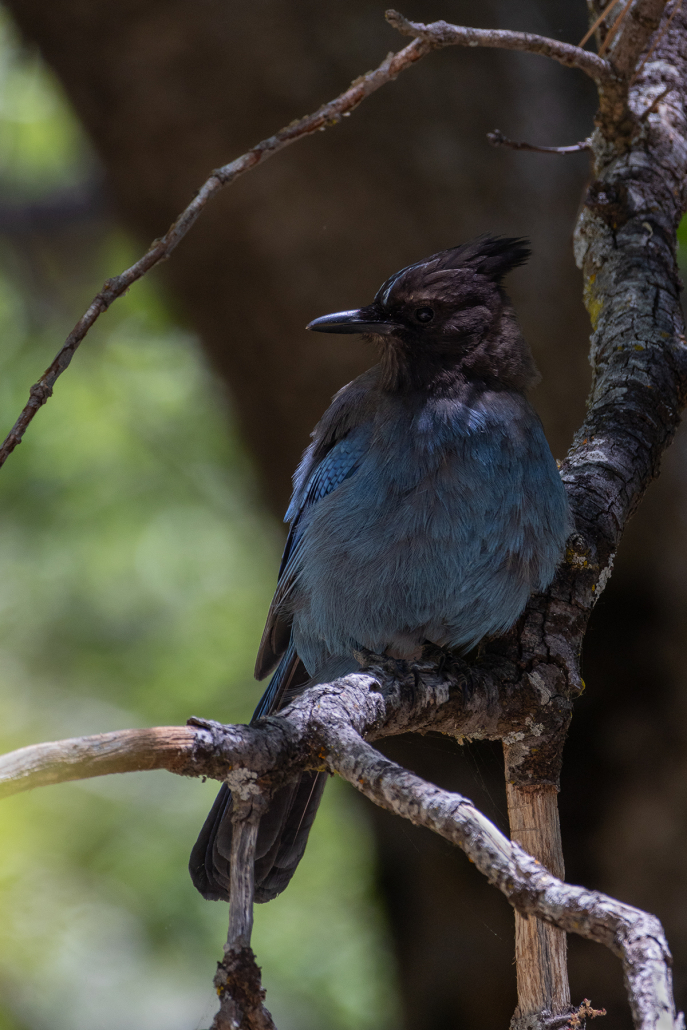
A little further on, we found a familiar bird but one that I can’t resist photographing. Maybe it’s just me, but I love a Jay and the Steller’s Jay, Cyanocitta stelleri,  has to be one of the finest members of the family. This fine individual was unconcerned by us as we neared the picnic area and gladly waited while I took its portrait.

A black and blue Steller's Jay with its crest partly raised sits on a branch in dappled light, its body facing the camera but head turned to the left.

Our final encounter came at the picnic site where a trusting female Red-winged Blackbird, Agelaius phoeniceus, hopped around the tables in search of forgotten crumbs. While not as showy as their male counterparts, I find these to be attractive birds and was happy to photograph this one.

A brown streaky bird sits on the edge of a picnic table in dappled sunlight beneath the trees. She faces to the right but looks slightly at the camera.


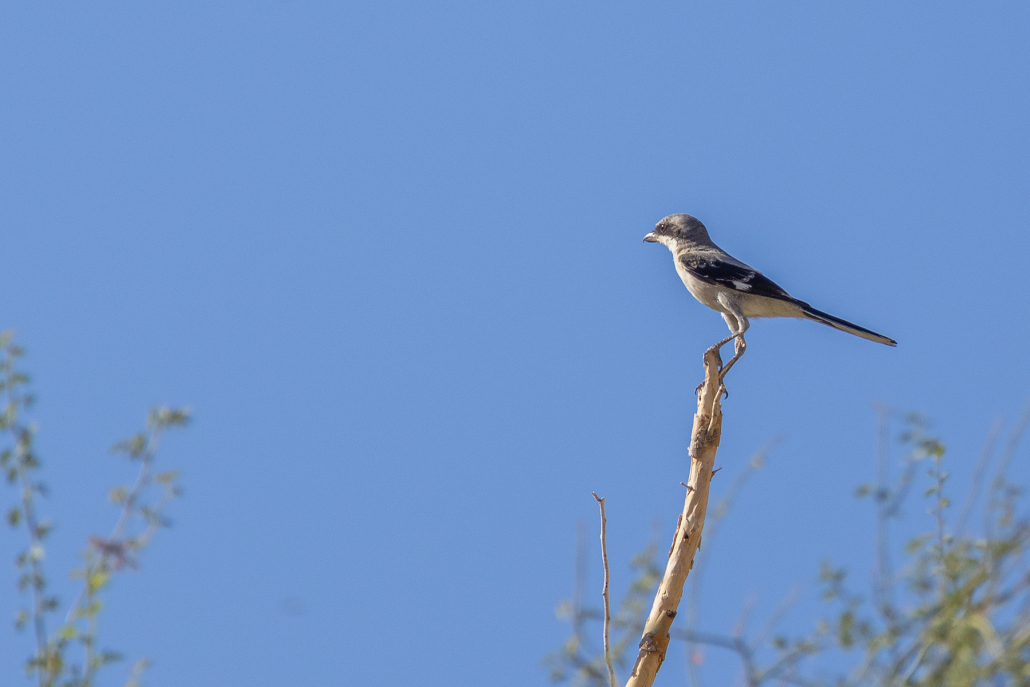
The next morning, rather than drive out further afield, we opted to walk out directly from our AirBnB to explore a local trail along the side of a dried creek bed. Owing to the aridness of the area we weren’t expecting to see as many invertebrates, although there were a couple of flighty dragonflies around. We did see some birds though. Many were distant such as American Kestrel, Mourning Dove and Mockingbird, but we enjoyed a Loggerhead Shrike, Lanius ludovicianus, which was on the top of a dead tree beside the path. We had had wonderful views of this species on our last trip and it was nice to encounter this species again albeit from a different angle.

A smart grey bird with darker grey wings and a white breast sits on top of a dead branch that sticks up vertically. It has a long tail and a hooked beak, the dark grey of its wings is echoed in a mask-like marking that covers its eyes. It looks slightly away from the camera into the distance. The background is mostly blue sky with a few leafy branches sticking up into it from beyond the bird.

One of the species we were most keen to see while we were here though was a larger bird. A ground-dwelling member of the cuckoo family, the Greater Roadrunner, Geococcyx californianus, is probably best known from the Looney Tunes cartoons but, unlike their ‘meep-meep’-ing counterparts, the real ones are streaky brown birds which feed on a variety of prey and tend to clatter their bills together more often than calling. I was therefore delighted when we came across one which, with patience, came quite close to us.

A roadrunner, with streaky brown plumage and a long tail, stands in the middle of a paved path that is dappled with shade and looks to the right, its beady eye facing the camera. Its beak is slightly open.

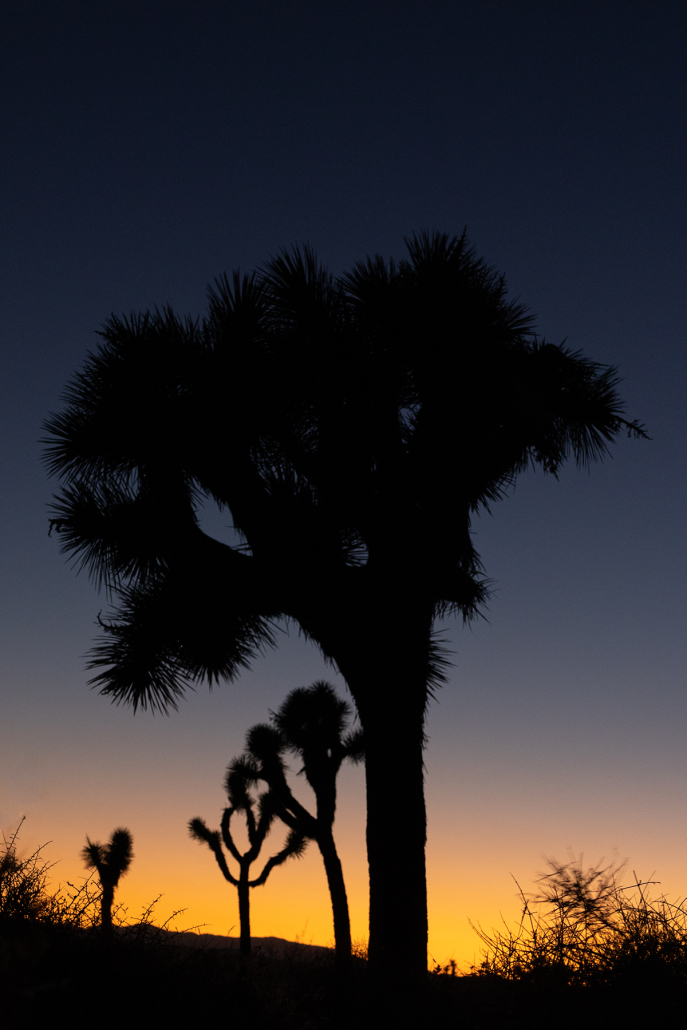
Later in the day, we decided to make an evening excursion into Joshua Tree National Park and the true desert. We had read that it was an excellent spot for stargazing due to low light pollution levels and we were more than happy to explore this. We set off in the early evening and arrived just in time for the sunset. I had no tripod with me as with a wedding to pack for as well, luggage space had been limited, but I used a couple of rocks to make a solid base and made the best of the situation to get a classic silhouette shot of an iconic Joshua Tree, Yucca brevifolia, for which the park is named.

A silhouette of a spiky Joshua Tree against a sunset. The sky is orange at the base of the image and fades to deep blue at the top as night draws in. There are several other Joshua trees in the middle distance.

We settled in to watch the stars emerge in the clear desert sky and were amazed when, a short while later instead of stars we found ourselves witnessing a SpaceX rocket launch. It was in fact the second we had seen in our time there, the first being in daylight from Santa Monica, but this was so much more dramatic in the dark. I have no images but my husband captured an extraordinary shot on his phone, which is in our album of the trip. Needless to say, although we very much enjoyed our dark sky experience, this was an unexpected talking point for the evening. It was incredible to watch and yet at the same time, we debated the ethics of the venture when climate change is affecting our world so much and we still have so much to discover on earth. Nevertheless, our journey took us through the park and out of the other entrance before we headed for our accommodation and this allowed us to experience even more. We saw a number of Black-tailed Jackrabbits, Lepus californicus, relatives of our hares along with a grazing Mule Deer which we later learnt are rare in the park, presumably preferring more lush landscapes to the harsh desert environment here. We also saw a huge number of small rodents, although in the headlights of the car and with their bursts of speed, it was impossible to identify them.

The next day, we decided to go back into the park in daylight and explore further. This would mean venturing out in the heat of the day, but we felt it would be worth it so we made sure we were prepared. Entering near Cottonwood Springs, we found ourselves in the Colorado Desert which is a distinct habitat from the Mojave Desert in the western part of the park. Here, the lower elevation meant a vegetation more like that in the valley with species like Cholla cactus, grasses and desert saltbush. We saw Gambel’s Quail in the undergrowth and despite only seeing our first Roadrunner the previous day, several more lived up to their name and ran across the road in front of us (thankfully at a safe distance each time!).

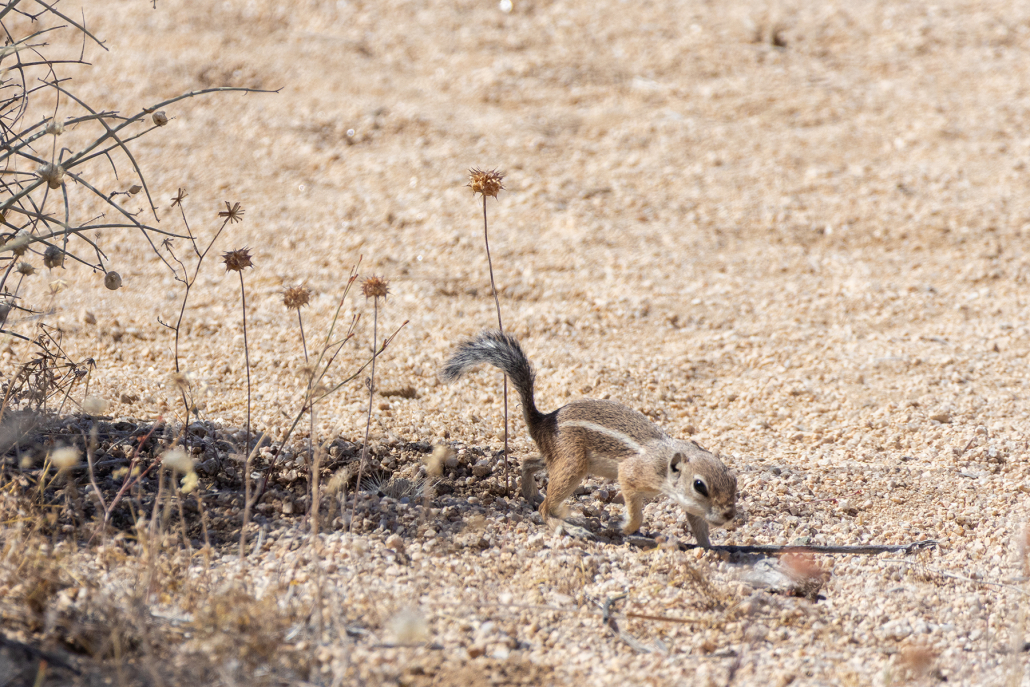
We stopped at Arch Rock and made the short hike out to see the natural rock formation. Impressive though it was, I have to admit, I was more interested in the charming White-tailed Antelope Squirrels, Ammospermophilus leucurus, which we met along the way, skittering between patches of shade.

A tiny squirrel with white stripes up tawny brown flanks runs diagonally towards the camera from a patch of shade. The squirrel has its tail up and the desert ground is sandy with the odd bit of dry vegetation in the foreground and a small shrub on the left of the image making the patch of shade it is leaving.

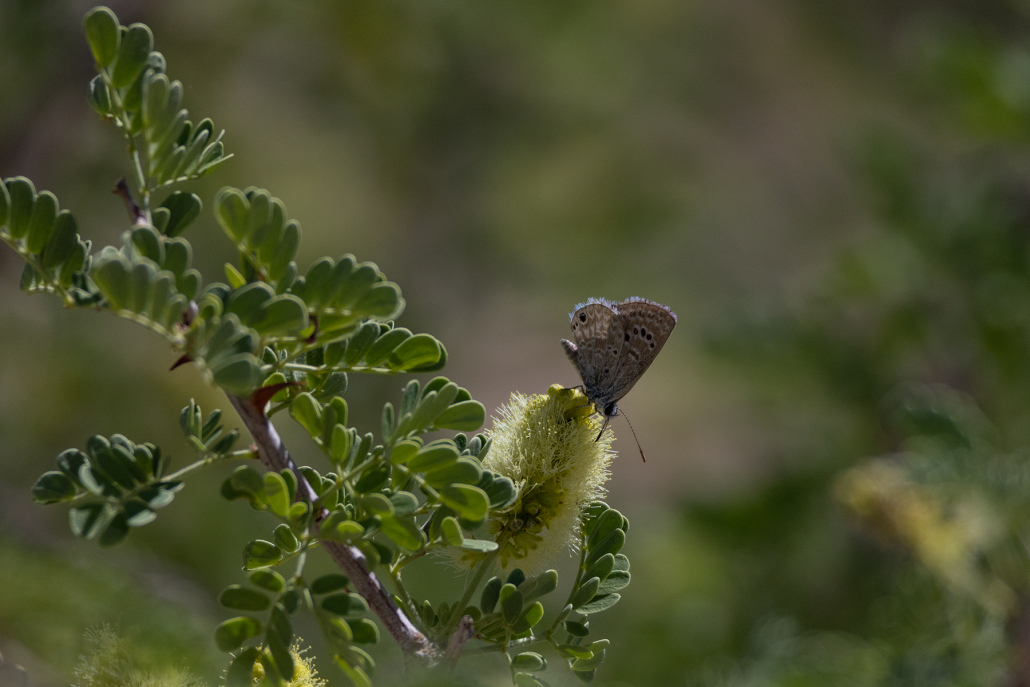
Our next stop was at Barker Dam and this proved more fruitful still despite only a short section of trail being open. The first thing we noticed was a Catclaw Acacia, Senegalia greggii, in bloom and being visited by tens of butterflies, all the same. These, we would later find out, were Ceraunus Blues, Hemiargus ceraunus.

A small butterfly with a delicate pattern of spots and streaks on the underside of its wings visits a pale yellow fluffy flower in search of nectar. The butterfly is brownish grey on the underside but a thin streak along the edge of the wing hints at the blue on its upper surface which isn't fully visible because they are closed. It faces slightly downwards and to the right as the flower belongs to a tree, the branch of which comes up through the image at a left-leaning diagonal. There are more branches out of focus in the background.

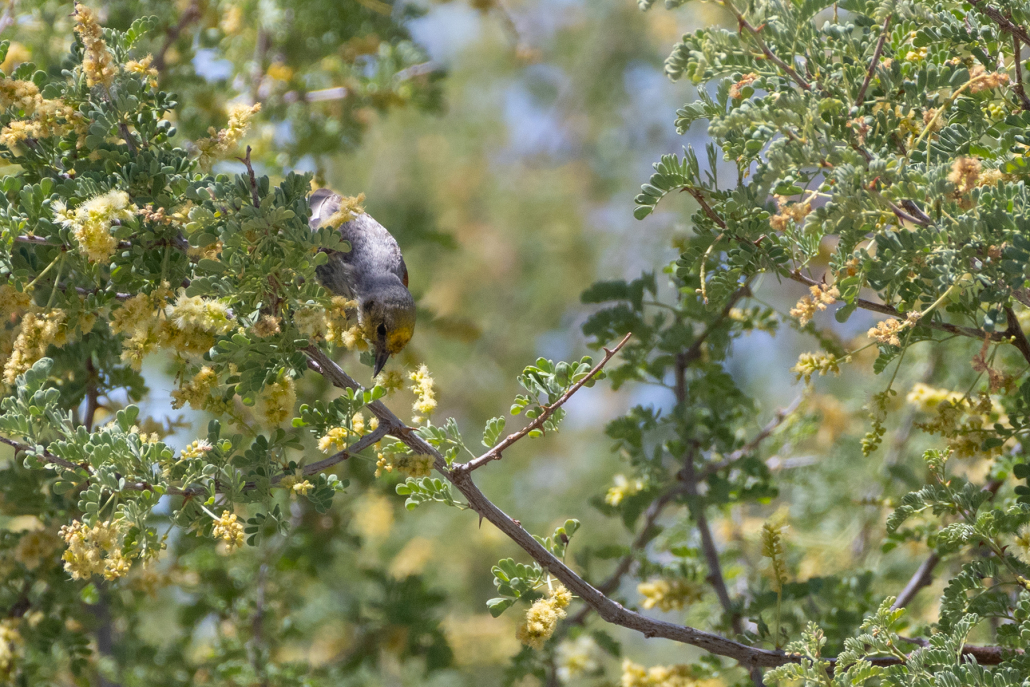
Nearby, more of the same trees were being visited by Verdins, Auriparus flaviceps, a yellow-headed relative of the European Penduline Tit. We had seen these birds for the first time earlier in our trip but this was our first experience of them close at hand. It seemed there was a floral oasis here in addition to the dam itself and these birds and insects were benefiting from it in the otherwise inhospitably dry desert.

A small grey bird with a yellow head hangs off the edge of a branch in search of food. The branch has lots of small leaves and yellow fluffy flowers, and there are more such branches in the background.

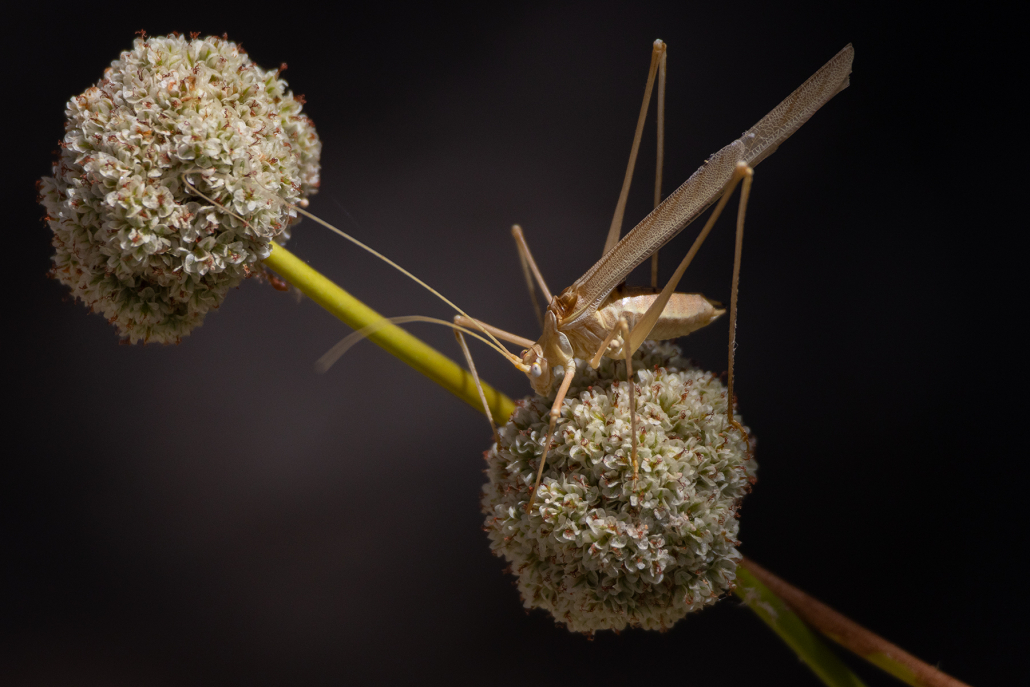
Further on, I found one of the most intriguing insects of the whole trip though and enjoyed the setting in which I found it, on a sunlit Buckwheat stem against a shaded rock beneath a shrub giving a naturally dark background and adding a bit of drama to the image. This is the weird and wonderful looking, locally endemic California Thread-legged Katydid, Arethaea brevicauda.

A pale tan coloured, very long-legged Katydid with long wings too, sits on top of a buckwheat flower which is bathed in sunlight. The background is cast into shadow and makes everything stand out in stark contrast.

Before we left, we also saw some very attractive Black-throated Sparrows. Unfortunately, they were not in the mood for photos but sometimes nature is just nice to watch!

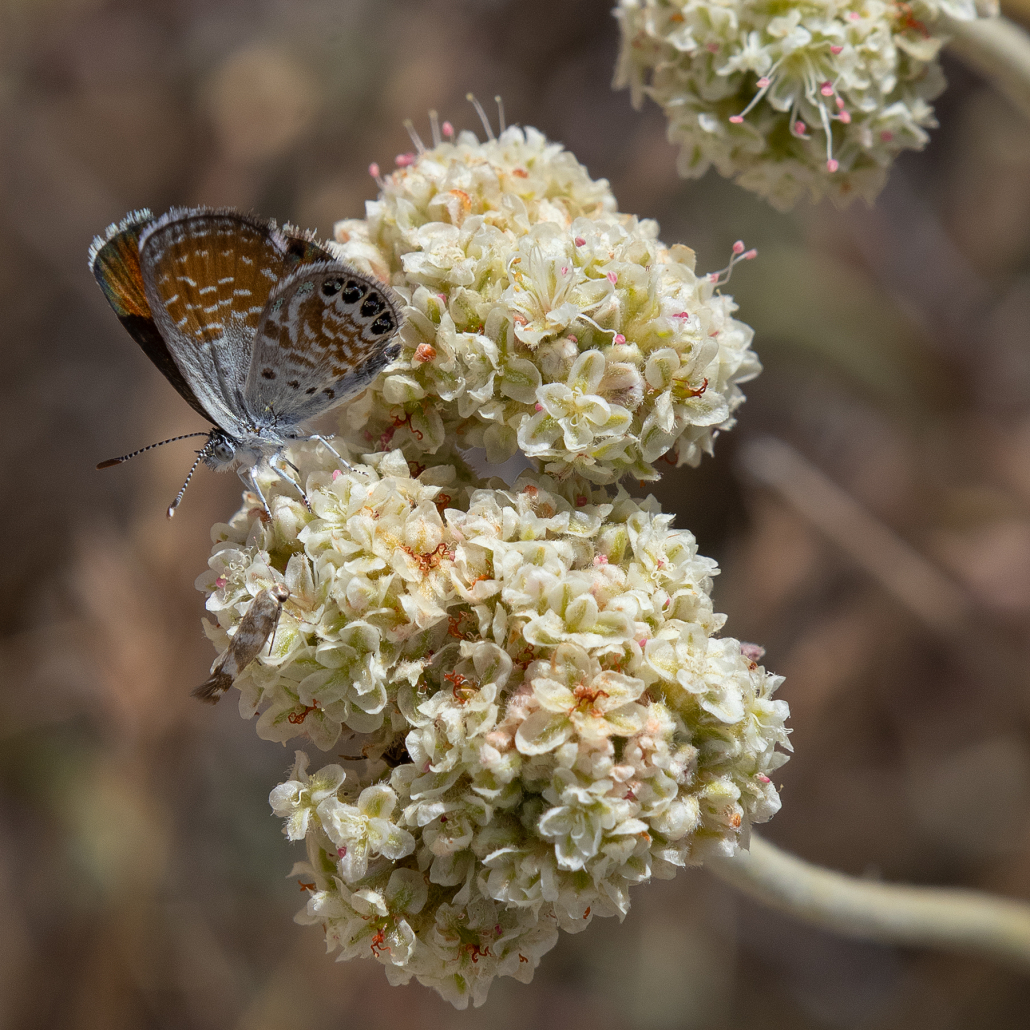
Our final stop meant a short back-track since we had over shot the turning. We headed to Keys View ostensibly for the vista over the valley below which was pretty spectacular. We also saw a Turkey Vulture and a pair of Red-tailed Hawks here but the species that excited me the most here was another butterfly, and a tiny one at that. The Western Pygmy Blue, Brephidium exilis, is the smallest species in North America and a similar size to the smallest in Europe, the Grass Jewel.

A tiny coppery coloured butterfly sits on top of a buckwheat flower with its wings slightly open. There is a metallic sheen on the upperside while the underside fades from copper to pale blue-grey near the body with an intricate pattern of spots. The butterfly is facing to the left and the flowerhead, although itself small, dwarfs it.

This had been our final full day in the desert and the following morning we would leave to make the return journey to LA before flying home. Despite the heat and the harshness of the desert environment, if you stopped to look there was no lack of wildlife to find. The thermometer as we left for the final time though touched 50˚c and we were most grateful of our air-conditioning in the car. Perhaps if we ever make it back to that part of the world again, we won’t go in the middle of summer!