Revisiting the Tomkinson family collection

It has been quite a while since I’ve written anything for a number of reasons, but I’m back at last and I’m rearing to go! I thought I’d get my 2017 blogging underway with an unusual topic that I’ve been longing to tell you about for some time: the Tomkinson collection. If you follow me on Twitter you may have seen a recent post linking to an article about an egg collection that has been taken on by the Natural History Museum and this is my take on it all.

When I was a child my love of wildlife, and birds in particular, was nurtured and encouraged by my parents but also by my Great Uncle, John Tomkinson. He lived in South France and we didn’t see him very often, but every time we did he would be asking me what I had seen in the garden and whether I had learnt the song of a certain bird yet. Sadly, he died when I was 10 but I have fond memories of him and am thrilled to have been left his binoculars along with a few of his books. The books allow me to learn more about him on a deeper level. It’s almost like I have a firsthand account of his likes and interests, and while I could learn more about him by using sites like Genealogy Bank and accessing their census records, I don’t think anything could beat what I am learning about him through his books, and his binoculars too, of course. I use the bins regularly and am always reminded of him when I do. It truly feels like a blessing.

In turn, my Great Uncle John was encouraged to observe nature as a young boy by his father, my Great Grandfather, Gerald. Gerald was a keen birder and collector of eggs, a passion which he shared with John. Between the 1890s and mid-1950’s they amassed a large and meticulously recorded egg collection. In the 1970’s John donated the collection to the Wildfowl and Wetlands Trust and it has been kept at Slimbridge ever since. We took my Great Uncle back to Slimbridge in the mid-90’s, shortly before he died, to see the collection again. I have little recollection of the trip itself, but I do remember completing a school project on it at the time and a couple of numbers have always stuck in my head: Around 27,000 eggs in the Tomkinson collection totalling 5,000 clutches of 335 species of bird. The figures are quite astonishing but the records kept alongside them are equally important.


I should point out here that when the collection was put together, the gathering of bird’s eggs was legal. I should also explain that Gerald and John were very careful in the techniques which they employed and in their recording of the endeavour. They collected only entire clutches and this is an important consideration: in nature when a bird loses a whole clutch of eggs, to a predator for example, they will almost always lay a new clutch of the same size as the original or larger. By contrast, when only one or two eggs are lost, the bird usually won’t lay more. Therefore, in taking a whole clutch early in the breeding season, Gerald and John ensured that the population size was less likely to be affected by their actions.

Anyhow, the long and short of this story is that before Christmas we were contacted by Slimbridge to ask whether we would like to visit the collection again. This came about because it was due to be moved to the Natural History Museum’s collection at Tring where it will be better housed and available for use in research projects. We were thrilled at the news that it has become such a valuable research asset and jumped at the chance to take another look at this astonishing piece of family history. And so, on a wet weekend in December whilst visiting my parents in Herefordshire, 7 of us set out for WWT Slimbridge for the day.

We had a wonderful warm greeting and began our day with a particularly special and memorable treat; an exclusive visit to Sir Peter Scott’s house. He is a personal hero of mine on many levels. Needless to say that to be allowed to sit in his study, to see his last painting still on the easel and originals on the walls, to look at this hand painted records of Bewick’s Swan beak patterns and see what books lined his shelves was an absolute joy and an experience that I will never forget.

Having torn ourselves away from the house we split into two groups. The room holding the egg collection is fairly cramped and so for ease of access half went for lunch while the others spent time looking through the collection and vice versa. I could have spent a week in there let alone just a couple of hours! I should point out here that I had to resort to using my phone for any photography because the light levels in the room were too low (for conservation purposes) to take images handheld on my DSLR and there simply wasn’t space for a tripod between the cabinets. Not only this but the eggs are all under glass for protection and so I had lots f reflections to contend with… it was not ideal! I therefore apologise for the quality of the images but I felt that they were still worth sharing.

The collection is housed in a series of wooden cabinets with drawers full of boxes containing whole clutches of eggs. The full drawers were a thing of beauty in themselves, such delicate things as egg shells all perfectly presented, some even with feathers from the nest.


The factor which made it all the more fascinating though was the records. Each clutch was numbered and logged in a record book which listed when and where they were collected along with any other relevant information such as clutch size, any unusual colouring, presence of a cuckoo egg or pygmy egg. There were also a series of diaries which can be tied in with the record books, describing outings in further detail and mentioning things such as when the bird had been seen building the nest and by whom, detailing more precisely the locations, many of which are still on family owned land and familiar to us. For example, this clutch of Long-tailed Tit eggs was collected from a tree in my Great Grandparents’ garden.


Alongside these there were also a series of photo albums. These were mostly images from trips abroad but contained a few shots which made the mind boggle rather – Gerald, my Great Grandfather, naked as the day he was born with the exception of a hat and shoes, in an image simply captioned “Packing up the eggs”! Only by looking at previous photographs does it become apparent that he had stripped off to wade out in chest deep water to a Grebe’s nest (somewhere in Hungary if I recall correctly)… rather him than me!


I also found one of my Great Uncle as a young boy going over a cliff edge with a piece of rope tied round his waist to collect his first Buzzard’s nest. Let’s just say that health and safety is a very different matter these days!


Finally, there were the oddities in the collection which one would perhaps struggle to see in a lifetime, let alone all in one place:

  • Pink eggs from a Raven (they are usually greenish in colour).
  • An entire clutch of Linnet eggs that are pygmy (much smaller than normal and probably would have failed to survive).
  • Single pygmy eggs in the nests of Long Tailed Tit and Coaltit along with normal clutches (one such clutch is pictured above).
  • A Treecreeper nest with an unusually large clutch of 14 eggs from a single bird.
  • A clutch with 2 Cuckoo eggs in from separate individuals.
  • A clutch of 4 Redstart eggs with a Coaltit egg in the same nest.
  • A clutch of 4 Bluetit eggs with a Redstart egg in the same nest.

To name but a few…

Interestingly, a bird laying eggs that have a particularly unusual colouration can be a great help scientifically, as this bird will continue to lay eggs this way for her entire breeding life and can therefore be tracked fairly reliably if she stays in one area.

There is little doubt in my mind that a great deal can be learnt from the Tomkinson collection which spans every group from tiny Whinchats and Tree Pipits through Sparrowhawks and Guillemots to gangly Flamingos. I understand that there has already been significant interest in the collection within the research community and I am incredibly proud that my family have left such a valuable legacy to science. I hope to visit the collection again now that it is at Tring and I cannot wait to see what they discover!

Greece in Autumn

Last week I told you about the beginning of a tour I led for Greentours to the Peloponnese in south-western Greece. Today I will pick up where I left off for the second half of the trip. While the mediterranean climate is a draw for many a tourist in the area, Greece in autumn holds a special lure for nature enthusiasts at this time of year in the form of stunning arrays of autumn bulbs.

The second morning in Gytheio we woke to bright blue skies and after a lovely breakfast overlooking the calm waters of the harbour, we set off for the day. We headed north towards Sparta and skirted the edge of the town heading west towards the hilltop citadel of Mystras. From afar you could barely see it, the hill it is perched upon blends almost seamlessly with the vertiginous Taygetos range behind. Driving closer, the ancient site becomes clearer by the moment and before you know it the road is winding its way up to the entrance. We parked up and walked round to the gate. On the gate tower itself we had fantastic views of an Eastern Rock Nuthatch preening on a sapling that grew between the stones. Under the arch we found a lovely clump of purple Campanula versicolor blooming in the shelter of the old walls. Once again nature and history were intertwined in an effortless beauty.

We spent over an hour wandering at leisure among the ruins, some more complete than others, Byzantine churches scattered throughout. The views over the plain below from the Upper Fortress was spectacular. In sunnier spots Greek Rock Lizards and Peloponnese Wall Lizards skittered about in search of prey, occasionally chasing one another.


greek-rock-lizard


peloponnese-wall-lizard


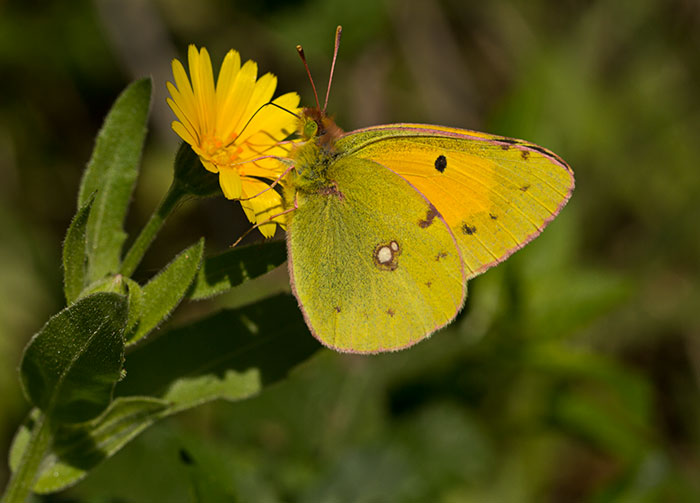
There were lots of butterflies around too, among them Comma, Red Admiral, Clouded Yellow, Small White, Brown Argus, Small Copper and Wall Brown as well as Hummingbird Hawkmoths whizzing energetically from flower to flower. A Cetti’s Warbler sung from an olive grove on the hillside, a Redstart danced its characteristic bob on a rooftop and Buzzards soared on the rising thermals above.


clouded-yellow


It was soon time to move on and we wound our way further uphill and into the mountains. Beside a mountain pass we found our next stop near a chapel under magnificent Plane trees. Here, a small stream trickled its way downhill and having enjoyed a picnic we set out to explore our surroundings. The trees here feel almost as old as the mountains around them, huge boles supporting branches laden with golden autumn leaves, many hollow but still reaching skyward. There should have been Fire Salamanders to be found but despite our utmost searching we didn’t come across them. The area was green with mosses and beautiful variations of Cyclamen hederifolium leaves and, among them, masses of different fungi.


three-in-a-row


The main purpose of our stop here was not the salamanders but another autumn bulb and a particularly stunning one at that, Galanthus regina-olgae, a relatively large but nevertheless delicate Snowdrop.


galanthus-regina-olgae


Having spent a happy afternoon discovering the treasures under the trees we headed back to the vans for the journey home. On the top step by the chapel was one last surprise, a Western Conifer Seed Bug. This species is in fact invasive, native to North America originally and spreading across Europe, but still interesting to see.


western-conifer-seed-bug


The following day our first aim was to head back out to the Narcissus tazetta site on the edge of town which we had visited so briefly in the rain. The sun was shining and there was a lot more life to be seen. The dainty daffodils were out a little further and giving off a sweet, heady scent in the warm air.


narcissus-tazetta


With less of a hurry to get out of the rain we found more this time too. There were Crocus boryiCyclamen graecum and Sternbergia lutea ssp. sicula to be seen as well as a lovely Clematis cirrhosa which was draped over almost every tree in a neighbouring gulley. Male and female forms of Ephedra foemina hung from the road bridge over the gulley and intriguingly, several instars of Swallowtail caterpillar were found on a single Fennel plant. There were more birds around too including a sweet female Redstart catching insects from the telegraph wires overhead.


swallowtail-caterpillar


The real difference though was the number of butterflies. The first visit hadn’t yielded a single one, unsurprisingly, but now there were masses. Plain Tigers, similar to the American Monarchs, flapped past in a slightly lazy fashion while Common Blue, Painted Lady, Large Wall Brown, Eastern Bath White, Small White, Red Admiral and Clouded Yellow nectared alongside a new species for the trip, the tiny Lang’s Short Tailed Blue. The star find though came in the form of another caterpillar. Right by the vans were a couple of Oleander bushes; low and behold, nestled among the leaves an Oleander Hawkmoth caterpillar was chomping its way to adulthood. Despite its vibrant turquoise false eyes, it was surprisingly well camouflaged. A quick search revealed several more, some already advancing towards pupation.


oleander-hawkmoth-caterpillar-head


We struggled to tear ourselves away from this spot now that we had discovered so many wonderful things but eventually we managed it and headed south into the Mani. Our next stop was by a small coastal village where we found glorious thick clumps of Colchicum parlattoris growing between rocks on the roadside.


colchicum-parlattoris-bee


As ever, these were not the only lovely things to be seen, there were plenty of butterflies around and several other plants which were now becoming familiar friends. Among the new things though we  had shiny green chafers buzzing round our heads, I found a marvellous Cicada case on a grass stalk and a group member suddenly appeared holding a stunning Glass Lizard. These are legless lizards rather like our Slow Worms but much larger, this beautiful male was about 3 feet long!


glass-lizard


Moving on we drove through increasingly typical Mani countryside with hilltop villages all around us, displaying their characteristic square towers. Every strong household had a tower, declaring their status and defending against invasion, both on a personal and village scale, as well as providing a high point from which to shout at your neighbours! The surrounding hillsides are covered in a dense scrub but even driving through there are things to be seen. We came across a Jackal prowling through the bushes at one point and the rocky outcrops were perfect Rock Thrush territory. We stopped for lunch on the edge of a particularly picturesque village called Vathia. There was little to be seen in the way of wildflowers but there were Quail in the undergrowth and the views made up for it.


vathia


Our journey south continued till we reached the Gates of Hades and the Death Oracle. This sounds very dramatic, I know, but these are historical sites at Cape Tanaeron. The Gates of Hades are actually a series of caves set back from the small pebble beach there in a narrow gulley where Fig trees grow in the scant shelter from the rugged coastline. The Death Oracle is now the Byzantine Christian remains of a church which was built using the original materials of the Oracle itself. The headland is fairly exposed but still yields some interesting things. Not least the number of recently set seed heads there from the Sea Squill which must have been a fantastic sight in full bloom. There were more Colchicum parlattoris here too, Caper bushes and Ephedra foemina overhung the rocks against the sea. There was a beautifully dainty Sea Lavender too, Limonium virgatum which grew plentifully along the high tide line. Of course there were a few butterflies here too and a lot of Red Winged Grasshoppers as well as a stranger looking grasshopper called Acrida ungarica.

Moving on once more, we took the opposite side of the peninsula to that which we had travelled down. The plan was to stop at a couple of sites for Campanula versicolor  and Mandrake but the amazingly atmospheric skies we were enjoying turned into an enormous thunderstorm with a heavy downpour. It was fairly short lived and we were soon out the other side of it but needless to say the original plan had gone out of the window. Instead, we stopped at a charming little coastal village where we parked almost on the beach. We enjoyed drinks from a local cafe and enjoyed searching the beach for shells. I was particularly pleased to find Tusk Shells and a complete, perfect green sea urchin smaller than a 5p piece. The clouds had dispersed somewhat and we had a lovely Turner-esque sky above us which I managed to snap on my phone just before climbing in the van to drive back to Gytheio as darkness fell.


kotronas-sunset


Sunrise the following morning was fantastic but the red sky in the morning soon lived up to the rhyme. Thankfully the downpour was over soon enough and we were able to load the vans during a break in the weather. Sadly it was to remain overcast for much of the day but spirits un-dampened we carried on regardless. We were heading back inland and starting the long journey back towards Athens.


sunrise-over-gytheio-harbour


Of course we couldn’t make the trek without having a few stops first and we began at a roadside site in the middle of nowhere up a mountain, as you do! The scrub here was different with fewer really prickly shrubs and a base of heather, Erica manipuliflora, studded with Spurges and a myriad of other plants. Amongst it all were some lovely Crocus cancellatus and Crocus hadriaticus.  The former were growing in puddles in places while the latter clung to jewel-like water droplets from the previous rain storm.


dew-jewelled-crocus-hadriaticus


There was a small pink flower, the foliage of which smelt rather unpleasantly like rotting cabbages when crushed, Putoria calabrica and a dainty white scabious, Lomelosia argentea. Apart from these and the crocuses there were little flowers in this slightly desolate landscape but there were a few Strawberry trees among the scrub and in the damp conditions their rusty red bark glowed.

We were soon moving on once more to a village known for its Crocuses. Here we wandered through a couple of small fields where there were swathes of Crocus goulimyi and Cyclamen graecum. Round the corner, an old stone threshing circle proved the perfect spot where C. goulimyi was joined by C. boryi and C. laevigatus. Another Oleander Hawkmoth caterpillar was found nearby and Goldcrests were feeding in a maple tree.

Our next stop was for lunch above another village where there was a little shelter to sit under. While the picnic was prepared the group scattered in search of some few last treasures. There was soon an excitement as some Spurge Hawkmoth caterpillars had been found on Euphorbia rigida. They were an impressive sight, a little smaller than the Oleander Hawkmoths but vividly coloured. An oil beetle was also discovered but no sooner than we had marvelled at these tiny wonders it was time to hit the road again.


spurge-hawkmoth-caterpillar


Our journey now was a long one to reach our hotel for the night and we didn’t stop again but we did have wonderful views of the Targetos mountains which rose above the clouds like something from a mythical tale. After navigating a winding mountain pass in the dark we made it back to the first hotel we’d stayed in and a wonderful warm welcome. The following morning would be our last in Greece and would be spent travelling back across the Corinth Isthmus to the airport in Athens. We had enjoyed a fantastic few days in a warmer clime, if slightly wetter on occasion than we might have liked, and seen a beautiful array of wildflowers and wildlife. Greece in autumn had exceeded expectations and I hope to get the chance to lead another tour there in future.