Singapore: a truly green city

Our month-long odyssey to Australia and New Zealand was coming to an end but we weren’t going home without squeezing in one more bit of exploration: the wonderfully green city of Singapore. We had stopped-over here on our way out to Sydney but only for a couple of hours; on the way back we were going to make the most of it with a four night stay. We managed to check in early thankfully having landed at only just after 6am and after a couple of hours napping we were soon heading out to start our stopover in style.

Our first stop was the Gardens by the Bay where we began in the Cloud Forest Dome. There was a sculpture trail to follow including an exhibition of modern sculptures by an artist who had taken their inspiration from the natural world. The works featured enormous recreations of two types of flower which had been combined into a single bloom to create a strange imagining of a hybrid. There were also plenty of smaller, more traditional sculptures to look out for hiding among the foliage.


Sculptures in the Cloud Forest Dome, Gardens by the Bay, Singapore


The most impressive feature had to be the wall of vertical planting creating a huge green “mountain” at the centre of the glass dome, which we steadily climbed through various exhibits and planting zones. It made a staggering backdrop to the world’s largest indoor waterfall (or so we were told!) which plummeted from the top to basement level in a single drop. Clearly a lot of work goes into maintaining the huge variety of plants and making sure the biome looks its best for visitors. We spent some time watching the gardeners high at work on their abseiling ropes tending to some of the higher bits – not a job for the faint hearted!


On reaching the top we were greeted by another slightly odd sight, it was an area of wet planting with lots of wonderful carnivorous plants. What’s odd about that I hear you ask… well, the Lego imitations in among the real thing would be a starting point. Some, like the Rafflesia, were close to life-size but others were much larger. I have to say that it was rather effective though, many of these plants are small and can seem insignificant in larger installations and so by making them eye-catching it added another dimension. There is the added bonus of drawing children in by using Lego too, there were several having discussions with their parents about what they were looking at and I think that, despite the fact that Lego is plastic, it is really important to try and engage the younger generations with nature, so if this encourages them then why not?!


We continued with a wander round the Flower Dome which has a more mediterranean climate. With Christmas approaching, a large portion had been devoted to rather twee Christmas grottoes and the like but we did enjoy the rest and I found the perfect display for me, I felt like stepping right in and taking a bite of the mushroom…


…I do love a pun from time to time!

We then headed out towards the super tree grove and to explore the rest of the gardens. Unfortunately for us though we were caught in a monumental downpour which didn’t abate and rather than get soaked to the skin we decided to make a break for it and return to the hotel to relax.

The following day we decided to be a little more adventurous in our exploration. I had wanted to visit a wildlife reserve while in Singapore, of which there are a surprising number considering the whole island is a city. We chose Sungei Buloh reserve and hopped on the MRT (train) to get there. After about an hour riding the length of the island and hopping on a bus for the last leg, we arrived. We were greeted by some enormous Rhinocerous beetles thundering round our heads as they bombed from bush to bush and a Changeable Hawk Eagle alighting in a tree a short distance away. We were off to a good start!

Before we even reached the visitor centre our attention was taken by the quantity of Dragonflies over a small reedy waterway. There were some stunning specimens with wings that looked as though they’d been dipped in deep red velvet but they were mostly just out of reach for a decent photograph. I did manage to capture this female Scarlet Skimmer posing nicely on a reed though.


Walking a short way further on, I spotted movement among the reeds again and we noticed a couple of these Changeable Lizards just hanging around, watching people come and go. They were trickier to see than you might imagine looking at the contrast between them and the reeds in the photo below, waiting for one to move proved key in narrowing down their precise location.


Having picked up a map of the reserve we headed on in and within moments we were admiring all sorts of wonderful species. The area just beyond the entrance was thickly vegetated with large shrubs that quickly gave way to full size trees. Among them several were in full bloom, covered in bright tropical flowers. One of the larger blossoms had crinkled petals that reminded me of scrunched diaphanous crepe paper that the light shone through with a golden glow. This was Simpoh Air and each flower was several inches across framed by huge, glossy leaves.


As the trees closed in we took a path that led to the right and towards the muddy shore. A small flock of Asian Glossy Starlings feasted noisily on the fruit of a palm tree overhead and a school of fish made the water just offshore appear to boil as they all shot to the surface. We were wondering what might cause them to do this and began to approach the railing where the path overlooked the water when suddenly a large Water Monitor, spooked by our presence presumably, shot out of the undergrowth. Neither of us had seen it and I have to admit it gave us quite the fright but it was the first of many that we saw around the reserve. Several posed beautifully while others skulked off into the bushes.


This individual seemed particularly nonchalant and allowed me a closer portrait – I will add here that I used my telephoto for this. It was amazing to see these stunning reptiles at reasonably close quarters but I didn’t want to disturb them more than necessary.


There were plenty of smaller things to look at too. This Black Forest Grasshopper was one of the first invertebrates that we spotted despite the hum of life in the forest being almost deafening.


The path we had chosen wound loosely along the coast, weaving inland through densely wooded areas before leading through mangrove swamp to the water’s edge. On a boardwalk area which overlooked a stretch of water separating Singapore from neighbouring Malaysia, we had lovely views of a Striated Heron which had found a barnacle crusted perch among the mangrove roots.


In the shallower sections beneath the mangroves, Blue Spotted Mudskippers made their presence known either flopping their way across the mud or splashing through puddles. At one point we came across a pair which appeared to be fighting if you could call it that, posturing at one another and butting against each other.


There were also Singapore Tree-Climbing Crabs scuttling around in the mud, sifting through it for particles of food washed in on the tide. Their vibrant blue-purple legs and magenta-red claws were surprisingly hard to see and again, it was their movement that gave them away among the tangled mangrove roots.


Another bird caught our eye as it landed higher up among the arched roots and low branches, a Collared Kingfisher.


Wandering back inland we came to a glade in the forest where there were a few scattered shrubs in a more meadowy habitat. In one of these shrubs I spotted a pair of tiny birds and we watched them foraging for a short while. The male was more vibrant and thus easier to follow than the female, with a bright red cap and back against a dark inky blue head and wings. We were later able to identify them as Scarlet-Backed Flowerpeckers.


Nearby, we came across some small ponds where a group of school children were earning about the importance of the wetlands. There were lots of reeds around the ponds and I was curious to see masses of pink eggs up the stems just above the water line. With a little research I came to learn that they were the eggs of the Golden Apple Snail, a popular addition to aquariums and an introduced species to Singapore.


In addition to the reeds and rushes there were some more interesting flowers here too, the yellow-orange blooms of Candle Bush. Yellow-Vented Bulbuls chattered from the neighbouring trees but evaded a photograph by darting back into the foliage every time I lined up my lens!


We soon came to the Wetland Centre and were greeted by the Dog-Faced Fruit Bats hanging in the roof of the porch.


There were some small pools around the centre too and we watched a Water Monitor casually swimming across the larger one and clambering out on the other side. The pool held a variety of colourful fish, the most noticeable of which were another introduced species, the Mayan Cichlid. Their vibrant patterning makes their appeal for the aquarium trade apparent but it is a shame to see yet another non-native species in such a small fragment of valuable habitat.


There was yet another invasive species just round the corner sitting on a log too; a Red-Eared Slider. Reported to be the most traded turtle in the world and native to North America, these turtles are becoming problematic in many countries worldwide as a result of the pet trade.


Leaving the Wetland Centre, we followed a trail round the Mangrove Boardwalk where we watched Plantain Squirrels race around the tree tops after one another. The insect noise here was greater than ever, much my husband’s dismay and my delight. There were all sorts of wonderful critters to be seen and heard, the cicadas were the loudest, though tricky to locate we did find a few but the light levels made photography tricky without a flash. I did manage a decent shot of this bee though.


There were several birds here including House Crows and a gorgeous Oriental Pied Hornbill. Sadly I didn’t get a sharp image of the latter but mostly because I was too busy marvelling at the proximity of our encounter with this beautiful bird. There were plenty of butterflies around too such as this Common Palmfly.


This Oakblue Butterfly is one of several very similar species. I haven’t got the knowledge to narrow it down to species level and indeed my images may not contain the information required to do so, but it is another undeniable beauty.


One of my favourites from the day was this Blue Glassy Tiger which had the most stunning black and white markings.


Moving on, we soon came to a bridge over an inlet where we spotted a baby saltwater crocodile, about 18 inches long, languishing in the shallows.


At the far side of the bridge we came across a much larger individual, maybe 6 or 7 feet long, resting just beneath the water with only its eyes and nostrils breaking the surface. There were plenty of signs around reminding us not to get too close, thankfully despite seeing several other large crocs around the reserve we didn’t need to take action as they largely ignored us.


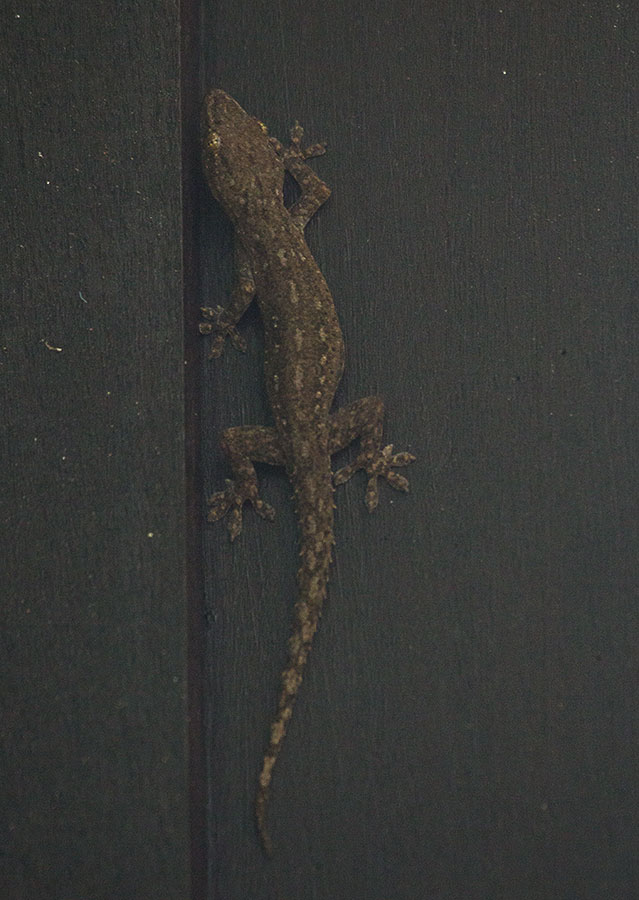
A little way beyond the bridge a smaller reptile caught our attention, a dark coloured gecko which was trying to hide on the back of a noticeboard. I haven’t been able to identify what species it is but would welcome any help available!


We continued on a circular route round some scrapes where migratory waders fed and egrets perched in the surrounding trees. As we neared the bridge once more we came across another lovely bird, the Spotted Dove. Sadly for me the light was not kind as clouds had rolled in but I managed a reasonable record shot.


As we crossed the bridge back to the main part of the reserve once more we spotted another large croc on the far shore, basking among the spiky mangrove roots, jaws agape as if waiting for the nearby White-breated Waterhen to wander into range.


After a wonderful day exploring the wilder side of Singapore, we returned to the MRT station just as the heavens opened and returned to our hotel to unwind.

The next couple of days we spent doing the more touristy bits that one would expect in Singapore, drinks at Raffles, visiting various museums and galleries plus a lot of dim dum restaurants! In between we found time to relax by the rooftop pool on the 35th floor (don’t worry, there were plenty of safety rails, where necessary, to keep everyone safe up there!) where we got glimpses of some of the city adapted species that make Singapore home. One that surprised us a little was the Brahminy Kite, these large birds were regularly seen soaring over and among the skyscrapers.


Another bird that we particularly enjoyed watching was the swifts which came to enjoy the pool with us, dipping in to take a quick wash at high speed.


Our last evening we went for a final meal at the Marina Bay Sands which afforded us a brilliant and memorable view over the rest of the city as dusk fell. It made for the perfect end to our travels and although we were sad that our adventure was coming to a close, we were happy to be heading home after a month away.


Tiritiri Matangi, a natural jewel in the Hauraki Gulf

In the Hauraki Gulf off the coast of Auckland, New Zealand, lies the island of Tiritiri Matangi. In my last post I told you of our adventure on the mainland but now I’m going to explain why I saved this natural jewel so that it could have a post of its own. We had a wonderful time exploring Auckland and the Northland, albeit far too short a stop, but the highlight by far was this tiny island just offshore. Sure, there’s plenty of wildlife to see on the mainland too but 90% of it seems to be non-native species. This is absolutely not the case on Tiritiri Matangi. It is a scientific reserve, meaning that every animal there is monitored and while you might see the odd non-native bird that has flown across from the mainland, these are minimal here and the native species are protected in this predator free zone. It is one big conservation project and an exciting one at that.

We spent just one day here but it was extraordinary from start to finish. We began by catching the ferry from Gulf Harbour having had our bag checked for stowaway Skinks and cleaned every last bit of mud off our boots. We had already been given clear instructions that we needed to take everything we would require with us in terms of food and drink, that it must be in a sealed container and that we must take with us every last scrap of rubbish so we were well prepared.

The ferry docked on the island and we were given a short briefing by the warden before being allowed to set off and explore. We headed left from the pier and out towards Hobbs beach. The first bit of wildlife we saw were Little Penguins in nest boxes just a stones throw from where we had come ashore. These tiny penguins certainly live up to their name and are the smallest penguin in the world. They are found all around the coast of New Zealand and nest in burrows just above the beach. Here on Tiritiri Matangi though, a few special nest boxes have been installed where visitors can get a look at them in their burrows without causing too much disturbance. The light wasn’t good enough for a photograph but for me just seeing them was enough, as I’d never seen a wild penguin before and they were amazing!

We had a nice view from here as the ferry pulled out to leave too and the extinct volcano of Rangitoto was visible in the distance beyond the pier.


On round the corner a Tui flew low overhead and landed in a bush beside the path. This would be the first of many for the day but I snapped a photo despite the few twigs in the way and it marked a good start to the day’s wildlife watching. It also showed off the strange tuft of white feathers below their chin rather well.


Tui, Tiritiri Matangi


I turned around to find a small butterfly had landed nearby too. It was a little worn but as we hadn’t seen any butterflies to date I was still quite happy to photograph it.


It reminded me of the Small Copper butterflies that we get at home and indeed it is a relative. There are quite a few in this area though and they are very similar to the untrained eye so I’ve yet to be able to narrow it down further than that. Anyhow, I came to move on and found to my horror that in my haste to get my camera out to photograph the Tui, I’d put my camera bag on an ant nest! Now the angry ants were swarming all over it… d’oh! With some help from my lovely husband we managed to get rid of them without doing too much damage and we were soon back on track and enjoying the scenery.

Quite a few people had opted to go for a guided walk but we had decided to take our own route at our own pace as we have found that when there are only two of you it is often easier to see things as they don’t hear you coming. Of course you then have to work out what things are on your own but that’s all part of the fun. I mention this now because we had been watching a Whitehead, one of the translocated endemic birds that is part of the conservation programme on Tiritiri Matangi, when a guided group came through and unintentionally disturbed it. It was a shame and I didn’t get a shot of it as a result but it had been nice to see (in case you’re wondering, it looked like it sounded, brownish grey with a white head!).

We moved on before the group had fully caught us up and had a great few minutes enjoying a nice view of a Sacred Kingfisher in the top of a tree above the beach. The path then cut uphill, climbing above the bay to give us a great view back over Hobbs beach.


It really seemed an idyllic place and the sunshine only added to the beauty, making the turquoise sea seem to glow around us. The Pohutukawa trees were beginning to flower here too which enhanced the scenery even more.


As we climbed the slope we came level with the top of one of the Pohutukawa trees and in it, we found a Bellbird feeding.


A nearby Tui became interested that we had stopped and peered at us to see what we were up to.


Walking on through the woodland, we saw another Whitehead and a Stitchbird though here the canopy was so thick that photography wasn’t an option. I did manage a shot of a Rifleman, New Zealand’s smallest bird. It wasn’t great due to low light levels but it captures the essence of these tiny birds perfectly to my mind. They reminded me of a cross between a wren and a tree creeper with their habit of running up and down tree trunks in search of insect prey.


Further on, we came to an open section of grassland where we stumbled upon a family of really special birds, Takahe. These incredible birds are a member of the rail family but are significantly larger and thicker set than most others of their type. They were thought to have gone extinct until a small population was discovered in a remote valley in the Fjordlands of South Island in 1948. Their numbers are still low and they are an important part of the conservation story on Tiritiri Matangi where a number of adults have been released and have bred.

We bumped into a pair with a nearly fully grown juvenile and enjoyed their presence as they walked across the track in front of us and foraged in the undergrowth. The whole time they were calling to one another with surprisingly small, soft peeps.


It was an absolute delight to see these majestic and rare birds, and a real privilege for them to allow us such a close insight into their behaviour.

We soon reached the most northerly tip of the island where we stopped to enjoy our picnic lunch overlooking the Hauraki Gulf below. Walking on, we passed a small reservoir where we saw an endemic Brown Teal skulking in the reeds at the water’s edge. There were also a couple of North Island Saddlebacks which are a member of the wattlebird family like those we saw in Australia. They were a lovely colour, glossy black with a vivid chestnut saddle and rump and sporting two small red wattles at the base of their beak. They didn’t hang around long enough for a decent photo but again, it was great to see them.

Of course, it wasn’t just bird life that we were here to see, fascinating as it was. Tiritiri Matangi as a whole was a supremely beautiful place and much of the flora was new to us too. We particularly admired a flowering shrubby tree called Ngaio. It had leaves reminiscent of laurel or perhaps oleander but small white flowers with delicate purple spotting and strangely hairy petals.


I mentioned earlier that we saw plenty more Tui as we continued our day. In fact I would go as far as to say they and the Bellbirds were probably the most common birds on the island and we saw them seemingly every few hundred yards at least. I took a number of images but the next glade we stepped into proved the best in photographic terms as there were a couple of Tui which posed wonderfully for me. The first seemed quite reserved but showed of the iridescence of their plumage which, much like a magpie, seems almost black at first glance.


The second was more raucous and much more like the Tui we had come to know and resent at the bach for waking us up so early every morning!


To me, this image perfectly sums up my lasting memory of a Tui!

There were also a couple of Bellbirds hopping about in the clearing and so I took the opportunity to photograph them too. The first sat atop a dead flower stalk of New Zealand Flax.


The next sang from the branches of a small tree with intriguing seed pods.


Funnily enough, they didn’t seem to me the most attractive of the birds we had seen that day and yet their song was lovely and really did ring, bell-like, through the woodland.

Continuing our circular route of the island, we came across another butterfly in a grassy meadow area. It was another copper and much fresher than the last but whether it was the same species I wasn’t sure and so I photographed it too.


Just around the corner we had a lovely close encounter with a smaller relative of the Takahe, a Pukeko. We had seen these on the mainland but not managed a photo. This individual was much more obliging. My husband could never remember their name though and had taken to calling them “potatoes” because it was apparently easier. It certainly confused a few people when he announced that we had seen potatoes wandering around the island!


The next bird which we were particularly pleased to see was the endemic Red-Crowned Parakeet. This rare little parakeet was the first bird to be introduced to Tiritiri Matangi in the 1970’s and today the population there is thriving. This individual was feeding on New Zealand Flax seeds.


Unfortunately the image is not as sharp as I’d like as the stem was waving around rather in the breeze and I was more excited to watch them than take photos. We were also a little conscious of the time as we needed to make sure we didn’t miss the ferry back. We cut inland for the last stretch of our walk and just off the main track we found another different bird. This time not an endemic species but a non-native, the Brown Quail which hails originally from Australia. They were introduced to both North and South Island but now only remain in the North and have made their own way to Tiritiri Matangi. They, like many game birds, were quite shy, skulking in the undergrowth. We had had a brief glimpse of a pair in the Snowy Mountains and so it was nice to have a better view of them here and to manage a photo too.


Having made a circuit of the majority of the island by now, we headed up the hill to the small gift shop and visitor centre next to the picturesque lighthouse. While sitting in the shade here having a drink we had a nice view of a New Zealand Pigeon, quite a large bird with a striking green and white colouring. I chose a t-shirt with a design combining the traditional fern and these lovely birds as a souvenir to take home, the money going directly to the conservation of Tiritiri Matangi.

Not wanting to rush too much, we set off down the hill towards the pier to catch the ferry back. The path here led through a different type of woodland, full of spiky native Cordylines. As the path wound downhill we had a lovely parting view of the lighthouse at the top of the hill.


In the trees here we found more Brown Quail and a feeding station where a couple of Stitchbirds were coming down. Although not ideal as a photography point, this was my chance to get at least a record of these charming little birds and in the end they were almost too close!


A short distance further on our attention was caught by some other visitors taking photos beside the path. We didn’t need to get much closer to see the subject of their images, a female Wetapunga, one of the largest insects on earth. They are also endangered and have been wiped out on the mainland by predators. The first were released on Tiritiri Matangi in 2011 and they can take 3 years to mature enough to breed so to see one here was particularly special. It was staggering too, given its size, just how well it blended into its surroundings and this made it tricky to photograph – I’m not sure that I managed to fit the entire length of its antennae in either. To give you an idea of scale, the tree trunk on which it sits has a diameter of approximately 2-3 inches.


Wetapunga, Tiritiri Matangi


Returning to the pier, we waited a few minutes for the ferry to dock and enjoyed watching a couple of Pied Shag on some small rocks just off the island while it did so.


Pied Shag, Tiritiri Matangi


The journey back was as pleasant as the one out with plenty of seabirds to watch and chatter with other passengers about the wonderful day we’d had on Tiritiri Matangi. There really was something special about this island in the Hauraki Gulf and everyone on the ferry seemed to agree. Tiritiri Matangi had captured the hearts and imaginations of us all and we were thrilled to have spent a day exploring its woods, meadows and glades, watching some of New Zealand’s rarest species, taking in the spectacular scenery and soaking up the sunshine.

Just one last footnote before I finish. You will notice that the vast majority of birds I photographed are ringed, particularly those less common species. This is all a part of the conservation work being undertaken on the island. They are not captive birds but they are closely monitored to ensure their health and to secure their breeding population, as many of these species are now largely confined to outlying islands like Tiritiri Matangi where introduced predators are not such a problem. Of course, the more that is known about these birds, the better they can be protected and their lineage conserved for future generations to enjoy. Who knows, one day you might not have to travel to an island like Tiritiri Matangi to see them – wouldn’t it be amazing if they could be safely reintroduced to a predator free mainland?! It may be a pipe dream for now but what a dream to chase…