Tag Archive for: Alice Hunter Photography

Tidbinbilla, in search of Platypuses…

Tidbinbilla; even the name sounds distinctly Aussie and indeed it derives from Aboriginal origins. The meaning behind it is “a place where boys are made men”. Put into context that sounds potentially a little daunting but, having spent a wonderful weekend exploring the highest of Australia’s peaks, we decided to take a detour on our way back into Canberra and head to into the foothills of the Australian Alps once more, stopping at the Tidbinbilla Nature Reserve.

We had beautiful weather for our drive and managed to do a little wildlife spotting on the way with an unusual sighting of a splendid male Ostrich. Despite some strange looks on announcing our sighting, with a few querying our identification and suggesting it was an Emu, the rest of the family backed us up having seen it too from their car and it is known that there are a small population of feral Ostriches in Australia.

We arrived at Tidbinbilla in the middle of a torrential downpour but our spirits weren’t dampened and after an indoor picnic in the visitors centre, we set off to explore what the reserve had to offer. We began by taking the circular drive that runs round the reserve. The rain persisted and so most of our wildlife viewing was done from the dry comfort of our hire car. We took a short side track to a viewpoint which must have been spectacular in clearer weather. The rain eased off and we made a break from our shelter to take it all in. The outlook was still interesting as it gave an indication of the scale of the valley and the density of vegetation here. The low cloud certainly made it an atmospheric experience and we also had a lovely close encounter with a female Eastern Grey Kangaroo and her Joey.

Our next stop was at one of the main carparks for the eucalyptus forest. Here we waited out another heavy shower before venturing out for a walk. Our niece was particularly keen to look for Koalas so we headed into the enclosure. I should note here that while all the animals here are native and in a natural habitat, there are areas which are protected by predator proof fencing as part of a conservation programme which is particularly beneficial to some of the more unusual and endangered species on the reserve. During a pleasant walk round this smaller enclosure, we spotted a number of Brush-tailed Rock Wallabies and some Potoroos which are rabbit sized kangaroo-like marsupials. To our dismay we didn’t manage to spot any Koalas out in the forest but there was a small area near the gate where a couple of captive individuals were sheltering from the damp weather, along with 2 tiny babies which were rather adorable to see.

Moving on, we decided that as the worst of the rain seemed to have passed, we would take a longer walk round the main Sanctuary area. There was so much to take in, not only visually but in terms of smells and sounds too. There was a wonderful petrichor in the air after the rain which was quite different to that at home, it had a hint of that medicinal quality of eucalyptus whilst still being earthy. There was plenty of birdsong too plus Kookaburras laughing nearby. One of the first things we came across was an Australian Swamp Hen foraging in the tussocky grasses beside the path.


tidbinbilla


We followed the trail round to the furthest pool where we stood in front of the weir and watched the water. There was a bird in the reeds on the lefthand side which, when it eventually revealed itself, turned out to be an Australian Reed Warbler.


Tidbinbilla


Then there was a ripple and we saw what we had been looking for in every pool we had passed; a trail of bubbles and, after a few moments waiting, at the end of them a Platypus. We stood and watched for some time as it went about its business. Most of our time was spent wondering where it would surface next or trying to follow the bubbles it left in its wake. It stayed mostly at the far end of the pool but we had reasonably clear views of it. The light was not ideal, but I managed a record shot or two, and seeing as it was such a highlight for us, I decided to share one with you.
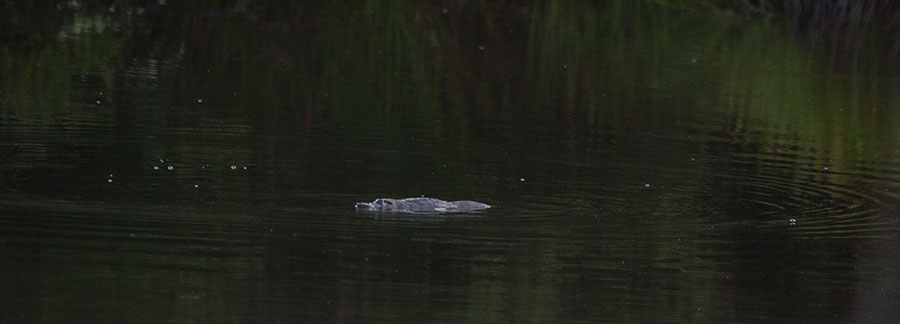


Tearing ourselves away from this bizarre creature, we continued on down the path to see what else we could find. Suddenly, beneath a tree beside the path we spotted a slightly more dangerous resident, a Red-Bellied Black Snake. This individual was an impressive size, easily four or five feet long and spread out to bask in the warm air, presumably having cooled down in the earlier rain.


Having studied the serpent from a safe distance, we continued on once more. Here a boardwalk took us over one of the larger pools and we had a different view of the species that called it home. A Little Pied Cormorant was perched up on a half sunken tree trunk looking particularly photogenic with barely a ripple disturbing its reflection.
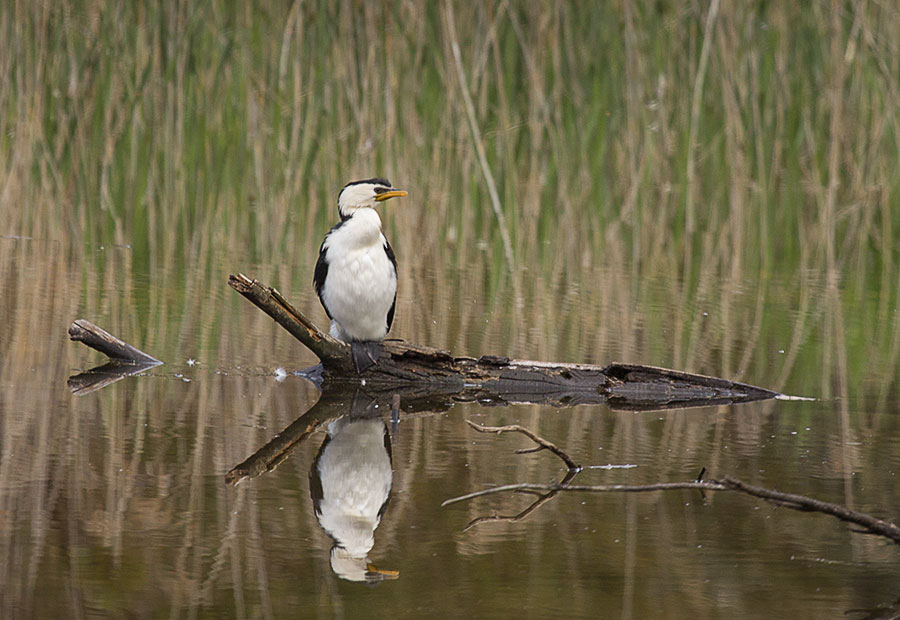


Presently, the Cormorant took to the water and joined a Musk Duck in diving for prey items. The male Musk Duck has to be one of the most peculiar looking wildfowl I’ve come across with a large leathery disc-shaped flap beneath its bill. I’m not sure what purpose this serves other than perhaps as a favoured feature during the breeding season. The duck itself is large and quite bulky too, sitting low in the water and almost appearing to be unsuited to its preferred habitat as a result. We watched this one for some time as it dived repeatedly.


In addition to the birds, there was other life in the water too and although not crystal clear the visibility was certainly good enough to spot a reasonable number of Eastern Long-necked Turtles going about their business beneath the surface. As the afternoon drew on, there seemed to be more insects around the water and this drew in the Welcome Swallows that were flying overhead. One particular individual was bold enough to sit on the handrail only a few feet from us. I am particularly fond of hirundines and Swallows in particular so it was lovely to see these little birds so close.


Having crossed the boardwalk, the path wound round to another pool where we came across an Australian White Ibis feeding in the shallows.
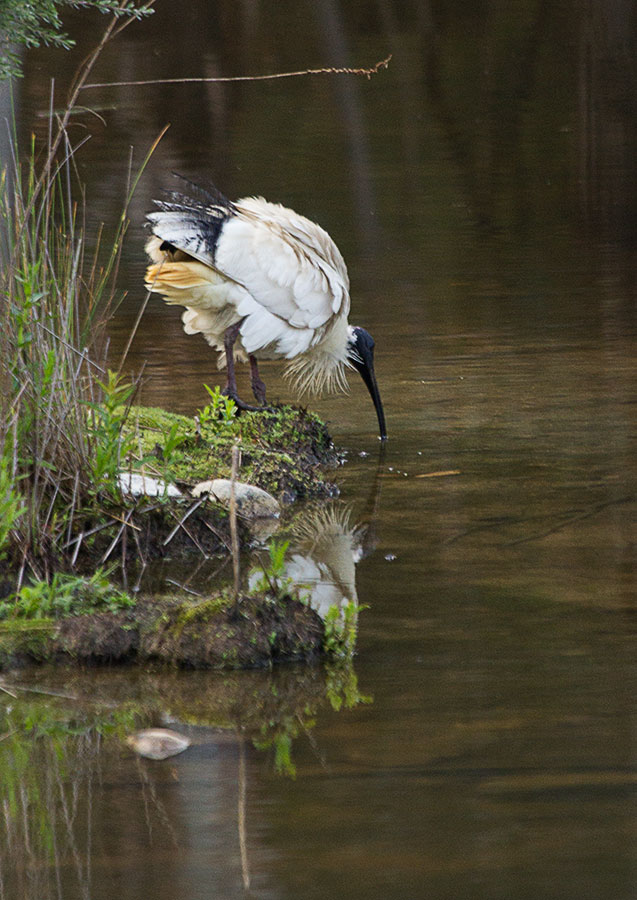


A short way further on, we disturbed a small number of Eastern Grey Kangaroos as they browsed the foliage at the water’s edge. They didn’t seemed too perturbed by our presence as we kept quiet but there was always one of the group watching us to make sure we weren’t a threat.


Nearing the end of the main circular trail, we finally had a good close view of the noisiest residents that we had heard, the Laughing Kookaburra. These are among the largest members of the Kingfisher family although they don’t eat fish but tend to hunt small ground prey such as small mammals, lizards and insects. Their call is very loud and carries a fair distance too so although we had heard them regularly throughout the trip it was a treat to get a really good look at one.


Returning to our starting point, the rest of the family headed on home but my husband and I decided to stay on a little longer and explore the Black Flats Dam area. We had an enjoyable wander through the scrub and saw a few new and different birds including Black-faced Cuckoo-Shrike and Dusky Woodswallow. Taking a seat near the dam itself we also had lovely views of another new bird for the trip, a Grey Shrike Thrush. It was a rather charming bird and was hopping around between several eucalyptus trees above us. I tried in vain to get the photo that I wanted but didn’t quite manage it –  all I can say is “sometimes stick happens!”.
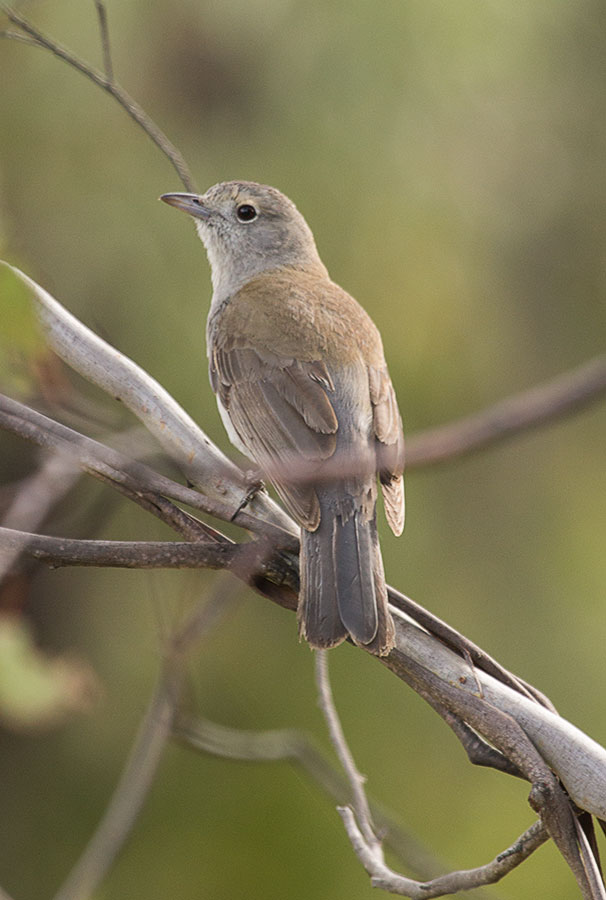


We eventually decided that we should wend our way home and so climbed back into the car to drive back round the rest of the loop to the reserve exit. We were not short of a few more encounters on our way out though as now that the rain had stopped there were a few more opportunities to see things. Using the car as a moving hide, we were able to get nice views of a few species which we had seen only in passing before. The first was a Masked Lapwing which had a chick with it.


Next we came across a curious Kangaroo with a Joey in it’s pouch.
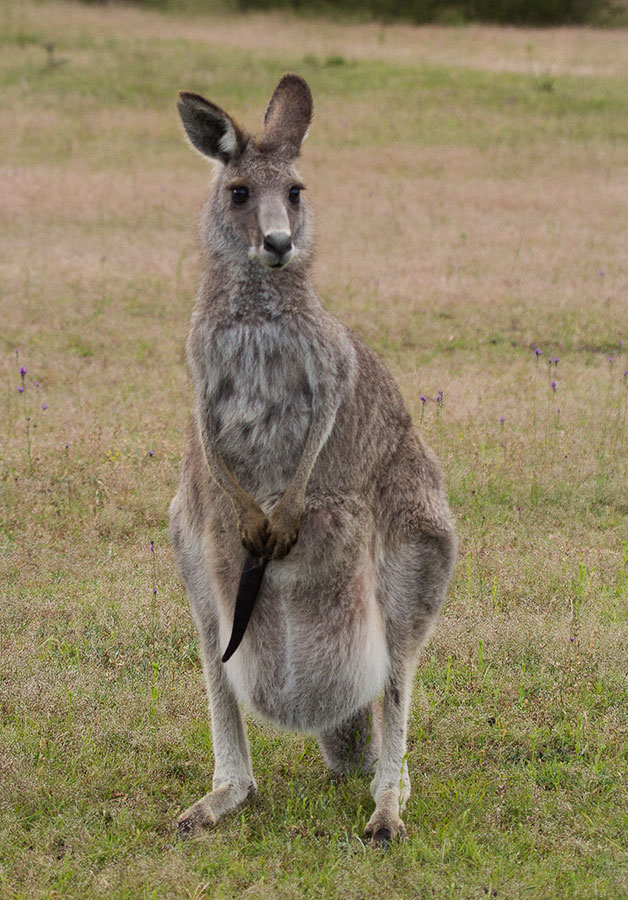


Lastly, we were able to watch a pair of wonderful pink Galahs foraging in the short grass near the visitor centre on the way out.


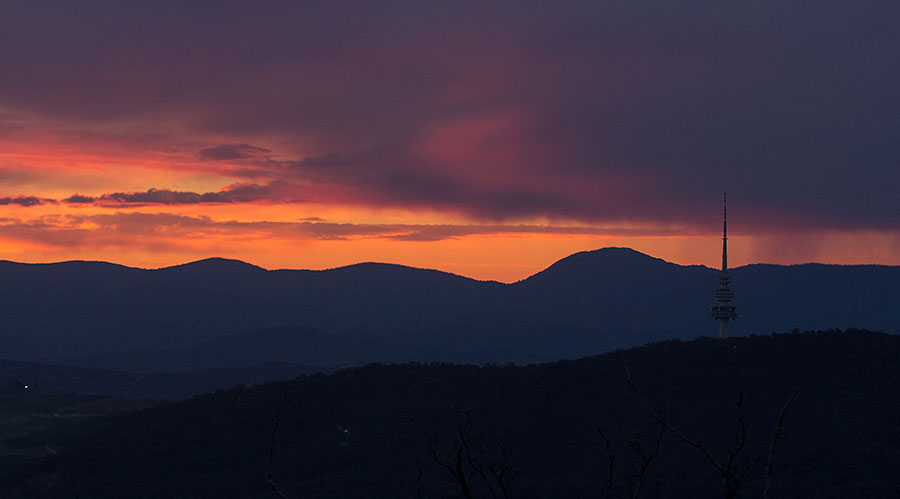
Our trip to Tidbinbilla had been a great success and a wonderful day. We made it back to Canberra just in time to head up Mount Ainslie for the sunset which was a particularly good one looking out over the Telstra Tower to the very hills we had just come from. It rounded off our family weekend away beautifully.
SaveSave

Snowy Mountains: Summer snow in Australia

Following on from my last post, we continue our Australian adventure with a trip to the Snowy Mountains. First though, another day or two in the beautiful city of Canberra, starting with a trip to the National Botanic Gardens.

Having walked our niece to school, we set off fairly early in the day to avoid the heat of the sun. We had already taken our car to a car detailing Campbelltown company (or somewhere a little closer to home!) so we were well prepared. The car had been cleaned both inside and out and our bags were packed! We were ready to go! I was particularly interested that the gardens only showcase Australian species and keen to see whether I could find out more about some of the plants we had already seen elsewhere.

We were immediately greeted with some impressive and rather characterful Gippsland Water Dragons which seemed to be quite at home all over the gardens. This individual was lounging on a bench!

Continuing round, my eye was drawn to a butterfly, the first other than a familiar Small White and a distant Swallowtail that I had seen. Having done a little research since my return home I’ve discovered that this is a type of butterfly known as a “Dart” or “Darter”. They are related to our Skippers which is what I had initially expected. Similarly to our Skippers, they are also very tricky to tell apart, particularly for people who are unfamiliar with them like me. I haven’t been able to narrow it down any further but if anyone knows any more, do let me know! Anyhow, this one was nectaring on a Daisy.

Next, our brother in law took us to his favourite part of the garden and it wasn’t hard to see why he loves it so much. The rainforest gully is somehow more tranquil than some of the other areas and very atmospheric with the misters that keep the vegetation looking its best in the Australian heat. I couldn’t resist a quick snap on my phone to capture it.

You may be wondering why I took this on my phone and the answer is a simple one. I don’t always like to carry all my equipment and be constantly changing lenses, particularly when I’m on holiday. Phone cameras these days are pretty decent and therefore, for wider angle shots like this it is ideal. Not only that but it fits in my pocket! On this occasion, I had my macro lens on my SLR and didn’t take much extra gear with me because I just wanted to enjoy my day out. Sometimes it’s all about experiencing life rather than just taking pictures!

Having enjoyed a tour of the gardens, spent a while watching a New Holland Honeyeater feeding on a wattle bush and wandered round the bookshop we set off to the National Arboretum where we had a lovely lunch. The views over the city were spectacular and got better by the moment as we took the short walk from the visitor centre up to a look out point which mapped it all out for us. On the way up we had great views of a White Fronted Chat and found lots more lovely wild flowers growing beside the path amongst the unmown grass. One such flower was an Australian Bluebell, Wahlenbergia sp. I do have a soft spot for Campanulas!

From the top we had a wonderful view of course, not only of the city of Canberra and it’s suburbs but also in the opposite direction looking towards the Australian Alps. The hills stretch into mountains and the mountains stretch into the distance. It’s a beautiful spot and we enjoyed the view for a while before heading back to pick up our niece from school.

The following day we set off for more adventures. This time, we were heading towards the Snowy Mountains for a long weekend away with the family, but as my sister in law was working during the day they would join us later so we had time to take a detour and explore a little on the way. We started out by taking the road out past the arboretum and across the Scrivener Dam which transforms the Molonglo River into the magnificent Lake Burley Griffin. From here we took a right on Cotter Road and headed out past Stromlo towards Tidbinbilla. Our first stop was Gibraltar Falls.

A short walk from the car park down some rather steep steps led us to the viewing platform from which I took the above photo. The falls continued a good distance down beneath us but were largely out of sight. Nevertheless, the view of the top half was spectacular enough and the beautiful weather capped off the experience. We re-traced our steps and took a quick detour down a side path above the falls which took us over the creek. Here the water was misleadingly calm, you wouldn’t have guessed at the tumble it was about to make if not for the abrupt disappearance of the landscape between us and the distant horizon.

We took a few minutes to explore the trail and see if there was another point from which to look back at the falls. There may have been beyond the point we stopped but we didn’t find one and weren’t prepared for a full on hike. On the way back to the car though, I came across more of the gorgeous Tiger/Hornet Orchids that I’d first found on Mount Ainslie. I must have been too preoccupied with the view to spot them on the way out. Not only were these blousy yellow beauties making themselves apparent but I also spotted a couple of other orchids nestled amongst the low vegetation. The first was a lovely species called Pink Fingers for fairly obvious reasons, which has beautiful delicate pale pink petals and lovely stripes inside the labellum. The other I was a little less sure but I think it was a related specimen known as Lesser Fingers. The alternative was that it was a paler form of the first one but it had to many slight differences to my eye. When it comes to Australian orchids, I’m no expert though unfortunately so unless any of you can tell me I will have to settle for best guess! Either way, these are both record shots but I thought you’d like to seem them nonetheless.

As we still had a fair distance to travel, we were soon on our way once more. We made a brief stop at Lambrigg’s Lookout to stretch our legs and take in the view. From here, we drove on through Tharwa and into Namadgi National Park where we were soon on the gravel track that would lead us through the park and out the other side. Contrary to our concerns that this might not make for easy driving, the track was incredibly well maintained and we barely saw another vehicle. We next stopped at an excellent viewpoint overlooking Gudgenby Valley towards Mount Kelly in the distance. The sun was shining with us but the sky was particularly moody here and it resulted in just a few patches of sunlight hitting the valley floor. I therefore decided that it worked better as a monochrome image; I don’t often process into black and white but sometimes it is the best option.

Continuing on our route, it wasn’t long before we found ourselves at the aptly named Gate of Lost Soles where a mass of odd shoes had been strung to a five bar in typical Aussie humour. This signified our departure from Namadgi National Park and we drove through some beautiful open grass plains and past some large farmsteads. I spotted a Short Beaked Echidna bumbling about in a field beside the road which we were both quite excited about and not much further along the road we came across another which was much closer to us and we watched it for a few minutes. Before long we were arriving at our Airbnb property on the edge of the village of Dalgety. We opened the gate and started down the drive only to see not one but two Echidnas in the garden! They were searching for ants among the grass and we soon discovered that by getting down wind of them you could get surprisingly close as they have appalling eye sight.

I cannot tell you how much joy these extraordinary little animals gave me. I also should confess for those of you that haven’t seen one in the flesh that they aren’t so little! They are over a foot long and rather like our hedgehogs they tend to be prone to parasites – we saw several with ticks. Another fun fact which I think I ought to share if only for the quirkiness of it is that their babies (hatched from an egg, as these are egg-laying mammals called monotremes along with Platypuses) are called Puggles!

We unloaded the car and had a quiet wander round the small plot. There was a beautiful male Flame Robin on the fence by the creek at the bottom and a variety of wildflowers growing in the rough lawn. I decided that I would have a go at photographing some another day as the light was fading. Having settled in and been joined by the family later that evening we got some rest ready for adventures the next day. In the morning, we set out for the small town of Jindabyne to stock up with a few provisions before heading into the mountains. We set off towards Thredbo and having been slightly later in getting going decided to stop for lunch at the Wild Brumby distillery – cue some awesome German style food and gin tasting, because…why not!? Anyhow, we didn’t see any of the wild horses that the distillery was named after, but we did enjoy our stop but it was time to continue on our way.

It seemed only right that we stop for tea and cake in Thredbo village and we were rewarded with the discovery of Lamingtons – if you haven’t tried this sweet Aussie delight, you should! In a small gallery next door, I was pleased to find a suitable echidna card to send my Mum and delighted that it was by a photographer whose work I’ve admired for a while, Charles Davis. We were soon off on a wander round town and enjoyed a stroll along the riverside, capped off with a spin on the Thredbo Bobsled experience (not something I had considered would be on the agenda in Australia!) and some time on the trampolines with our niece. The rain crept in at this point and we adjourned back to the car for a short drive onward to explore as far as possible before we had to turn for home. Our turning point was at Leatherbarrel Creek where we paused briefly to watch the river and take in the splendour of the forest around us.

On the way back down the hill towards Thredbo it became apparent just how much of a problem the Eucalypt dieback is becoming with vast swathes of the hillside supporting just grey, bare branches of what was once vibrant eucalyptus forest. Not much further on, our most exciting find of the day was an Emu right next to the road. We had seen a grand total of eight over the course of the day but this was the closest yet. Unfortunately for me, my camera gear was in the boot of the car as we were quite cramped for space. I therefore only managed a rather dodgy phone shot but nevertheless it will be a lasting memory.

After a lovely day out we enjoyed a barbecue while the sun went down and followed it up with toasting some marshmallows over the outdoor fire pit. It was pretty wonderful as the stars were spectacular from our remote location and all we could hear was the frogs in the tiny creek at the bottom of the garden. The serenity was so calming, I wish I could do this on a more regular basis. Maybe I’ll head online and look for some custom fire pits that can be installed in my backyard so that I can have more quiet barbeque nights with the people I love.

Our second day in the Snowy Mountains dawned bright and I spent a few minutes wandering round the garden with my macro lens before we set off for the day. On closer inspection, a good proportion of the flowers were European species that have been introduced although there were a few less familiar ones too. One of the more interesting subjects I captured was rather unexpected.

I wasn’t entirely sure what I was looking at to begin with but with some help from entomologist friends I was able to clarify the matter. This is a pair of Tiphiid wasps. The male (on the right) is carrying the wingless female from flower to flower so that she can feed on them and ultimately so that they can mate. It seems strange that one must carry the other around but it provides a really interesting insight into their lifecycle and one that I feel I was fortuitous to capture.

It wasn’t long before we were ready to get going for the day and we grabbed some picnic provisions from Jindabyne before driving up the Charlotte Pass. Our first stop on the way was at a Hydro-electric Surge Tower. This may not have been a typical port of call for us but the views back over lake Jindabyne below were well worth stopping for and we also got to see a pair of Wedge Tailed Eagles soaring on a thermal below us which was great.

Our drive on up the mountain pass took us past some lovely scenery and we emerged at the top in summer clothing to play in the snow! It certainly seemed strange to have snow on such a warm day but it was definitely melting and decidedly patchy though that didn’t dampen our spirits. According to a lady we met, it was the largest dump of late snow that they had had in 17 years and they were saying that normally by this time there were more alpine flowers blooming but the weather had delayed the season.

We had parked up and decided to take a short walk up to a higher viewpoint away from the main carpark. On the way up we marvelled at the variety of colours in the twisting bark of the Snow Gums and found several Spotted Mountain Grasshoppers in a variety of shades of olivey green.

On reaching the viewpoint we could see the summit of Australia’s highest mountain, Mount Kosciuszko, although from our already lofty altitude it didn’t seem much higher. After a few photos we headed back down, pausing for a snowball fight on the way, as one does!

snowy mountains

Turning back down the mountain we found a nice place to stop for our picnic and had no sooner finished and climbed into the car than the heavens opened. Chatting about our excellent timing, we wound our way back to Jindabyne where we paused for a walk along the lake edge. There were masses of frogs calling, several species too, though we couldn’t see a single one. We spotted a Cunningham’s Skink basking in the sunshine on a large rock and came across a bundle of Spitfire Sawfly larvae clasped around a eucalyptus twig, a rather extraordinary sight.

Retiring to our cosy cottage, we enjoyed a pleasant dinner and watched the sunset in a blaze of colour. The soft, fading light allowed me one final image to round off the weekend.

I hope you’ve enjoyed reading about the second part of our Australian visit. The next post will cover a trip to a fantastic nature reserve on our way back to Canberra. I had originally planned on including it here but realised I’ve waffled on for long enough!

SaveSave

SaveSave

SaveSave

SaveSave

SaveSave

SaveSave

SaveSave

SaveSave

SaveSave

SaveSave