Butterflies of Greece with Greenwings
Last June I was thrilled to lead my first tour for Greenwings Wildlife Holidays to Greece alongside Julian Dowding and in the company of the fantastically talented Richard Lewington, illustrator of a great number of field guides including the Collins Butterfly Guide. Seeing as the holiday was billed as “Butterflies of Greece”, this would undoubtedly be our go-to reference book for the coming week and having Richard’s expertise in the field with us would prove a fascinating insight and inspiration. Having visited this particular area of Greece previously, I was interested to see it at a different time of year and I look forward to sharing my experience here with you.
We met as usual at Athens airport and went through what I now consider to be a seemingly normal Athenian style debate with the car hire company as to when the pre-booked vehicles would be available (this has happened on every occasion that I’ve been to Greece so far and regardless of which company we book with!). With the vehicles finally in place and our luggage stowed, we set off for the mountains. The first part of the journey was less scenic motorways skirting the city, but once we left these faster roads we were able to spot a few species on our way. Those of particular note included a White Stork and a Swallowtail that zipped over the road. We also enjoyed an abundance of Clematis scrambling over the low shrubs on the dry hillsides and commented on the purple profusion of flowering Vitex agnus-castus, known by some as the Chaste tree, and which has flowers superficially similar to those of Buddleia.
We arrived in the pretty town of Delphi in the early evening and having found our hotel, we settled in with our hosts before heading out to a local restaurant for an enjoyable dinner with a pleasant view over the valley below.
The next day dawned a little cloudy but we set off up the slopes of Mount Parnassus above Arachova in the hope that the sun would prevail. Our first stop was at a damp meadow beside the road. As we climbed out of the buses, a pair of Red-Backed Shrike flew into a small tree beside us. The very first butterfly was seen less than a yard from the minibus too, an Essex Skipper nectaring on Yarrow.

Essex Skipper on Scabious
To the casual observer the meadow itself didn’t appear particularly floristic at first glance, but as soon as we were out exploring there were plenty of nectar-rich flowers in bloom including pale pink Spiny Restharrow, golden Lady’s Bedstraw, Birdsfoot Trefoil and Ground Pine, white Cut-leaved Selfheal, and dark purple Round-headed Leek. The hum of bees was intense despite no sign of any hives nearby and a Hoopoe called.

Round-headed Leek, Allium sphaerocephalon
More butterflies were soon found with the first few being Common Blue, Brown Argus, Clouded Yellow and Meadow Brown. Two blue butterflies caused some discussion and eventually revealed themselves, with Richard’s help, to be Escher’s Blue and Zephyr Blue. There were quite a number of Mediterranean Shieldbugs adorning the spiky Illyrian Cotton Thistle and a variety of other plants as well as a rather colourful cricket from the Poecilimon genus.

Mediterranean Shieldbug, Caprocoris mediterraneus
We paused a while to watch a Woodlark sing from the top of a fir tree before following Julian’s call from over the road. He had found a Large Wall resting in the shelter of a boulder and demonstrating beautifully it’s camouflage. A Wal brown flew past and settled a short distance away while several more Essex Skippers and Common Blues were noted.
Continuing our exploration, we came across a large group of Foxglove plants which had rather smoother leaves than those at home and a very hairy lip. After some “umming and ahhing”, I finally confirmed them to be the Grecian Foxglove, Digitalis laevigata. A Corn Bunting sang loudly from a treetop up the hill and on a nearby Juniper bush, a beautiful Grecian subspecies of the Idas Blue was discovered of which the whole group were able to get photographs. We paused to admire a rather splendid, if tiny, Forester moth (Jordanita budensis) which had a bright turquoise head, on the way back to the vehicles.

Grecian Idas Blue, Plebejus idas ssp. magnagraeca

Grecian Foxglove, Digitalis laevigata
Moving on up the mountain, we decided that the cloud was too low to stay at the top and so we dropped back down to a sunnier spot where a flowery glade opened up in the coniferous woodland either side of the road.
The first species seen in this delightful spot was a Clouded Apollo, which had flown over the road as we rounded the bend. Hungarian Skipper and Heath Fritillary were quickly added to the list along with Painted Lady, Southern Small White and Clouded Yellow. Brown Argus and Essex Skipper were next to be spotted and a Dark Green Fritillary sailed into the sunshine to join us. A transparent Burnet moth caught the eye of a few of the group, and a Blue Argus caused quite a stir, posing beautifully for photographs. They were all sure to find plenty of nectar around us as there were thymes, clovers, knapweeds, geraniums and stonecrops flowering beneath our feet, while Robin and Wren sang from the depths of the woodland around us. Among the rocks at the higher end of the glade, one of our guests found a lizard basking in the sun which was most likely Erhard’s Wall Lizard, and a large shiny green Rose Chafer caught our eye atop an umbellifer beside the minibus.

Erhard’s Wall Lizard
Exploring a slightly shadier and damper hollow on the other side of the road, we discovered a few spikes of Red Helleborine in flower as well as some lovely Campanula sparsa and Everlasting pea, Lathyrus grandiflorus, around which a Wood White was fluttering.
Having hoped to enjoy our lunch in a meadow further down the mountain, we were a little surprised to find it still completely shrouded in thick mist. A quick change of mind found us on a rough track nearer our previous spot where a rocky patch allowed us plenty of “seats” to eat our packed lunches. We enjoyed the sunshine and watched Clouded Yellows flit past, Swifts wheel overhead and lizards scuttling around us while we ate.
A little wander brought a few more butterflies too including Queen of Spain Fritillary and another Hungarian Skipper. A Hummingbird Hawkmoth was spotted zipping from flower to flower and a couple more Transparent Burnets fed more lazily on sage and other blooms.

Transparent Burnet
A single Pyramidal Orchid stood proudly on the far side of the track overlooking a steep scree slope that dropped away into a thickly wooded valley below.

Pyramidal Orchid
Returning to the meadow that we’d hoped to have lunch in, it was still enveloped in cloud and so we continued down the hill a short way to another meadow beside the road where the sun was shining. It was full of flowers including among others bellflowers, pinks and clovers, and positively brimming with butterflies. No sooner had we ventured into the long grass than there were exclamations over new and exciting things to see.
Among the plethora of butterflies were several lovely beetles and a Violet Carpenter Bee which seemed rather sleepy.

A Chafer species, Chaetopteroplia segetum

A leaf beetle
Clouded Yellows were fairly numerous and there was a pale Helice female form fluttering around, along with a slightly elusive Greek Clouded Yellow. Other common species here were Essex and Small Skippers, Eastern Bath White, Marbled White and Brown Argus. An Olive Skipper was found and identified by Richard after some debate, meanwhile I came across an Oberthur’s Grizzled Skipper.

Oberthur’s Grizzled Skipper
There were a good number blues here too, Holly Blue, Silver Studded Blue and Amanda’s Blue joined a female Idas Blue, a male Zephyr Blue and a lovely female Adonis Blue. Heath Fritillary and Niobe Fritillary were spotted and a Southern White Admiral flew over at high speed. We found a beautifully posed mating pair of Black-Veined Whites and, whilst photographing them, Richard and I found a stunning female Field Cricket, a rarely seen species in the UK.

Female Field Cricket
We also saw quite a few Hungarian Skippers which would be a common species for much of the trip.

Hungarian Skipper, Spialia orbifer
Having spent a happy time wandering through the flowers and photographing the many butterflies here we turned back towards the minibuses, pausing on our way to admire a good number of Red Helleborine flowering beneath the fir trees on the opposite bank. There was an enormous specimen of Broad Leaved Helleborine in bud too, not far off waist high!
Moving on, we paused briefly beside the road where a large patch of Narrow Leaved Red Valerian flowered to watch a Hummingbird Hawkmoth and Narrow Bordered Bee Hawkmoth zooming round the flowers.
Heading on down the mountain to avoid further cloud, we stopped at a spot below Ancient Delphi to look for Grass Jewel butterflies, some of Europe’s smallest with a wingspan not much wider than a centimetre. Exiting the vehicles, one of our guests spotted a Short-Toed Eagle a short distance away. Over the road a Balkan Marbled White demonstrated incredible camouflage sitting on a leaf of Jerusalem Sage. There were some wonderful long-legged Bush Crickets clambering around the undergrowth and a large grey-brown Egyptian Grasshopper flew with a noisy whir of wings when spooked.

Bush Cricket, Acrometopa servillea
Wandering on down the road a short way, a bank of Corridothymus capitatus bore a bumbling mass of White Spotted Rose Beetles (Oxythyrea funesta) all busily feeding on the nectar while large, long-legged hoverflies buzzed between the plants.

Hoverfly on Corridothymus capitatus
There were some enormous Robberflies here too, perched on the hot stonework of a water channel beside the road and taking off to dart after smaller insects on which they prey. A few spikes of the Annual Asphodel (Asphodelus fistulosus) and Spiny Acanthus flowered alongside the elegant round, prickly heads of Echinops sphaerocephalus. The butterflies were not to be found in any number here though and so we moved on.

Robberfly
Our final stop for the day was at a spot above a village overlooking the Gulf of Corinth which I know quite well. Walking along a dusty track below a steep rock face that was perhaps once quarried, we had nice views of a Lesser Kestrel above and listened to the loud calls of a Rock Nuthatch which eventually made itself visible, tussling with a second bird. A wonderful large Antlion was found by one of our guests along with a Marbled Skipper and a Hairy flower wasp, Scolia hirta, which seemed to be taking a nap on a dry plant stem.

Hairy Flower Wasp, Scolia hirta
The stop paid off and having found their food plant, Heliotrope, I was delighted to locate “my” Grass Jewels, a group of seven or eight fluttering low over the gravel and providing wonderful photographic opportunities for the whole group.

Grass Jewel
Nearby, I was also able to point out a fairly rare endemic plant, the sweet scented Daphne jasminea growing on the rock face.

Daphne jasminea
Along with this, there was a pretty little pale yellow knapweed which I think was Centaurea lactiflora which is another endemic species.

Centaurea lactiflora
We retired to the hotel a happy group, and after a quick catch up to note all our finds on the checklist, we ended the day with another lovely meal in a local restaurant.
We began the following day with a little more sunshine and made a prompt start after breakfast to visit the ruins of Ancient Delphi before it got too hot.
The first butterfly of the day came before we were even through the gates, a Freyer’s Grayling settled on a tree trunk beside the entrance. Somewhere nearby a Woodlark called and as we gathered in the shade inside to discuss the plan for the morning and explain the layout of the site, a Spotted Flycatcher darted from the branches of the trees around us to catch insects in flight.
As we wandered uphill at a leisurely pace towards the reconstructed Treasuries, a pair of Rock Nuthatches made their presence known with a flurry of riotous calls and flew over our heads to land on the roof of the building. Their antics were watched with amusement while a busy pair of Sparrows brought nesting material to a hole in the wall just beneath them.
A short row of Chinese Privet had been planted opposite the main facade of the Treasury and it was flowering. There were lots of lovely emerald green Rose Chafers and a variety of other insects and beetles feeding on the blossoms, as well as a single Southern White Admiral which flitted from flower to flower for a few moments before disappearing down the hillside at great speed.
Just a few yards further on a litter of small kittens caught the attention of a few members of the group as they gambolled among the rocky ruins. Beyond them some lovely specimens of an endemic subspecies of bellflower grew from the cracks and crevices in the ancient walls, Campanula topaliana ssp. delphica, named for this ancient site where they were first found.
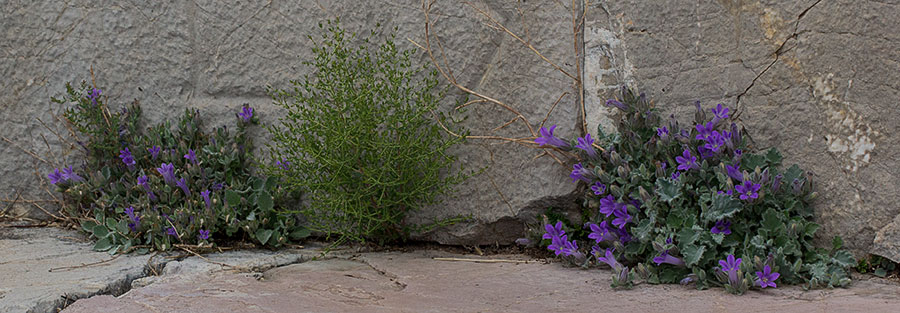
Campanula topaliana ssp. delphica
Having had a brief glimpse of a Mallow Skipper by the Temple of Athena, we found a Southern Comma just around the corner which was being particularly elusive as it fluttered in and out of sight behind the stonework. We paused too to admire the elegant unfurling flower buds of a Caper bush.

Caper bud, Capparis spinosa
As we approached the spectacular amphitheatre set into the side of the hill, one of our keen eyed guests spotted a small Kotschy’s Gecko on a wall. It was remarkably well camouflaged and taking shade behind some brambles which made it even trickier to see!

Kotschy’s Gecko
A moment later, a Woodchat Shrike obliged us by sitting on the very top of a nearby Cypress tree but its beautiful markings were difficult to pick out against the bright sky.
Having marvelled at the scale of the ancient theatre and taken in the ever more impressive view, we continued on uphill. Barely a stone’s throw away we stopped once more to admire a rather large female Greek Predatory Bush Cricket, Saga hellenica. It was wonderfully patterned in shades of brown and we agreed that, although it was beautifully visible amongst the leaves of the small Oleander bush in which it was sitting, its colouring would have been perfect camouflage in the dry grasses behind.

Female Greek Predatory Bush Cricket, Saga hellenica
On up the hill and round the corner we debated the identity of some rather large spiders which we eventually decided were our Garden Spider, Araneus diadematus just several times the size of the ones at home – they obviously have a good diet here! They were mostly quite high up with their webs strung between the branches of trees or from one tree to the next. One such tree was a particularly large Italian Cypress through which a prehistoric plant known as Joint Pine was growing, giving the tree a rather unkempt, straggly appearance.
We paused again a little way further up the hill to look for puddling butterflies at a small spring. The only species in sight was a Small White but turning around we were rewarded with some good views of Swallows, Crag Martins and Red-rumped Swallows hawking for insects at head level in front of us.
Round the next corner another stand of Chinese Privet proved interesting with another Greek Predatory Bush Cricket in its branches and a Thread-Winged Lacewing nectaring on the flowers.

Thread-winged Lacewing
Nearby, to the amusement of the group, a Squirting Cucumber plant allowed me to demonstrate the behaviour that earns them their name. Gently prodding one of the seed capsules duly prompted it to fly off the stalk that held it, propelling its seeds as it went in true squirty fashion – I hasten to add that this is best not done from close range if possible as one is liable to end up covered in gooey seeds!
It was only a few yards now to the top of the site and the impressive stadium. A couple of large moths were found sheltering in the shade of the thick walls and another Thread-Winged Lacewing was spotted on a grass stem at the far end of the stadium. Goldfinches and Greenfinches were seen among the pine trees beside the path here too while a Peregrine was spotted high above against the rock face.

Thread-winged Lacewing
Having made it to the top, we had a quick look around and then began the descent. The spectacular valley views were enjoyed all the way down and we soon reached the Temple to Athena again where some more butterflies awaited us. Joining the Mallow Skipper were Long-tailed Blue, Wall, Tufted Marbled Skipper and Grass Jewel all flitting around the Mallow and Pitch Trefoil flowers. Holly Blue, Large Wall and Eastern Bath White were also reported from elsewhere on the site.
The Rock Nuthatches put in another excellent performance on our way back past the Treasury and reaching the Agora, we found a pair of Grass Jewels performing their courtship with the male desperately wing-waving to the female who didn’t seem in the slightest bit interested! I did (I hope) capture some of this behaviour in a video which I will try to post at a later date if I can edit it suitably.

Courting Grass Jewels
Once we had gathered again we walked a short distance down the road to our picnic site beneath a plane tree by an old spring. On the way, I spotted a Hornet mimicking hoverfly.

Hornet Hoverfly, Volucella zonaria
We enjoyed our packed lunch and some orange cake in the shade while a probable Freyer’s Grayling eluded identification by flying from tree to tree whenever anyone got near.
A brief pause at the hotel after lunch yielded two more new butterfly species outside the door; Geranium Bronze, aptly on the Geraniums in plant pots either side of the entrance (although resting briefly on some foliage nearby) and a Scarce Swallowtail overhead.
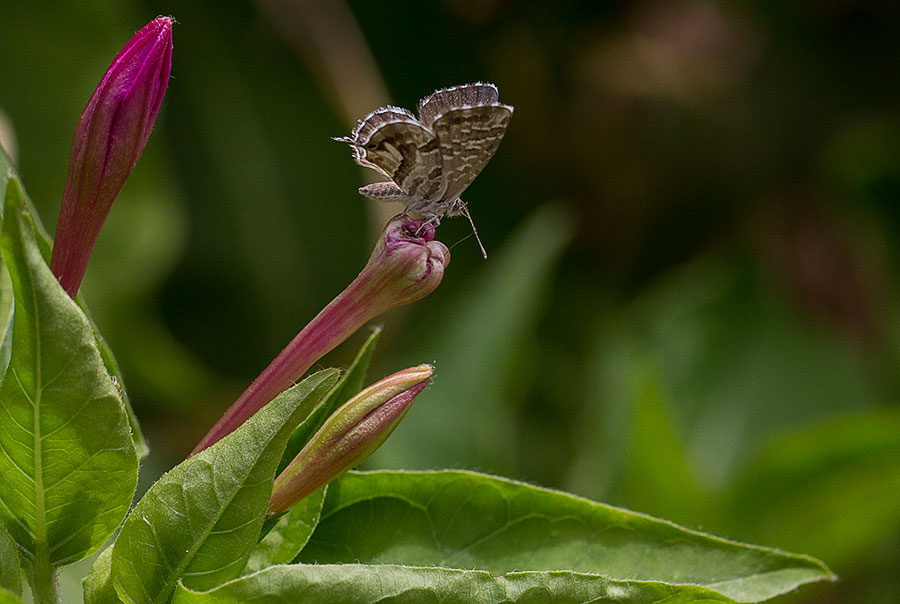

Geranium Bronze
Having retraced our footsteps from the previous day in the hopes of getting higher up the mountain we found that the cloud was still too low on the tops. We made a short stop a hundred yards down the road from our first stop the day before but saw little more than a Meadow Brown, a different species of Burnet Moth and a Pyramidal Orchid. The wind got up and so the decision was made to retreat to some sunshine.
Taking an exploratory route uphill towards the outskirts of a nearby village where the sun was shining on the grassy hillside, we found ourselves on a rather bumpy track up towards a new housing development. The front bus saw a Great Banded Grayling while the back bus enjoyed good views of not just one but three Hoopoes! A couple of whites fluttered around the thistles in what appeared to be a dry stream bed and all signs were encouraging that we might find more of interest here.
We pulled up beside a rather dry meadow with a mud puddle just beyond us. There were a few flowers here among the long grass and so we began our exploration. A Balkan Marbled White sat nicely for photographs while a Grayling species challenged Richard by flying at the slightest movement. It was eventually confirmed as a Hipparchia species, most likely the Southern Grayling but indistinguishable from Delattin’s Grayling in the field. There were a couple of Common Blues, a Painted Lady and a Hungarian Skipper found as well as a new species for the trip, a slightly tatty Ilex Hairstreak. Sadly the cloud drew in again and the temperature dropped so with few more butterflies to be found here we moved on once again.

Ilex Hairstreak
On the way up the mountain earlier, I had spotted some interesting looking plants on the rock face at the top of the pass while driving. It was decided that as that area was in sunshine we could stop and find out what they were and see whether there were any butterflies around them. It proved a productive stop in many ways as there were some lovely plants and butterflies to be found. The plant that I had spotted was an unusual cushion-forming Scabious, Pterocephalus perennis, with lovely big pink flowers on very short stalks.

Pterocephalus perennis
Amongst it we also found a tiny but charismatic jumping spider which was a female of the species Heliophanus melinus.

Female Heliophanus melinus
There was quite a lot of Thyme here too as well as a plant with grey leaves and tiny green flowers, called Herniaria hirsuta and a blue-flowered plant, Asyneuma limonifolium, which at first glance looks more like a bulb than the bellflowers to which it is more closely related.

Herniaria hirsuta
There was also quite a bit of Quercus coccifera here, the Kermes Oak, which is the food plant of the Ilex Hairstreak. Indeed, this was one of two Hairstreak butterflies found here alongside the Blue Spot Hairstreak. There were also Zephyr and Ripart’s Anomalous Blues as well as Meleager’s Blue, including a stunning blue form female. Meadow Brown and Marbled White were joined by Balkan Marbled White and Clouded Yellow. There were several rather flighty Great Banded Graylings, a good number of Painted Ladies and a Great Sooty Satyr. In addition to the butterflies there were several Antlions, a variety of beetles and a vast number of Grasshoppers which jumped in front of each of us like a small hopping and chirping bow wave with each step we took.
Having wandered around the hillside here for some time listening to the call of a Hoopoe, watching Red-rumped Swallows fly low overhead and making friends with the local sheep in Julian’s case, we climbed back into the vans for a short drive on down the track in search of a mud puddle. We didn’t succeed in finding one but we did see a nice flock of Linnets before we turned for home.
The day ended with another lovely meal in a local restaurant with fabulous views over the valley below. The walk back to the hotel was a leisurely one with a few pauses for postcards, maps and souvenirs to be bought before we packed to move to our next base the following day.
To hear about the second half of the trip though, you’ll have to wait for another post because I have far too many photos to post in one go! Watch this space for more butterflies of Greece in the next instalment.