Tag Archive for: Hoverflies

Unseasonable warmth

I often find that when I’m at my desk I get distracted by emails, other work or tasks around the house (I work from home). Getting out to somewhere where there are fewer distractions, with a note pad & pen in my pocket, is a useful way for me to focus my mind on writing or other large projects which need planning. I’ve even thought about keeping some CBD on me (in line with CBD oil law, of course), which could really help me to get to that place of calm and focus I need to work, whether that’s in the office or out and about. I also rarely go anywhere without my camera so that if I notice anything unusual I can take a snap. Yesterday is a perfect example: I had an idea in mind for this week’s blog, but having got caught up with other things I hadn’t set it out fully, so I decided to make the most of the unseasonable warmth and sunshine, and visit one of my favourite “thinking places”; my local woodland. It is the very same woodland that I wrote about for the Spring book that I told you of last week, Lady’s Wood. In short, my original blog idea is now on hold for another time. Let me explain:

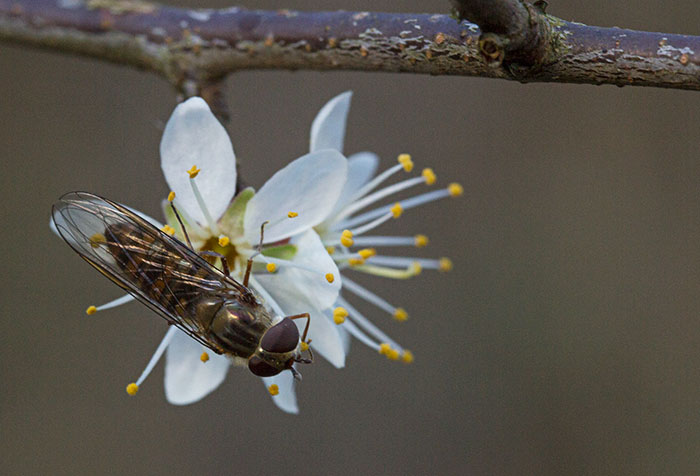
Walking through the field from the car park I couldn’t help but notice that the hedge seemed greener than normal at this time of year. There were still plenty of bare branches showing off a colourful array of lichens but that wasn’t all, there were leaf buds bursting all along the hedgerow. Living in a rural village I had noticed on the way into town back in January that the Hawthorns along the edge of the football ground were a vibrant green with new growth, and I thought to myself then how unusually early it was. But somehow that was less surprising than what I was seeing here, they were always the first to come into leaf and with the mild winter there was little doubt that others would soon follow. Here though it was Blackthorn that was green, a strange sight indeed for February as it usually doesn’t come into leaf until after it has flowered in late March and early April. Further along the hedge the Blackthorn was blooming too and I came across a Marmalade Hoverfly feeding on the blossom. I couldn’t help but wonder what else I might find in the woodland.
 

Unseasonable warmth


Sure enough near the entrance to the wood was an Elder bush in leaf and with flower buds forming. I have found Elder with leaf buds bursting at this time of year before but never seen flower buds so early; they usually bloom from late May onward.


Elderflower


Continuing further into the wood I could see that the bluebells, which I was expecting to be 2-3 inches high at most, were fully carpeting the wood and as I walked round I was astonished to find some already in bloom! Not in any great number, just a few here and there. I suppose that these few are a great minority in what must be a million or more bluebells but it still made me exclaim out loud to myself… if anybody had seen me they must have thought me quite mad!


Bluebell


I stopped and sat on the bench in the clearing by the pond, bathed in gentle spring sunshine, my mind whirring at the extraordinary weather we have had and the even more extraordinary consequences. The weather has always been a matter for great discussion in Britain it seems, but this winter is unlike any I’ve known before. We have barely had a frost and despite the occasional threat of snow mentioned by the forecasters I haven’t seen a single flake. I didn’t doubt that climate change existed before but it seems more apparent than ever this year. It isn’t just the plants either: Dunnocks have been singing their socks off in my garden for the last fortnight and sitting here in the quiet woodland just about all I can hear, bar the odd light aircraft going over, is birdsong and Great Spotted Woodpeckers drumming.

In one sense I can’t wait, spring is always a joy for me. I love winters that are really cold and crisp with heavy frosts and snow, but apart from that I often find them to be dark and gloomy. Spring is when the world around us comes to life again, the days lengthen and all sorts of wonders emerge.

In the back of my mind I can’t help but wonder what the world will be like if this is the shape of future winters. We may enjoy some aspects of the unseasonable warmth, we are undoubtedly grateful at not having to put the heating on so often, but there is far more to it than that. The storms that have battered our coasts and flooded out local communities time and again this winter are not something that we wish to face annually and yet they are inextricably linked to the weather pattern as a whole. It has been a more familiar sight than we would wish to admit over recent winters with tidal surges in Norfolk and persistent flooding in Somerset in past years adding to the list.

These events have a big impact on local wildlife too, but this is one of the last things considered when human lives and those of pets and livestock are at risk. I should point out here that I believe numerous organisations work exceedingly hard to do the best thing possible in such situations and that I have a great deal of respect for all of them. The problem is that the long term effect of these more extreme weather patterns is not fully understood. They may well pose a significant risk to some species and in the meantime, the ecosystem of an area could be affected and the balance skewed so that others may proliferate where they are less welcome. A worrying thought when our wildlife is already under threat from urbanisation, changes in agricultural practices, and persecution to name but a few. Let’s hope that it doesn’t become an annual occurrence.

Perhaps this problem would be less noticeable if there weren’t bluebells flowering in February but for me this mild winter has just further highlighted that climate change can’t be ignored. Having said that, I am an optimist at heart, so looking forward I will be hoping for a cold winter next year and enjoying this early spring while the sun shines.

On a lighter note I also feel I should point out that nature has me feeling like a fraud at the moment. The piece I wrote about Lady’s Wood for the book bears no resemblance to this year at all so far! I guess it goes to show that no matter what you think you know through years of observation, wildlife is truly wild and utterly unpredictable at times!

SaveSave

Ivy Bee bliss, an encounter that left me buzzing

This week while the weather outside is less favourable I want to think about a particular plant, Common Ivy (Hedera helix), and why it is so important for wildlife. You might be wondering what the link is between the two factors but at this time of year there are few plants which are still flowering and Ivy is one of them. This is a slightly spontaneous post after a somewhat momentous wildlife encounter I had last week. You might have read about it on Twitter if you follow me (@AHunterPhotos). I found an Ivy Bee (Colletes hederae) and I was rather pleased to have done so.


ivy bee (colleges hederae)


I had not seen one of these beautiful insects before last Thursday. They are relatively recently discovered, only being described as a species in 1993, and making their first appearance in Britain in 2001, when they were discovered in Dorset. Since then their spread across the United Kingdom has been steady. The Ivy Bee is one of a number of ground nesting solitary bees in Britain but unlike others they are very late flying, typically emerging at the beginning of September when most other species are dwindling. That said, my sighting last week was particularly late, perhaps due to the mild weather we have been experiencing.

In terms of identification they are difficult to confuse for other species because of this late flying period but they do have a few diagnostic features too. For example, the banding on the abdomen is quite bright and almost wasp-like though a little more orange in colour, and they have a rather wonderful furry thorax which is a lovely ginger colour. As the name suggests, they feed exclusively on Ivy. Males and females can be distinguished by size with the males being much smaller than the females. Like many other ground nesting solitary bees, they dig burrows in loosely packed, usually sandy, soil with each pair having their own hole up to a foot or more deep. In this, they tend up to 18 brood chambers which are each lined and provisioned with pollen for the growing young. Their life span as an adult is only about 3-6 weeks but they will spend around 10 months as a larva in the brood chamber.


Ivy-bee


Unlike most other bees there are no specific parasites which target Ivy bees. This is unusual but can be said to prove that they are a recently evolved species, as more established species tend to have associated predators and parasites that have evolved with them. There are a few generalists such as spiders and birds which may take a few individuals, but there are few other threats to the Ivy bee and this may well play a part in the speed of their spread. The Ivy bee doesn’t tend to fly in temperatures below about 14 degrees centigrade and so global warming may be a contributing factor to their rapid distribution too. The speed with which they have colonised the UK to date has been astonishingly fast with latest records showing they have reached North Wales. The nice thing about the Ivy bee though, is that while an invasion like this in other species might be a little concerning, there is no evidence that they are anything but good – they don’t harm anything or fill any niche that might out compete other native species – they are a welcome addition to our British wildlife.

The Bees Wasps and Ants Recording Society are mapping their progress across the country and there are very few records on the map, so being able to contribute to the data they are collecting is quite exciting, particularly as I don’t tend to do much in the way of biological recording and really think I ought to do more – what better way to kick start my recording!?

This encounter got me thinking too though. The weather has been unseasonably warm so far this month and along with the glorious little Ivy Bee were a whole host of other invertebrates making the most of the late nectar source. Two species of butterfly (Red Admiral and Comma) were drinking in the sun as well as the nectar, while at least 3 species of hoverfly joined wasps and honey bees and even a lone bumblebee on the little green blooms. I found myself wondering how much scent plays a part in advertising the blossom to potential pollinators, as it was really quite strong and I knew it was flowering long before I reached the plant. One of the reasons it is so important as a source of nectar is that Ivy has a long flowering season of 2-3 months from September into November, with each umbel of flowers lasting longer by flowering from the outside inwards and providing a constant source of nectar.


Hoverfly


Wasp


It isn’t just the flowers that are vital for wildlife though, later on the berries become another food source for many hedgerow birds such as woodpigeon and thrushes including some of our winter visitors like Redwing and Fieldfare. The berries are less conspicuous than many being bluish-black in colour. Nevertheless they are highly nutritious, with the pith being particularly calorific, and by eating the berries the birds do the plant a favour too as the seeds will pass through unharmed and be spread elsewhere with a generous helping of fertiliser to boot. Indeed, as many as 70 species of insect have been recorded nectaring on the flowers and up to 16 species of bird use the berries as a food source, while deer are known to browse on the leaves in winter. The ivy plant becomes a vital source of shelter in winter too, both for a huge variety of insects including favourites like ladybirds and for birds, particularly if it is a thick covering as the overlapping leaves provide a barrier against the weather and help to trap warmer air pockets.

Many people believe that Ivy will strangle and kill a tree once it gets a grip. There is much debate over this, though the general consensus is that this is not the case. There is naturally competition between the tree and the ivy for nutrients, water and light, the latter of which may well be the reason that the ivy climbs the tree in the first place. In smaller trees the ivy can become so prolific as to topple them over, but there is little evidence to say that the Ivy will kill a healthy tree otherwise. And so to the gardeners out there, if you want to improve your garden for wildlife, Ivy must be a serious consideration. It is an attractive climbing plant which will cope with little intervention but it is also invaluable to a great number of species, the Ivy Bee included.


SaveSave

SaveSave