Tag Archive for: Macro

Unseasonable warmth

I often find that when I’m at my desk I get distracted by emails, other work or tasks around the house (I work from home). Getting out to somewhere where there are fewer distractions, with a note pad & pen in my pocket, is a useful way for me to focus my mind on writing or other large projects which need planning. I’ve even thought about keeping some CBD on me (in line with CBD oil law, of course), which could really help me to get to that place of calm and focus I need to work, whether that’s in the office or out and about. I also rarely go anywhere without my camera so that if I notice anything unusual I can take a snap. Yesterday is a perfect example: I had an idea in mind for this week’s blog, but having got caught up with other things I hadn’t set it out fully, so I decided to make the most of the unseasonable warmth and sunshine, and visit one of my favourite “thinking places”; my local woodland. It is the very same woodland that I wrote about for the Spring book that I told you of last week, Lady’s Wood. In short, my original blog idea is now on hold for another time. Let me explain:

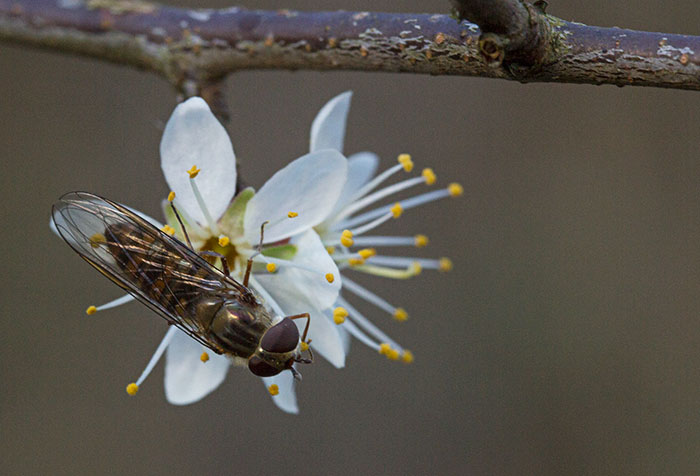
Walking through the field from the car park I couldn’t help but notice that the hedge seemed greener than normal at this time of year. There were still plenty of bare branches showing off a colourful array of lichens but that wasn’t all, there were leaf buds bursting all along the hedgerow. Living in a rural village I had noticed on the way into town back in January that the Hawthorns along the edge of the football ground were a vibrant green with new growth, and I thought to myself then how unusually early it was. But somehow that was less surprising than what I was seeing here, they were always the first to come into leaf and with the mild winter there was little doubt that others would soon follow. Here though it was Blackthorn that was green, a strange sight indeed for February as it usually doesn’t come into leaf until after it has flowered in late March and early April. Further along the hedge the Blackthorn was blooming too and I came across a Marmalade Hoverfly feeding on the blossom. I couldn’t help but wonder what else I might find in the woodland.
 

Unseasonable warmth


Sure enough near the entrance to the wood was an Elder bush in leaf and with flower buds forming. I have found Elder with leaf buds bursting at this time of year before but never seen flower buds so early; they usually bloom from late May onward.


Elderflower


Continuing further into the wood I could see that the bluebells, which I was expecting to be 2-3 inches high at most, were fully carpeting the wood and as I walked round I was astonished to find some already in bloom! Not in any great number, just a few here and there. I suppose that these few are a great minority in what must be a million or more bluebells but it still made me exclaim out loud to myself… if anybody had seen me they must have thought me quite mad!


Bluebell


I stopped and sat on the bench in the clearing by the pond, bathed in gentle spring sunshine, my mind whirring at the extraordinary weather we have had and the even more extraordinary consequences. The weather has always been a matter for great discussion in Britain it seems, but this winter is unlike any I’ve known before. We have barely had a frost and despite the occasional threat of snow mentioned by the forecasters I haven’t seen a single flake. I didn’t doubt that climate change existed before but it seems more apparent than ever this year. It isn’t just the plants either: Dunnocks have been singing their socks off in my garden for the last fortnight and sitting here in the quiet woodland just about all I can hear, bar the odd light aircraft going over, is birdsong and Great Spotted Woodpeckers drumming.

In one sense I can’t wait, spring is always a joy for me. I love winters that are really cold and crisp with heavy frosts and snow, but apart from that I often find them to be dark and gloomy. Spring is when the world around us comes to life again, the days lengthen and all sorts of wonders emerge.

In the back of my mind I can’t help but wonder what the world will be like if this is the shape of future winters. We may enjoy some aspects of the unseasonable warmth, we are undoubtedly grateful at not having to put the heating on so often, but there is far more to it than that. The storms that have battered our coasts and flooded out local communities time and again this winter are not something that we wish to face annually and yet they are inextricably linked to the weather pattern as a whole. It has been a more familiar sight than we would wish to admit over recent winters with tidal surges in Norfolk and persistent flooding in Somerset in past years adding to the list.

These events have a big impact on local wildlife too, but this is one of the last things considered when human lives and those of pets and livestock are at risk. I should point out here that I believe numerous organisations work exceedingly hard to do the best thing possible in such situations and that I have a great deal of respect for all of them. The problem is that the long term effect of these more extreme weather patterns is not fully understood. They may well pose a significant risk to some species and in the meantime, the ecosystem of an area could be affected and the balance skewed so that others may proliferate where they are less welcome. A worrying thought when our wildlife is already under threat from urbanisation, changes in agricultural practices, and persecution to name but a few. Let’s hope that it doesn’t become an annual occurrence.

Perhaps this problem would be less noticeable if there weren’t bluebells flowering in February but for me this mild winter has just further highlighted that climate change can’t be ignored. Having said that, I am an optimist at heart, so looking forward I will be hoping for a cold winter next year and enjoying this early spring while the sun shines.

On a lighter note I also feel I should point out that nature has me feeling like a fraud at the moment. The piece I wrote about Lady’s Wood for the book bears no resemblance to this year at all so far! I guess it goes to show that no matter what you think you know through years of observation, wildlife is truly wild and utterly unpredictable at times!

SaveSave

Cyprus in Spring – Part 1

I had hoped to have taken a few more photos over the past few weeks but the weather has not been kind and while I’ve captured a few nice shots it wasn’t enough for me to put together a coherent blog piece…perhaps next week! Instead I’m going to treat you to a few images that I took in Cyprus a couple of years ago and bring a little sunshine to the cold damp shores of Britain for a few minutes while you read this. I think it will be too much to include the whole trip so for now I’ll start with the first half. I hadn’t visited the island before but had heard that the Cyprus in spring was a rather lovely season and so when I got the chance to visit on an organised tour I was really intrigued and I couldn’t say no!

We flew into Paphos and having left the airport we stopped on the coast for lunch and our first encounter with the local wildflowers. There were all manner of beautiful blooms from vetches and scabious to the Three Horned Stock and the strange papery petals of Algerian Tea (Paronychia argentea), not to mention dazzling swathes of miniature mauve Irises. Sea lavender fought for space alongside the invasive but pretty Bermuda Buttercups and golden Crown Daisies shone in the sunshine. Here we came across our first endemic plant of the trip, a dwarf Knapweed (Centaurea aegiophila) which had a pinky white flower on a short stem in the centre of a leaf rosette. Among the flowers were Painted Lady and Clouded Yellow butterflies while lizards scampered at great speed beneath. We were joined briefly by a female Blue Rock Thrush and several Crested Larks too.


Crown Daisy (Chrysanthemum coronarium)

Crown Daisy (Chrysanthemum coronarium)


Sea Lavender (Limonium sinuatum)

Sea Lavender (Limonium sinuatum)


Our first afternoon was a wonderful taster for the rest of the trip and the following morning we set out for a day on the Akrotiri peninsula before driving north to our base for the next few days. The scenery as we drove out of Paphos was lovely, Orange and Lemon plantations, Olive groves and some lovely countryside. We stopped beside the road to stretch our legs and here we found our first Orchid of the trip and a pretty impressive one at that, the Eastern Marsh Helleborine (Epipactis veratrifolia) which is more common in Northern Africa and into Asia than around the Mediterranean.


Eastern Marsh Helleborine (Epipactis veratrifolia)

Eastern Marsh Helleborine (Epipactis veratrifolia)


Nearby were some lovely Turban Buttercups, several species of Bindweed, Allium and Stork’s Bill to name a few. There was also another endemic plant, a Tongue Orchid (Serapias aphrodite), which was not a type of orchid that I had encountered before. I would soon discover that the three species on the island are rather tricky to tell apart at first glance! Lastly for this pit-stop we had a wonderful view of an endemic butterfly, the Paphos Blue.  They are quite small but the male is a really vivid blue while the female is much darker. Their larval food plant is a yellow flowered Spiny Broom (Genista sphacelata) and I was lucky enough to find a gorgeous female laying her eggs among the twigs of a bush beside the road.


Turban Buttercup (Ranunculus asiaticus)

Turban Buttercup (Ranunculus asiaticus)


Paphos-blue

Female Paphos Blue

Paphos-blue-egg-laying


Our next stop was the archaeological remains at Kourion. There were some wonderful mosaics and a wonderfully reconstructed amphitheatre looking out over the sea. Whilst enjoying the fascinating medley of Hellenistic Greek, Roman and Early Christian elements, I couldn’t help but notice Fire Bugs all over the place and there were scuttling noises round every corner as lizards darted out of sight. There were Alpine Swifts wheeling overhead alongside Swallows and House Martins while a Cetti’s Warbler trilled across a small valley.

Moving on we decided to make one last stop further down the peninsula where we hoped to see Flamingoes on the lagoon. In fact while we did achieve this goal, they were rather distant and we found some more delights closer at hand to enjoy over lunch. The most spectacular in my opinion had to be the Cyprus Bee Orchid (Ophrys kotschyii) which was absolutely stunning. Admittedly I didn’t get the best images of them but I couldn’t leave them out as the flowers really are wondrous.


Cyprus Bee Orchid (Ophrys kotschyii)

Cyprus Bee Orchid (Ophrys kotschyii)


We also came across a Rugged Oil Beetle which I was particularly intrigued by – I know that we get several species of Oil Beetle in Britain but had never been fortunate enough to find one. Normally, as you know, I like to photograph my subjects in natural settings as I find them, but on this occasion the long grass was prohibitive to this and as a friend had picked it up for closer inspection I took the opportunity to snap a shot of the beetle in his hand – she was a rather impressive beast!!


Rugged Oil Beetle (Meloe rugosus)

Rugged Oil Beetle (Meloe rugosus)


Elsewhere in our lunch area we found Italian Gladioli, 3 species of Cistus, Tassel Hyacinths and several other orchids including Pyramidal, Woodcock, Fragrant Bug Orchid and Yellow Bee Orchid plus a couple of confusing subspecies (I’d love to share photos of them all but we’d be here till next Christmas! That said, I might sneak a few in later…). There were some more interesting insects too including an enormous Egyptian Grasshopper and some dragonflies including Small Skimmer.

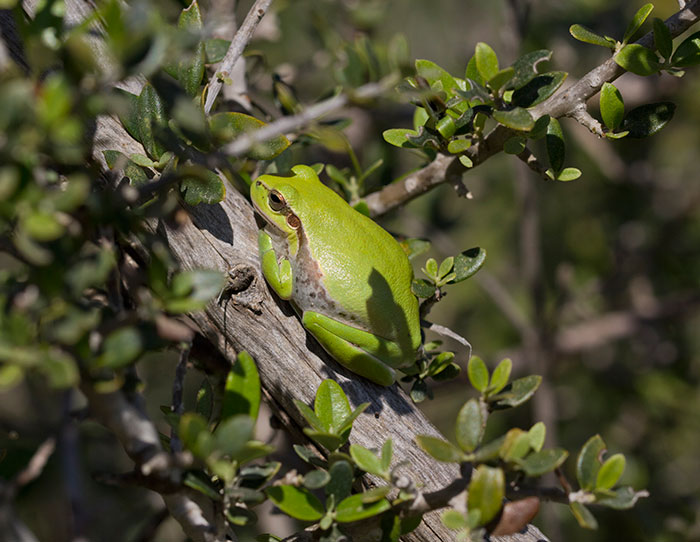
Finally it was time to leave the peninsula and head for our base for the next few days, a lovely spot in the North West of the Greek half of the island, Neo Chorio. We enjoyed the drive through the hills to get there, as ever the scenery was lovely although we did notice that there was a lot of Acacia cyanophylla, an invasive shrub with attractive yellow pom-pom style flowers. Arriving at our beach-side hotel we were greeted with a chorus of Tree Frogs and the distant call of a Scops Owl… bliss if you ask me!

As on many similar holidays I like to start the day early and get out before breakfast. The following morning was no exception and I joined a couple of others for a wander up the road. We had hoped to see a few birds and while they weren’t entirely absent they were very familiar – Goldfinches, Greenfinches and the seemingly ever present Cetti’s Warbler. I did come across a Violet Carpenter bee and we found two new orchids as well as a Red Horned Poppy which was nice.

The day began properly after a hearty breakfast and we set out walking. We had soon found yet more orchids including a beautiful specimen of Ophrys mammosa. I was thrilled to find a mantis nymph and again enlisted a willing friend to pose with it after I rescued it from nearly being trodden on. I was also interested to find Aristolochia sempervirens  with pitcher-like flowers growing nearby, I hadn’t seen it before but had spotted several Eastern Festoon butterflies and wondered whether it would be somewhere close as it is their larval food plant.


Ophrys mammosa

Ophrys mammosa

Mantis nymph (Empusa fasciata)

Mantis nymph (Empusa fasciata)

Aristolochia sempervirens

Aristolochia sempervirens


A little further on we found clumps of Cyclamen under the trees and a Small-Dotted Orchid (Orchis punctulata) which was just beginning to go over. In a grassy patch the other side of the path we also came across Naked Man Orchids (Orchis italica) and some enormous Agama lizards sunning themselves on the wall of a small chapel. The largest disappeared very quickly but one slightly smaller individual hung around long enough for me to take a photo, as did a very obliging Middle Eastern Tree Frog that I found in a nearby bush.


Agama lizard

Agama lizard

Middle Eastern Tree Frog (Hyla savignii)

Middle Eastern Tree Frog (Hyla savignii)


Over the next mile or so, we found around half a dozen more orchid species as well as some other lovely flowers such as an endemic Thyme with particularly long flowers and a different species of Gladiolus. There were Serins singing their jangly little song from the tree-tops around us most of the way too.

After lunch, we returned to the vehicles to take a dusty track up to the top of the Akamas peninsula where we found the endemic Troodos orchid and Tulipa cypria, the latter of which is a wonderful dark red. There were Red-Rumped Swallows flying round our heads while we were trying to avoid stepping on some of the smaller wildflowers underfoot. Needless to say we retired to our hotel a happy bunch that evening.


Tulipa cypria

Tulipa cypria


The next day began with a short dive to see some more wild Tulips, this time in a small field surrounded by peach and almond orchards. These were quite different to the previous afternoon’s blooms, bright red with a vibrant black and yellow centre which their Latin name describes as the eye of the sun (Tulipa oculis-solis). There were a few Tulips among the “weeds” beneath the trees but only in small patches, and while it was wonderful to find these striking flowers in the wild, I couldn’t help but feel they may not be there much longer if modern agriculture continues to encroach on their space. Nevertheless, it made for a very pretty scene with the orchards in blossom too.


Tulips among the peach trees

Tulips among the peach trees


Alongside the Tulips, we found a host of other floral wonders including Grape Hyacinth, Star of Bethlehem and Bellevalia nivalis, which is similar to a Grape Hyacinth but with deep purple flowers at the top of the stem fading to greenish white at the bottom. There was also a Long-Tailed Buzzard perched up in a tree a little way off which was lovely to see.

Moving on, we made our way to a spectacular geological feature on the south coast of the Akamas peninsula, the Avakas gorge. We parked up at the end and planned a walk up the gorge to see what we could find. The walk started well with a lovely Cyprus Pied Wheatear gracing us with its presence as we set off and we soon saw a very rare endemic Knapweed which is only recorded at this site. It wasn’t in flower but it was interesting to see nonetheless. The path we took wound between Juniper and Broom bushes which suddenly opened out into grassy clearings full of flowers where Wall butterflies joined Paphos Blues flitting from one bloom to the next and the air hummed with insect life. As the gorge narrowed we came across some rather delightful little arums known as Friar’s Cowl (Arisarum vulgare) which had a green and white striped flower sheath.

It wasn’t long before the path gave way to a small stream and we could almost reach from one wall to the other with our arms outstretched. It was quite fascinating, particularly as there was a rather large boulder hanging like a giant keystone above our heads. I can’t say that I’ve done a terribly good job on exposing my photographs; the light outside was exceedingly bright but in the bottom of the gorge it was wonderfully cool and rather dark, regardless it was a fabulous place.


Avakas Gorge

Avakas Gorge


Retracing our footsteps back towards the car park we enjoyed the sunshine and soon found more interesting things to look at while we ate our lunch. This time a Blue Tailed Damselfly among more orchids and a pink form of the Turban Buttercups we had seen elsewhere (mainly cream but a few yellow).  From here we headed back to the coast and back across the peninsula the long way round to take in the scenery. We made a couple of short stops to see Black Francolin and Chukkar; the first rather distant but calling beautifully and the second a good but brief  view of a pair beside the vehicle pretending to be bowling pins as many members of the Partridge family seem to when startled. We also found wild Coriander growing beside the road which smelt delicious.

We did make one slightly longer stop at what was supposedly an Old Hermitage. The rocks were weathered into a web of holes which made an intriguing natural rock garden with an abundance of different plants in each pocket. The highlight for me though was a wonderful close encounter with a small flock of Cretzschmar’s Buntings which rounded off the day nicely.


Cretzschmar's Bunting

Male Cretzschmar’s Bunting


After an evening’s star-gazing under fantastically clear skies we packed our bags ready to move on to the next place. I’ll tell you about the rest of the trip in my next post though… watch this space!


SaveSave