Canberra: A visit to Australia’s Capital Territory
In my last post I promised an update on some of my travels from last autumn beginning with a trip down under, so here goes: In November my husband and I set off to Australia, it was our first visit to this beautiful country and particularly special as we were going to see his sister and her family who are living out there. We flew via Singapore with only an hour or two stopover to change planes and arrived late Sunday evening into Sydney. First thing Monday morning, feeling a little less like zombies, we set out to explore a little more and pick up our hire car. We were soon heading out of the city and south towards the capital, Canberra.
On our way, we made an impromptu stop at a vineyard just off our route and found it to be a lovely spot with lots of birds to wet our appetites. There were Galahs and Sulphur Crested Cockatoos around the livestock troughs in the fields and a pair of Crested Pigeon beside the drive. The very fist photo I took in Australia though was of a sweet little bird, the Grey Fantail. There were two or three flitting up from their various perches to catch insects in flight. This particular individual was just in front of our car as we parked outside the Cellar Door.

Male and female birds are quite similar to one another and the species can be distinguished by it’s conspicuous tail fanning. In the image above you can see that the shape of the tail, even when not fully spread, is somewhat wider at the end than at the base. They also have rather charming white ‘eyebrows’ and generally behave rather like our flycatchers.
Having purchased a bottle of Riesling for later, satisfied our curiosity looking at the various birds and stretched our legs, we continued our journey. We arrived at our destination early in the afternoon and had a wonderful catch up with the family in the afternoon, pausing only to watch more Crested Pigeons and Cockatoos as they came and went from the telegraph wires in the garden.
The following morning, we had some time to ourselves while our niece went to a swimming lesson and we took the opportunity to get out and see a bit more wildlife. Only a few minutes drive down the road was a reserve called Jerrabomberra Wetlands. It had good reviews and was supposed to be an excellent place to see a good variety of species. It did not disappoint!
We parked up and almost as soon as we were out of the car we were spotting all sorts of new and exciting things. Of course at this stage almost everything was new and exciting to us, having never visited Australia before, but I do think it’s nice to have that appreciation for what others sometimes take for granted.
One of the first birds that we saw was Red Browed Finch, a small flock of which were foraging in the lower branches of a tree. A rustle in the undergrowth nearby revealed a lurking Australasian Swamp Hen which made a swift exit having realised it had been spotted! Red Wattle Birds flew from tree to tree and out of the corner of my eye, a pale bird caught my attention against the blue sky as it soared effortlessly overhead pausing briefly to hover for a moment before returning to it’s circling; a Black Shouldered Kite.

These beautiful birds are far from what we would imagine a Kite to look like at home. A little larger than our Kestrel, they are more hawkish and as I mentioned they hover to search for prey just like our Kestrel. Their plumage is particularly striking, mostly white with black accents on the shoulders as the name suggests and also in a tapered patch over the eye which makes them appear rather grumpy at first glance. We enjoyed a good few minutes watching this individual and caught sight of it several more times over the course of our visit to the reserve.
Walking on, we found some intriguing flora to look at including a striking Blue Storksbill (Erodium crinitum) which had particularly long seed pods and nestled in the reeds beside a lake, a pair of Grey Teal. These small ducks had very delicate patterning to their feathers which were mostly brown but with paler edges which gave them a beautiful scaly effect as you could pick out each feather even from a distance. There was also an unusual two tone bird call which we had heard as part of the dawn chorus that morning. We wondered for a while what it could possibly be before tracking down the creator of this rather lovely but quite extraordinary sound; an Australian Magpie. Far from the slightly tuneless caws of our own corvids, this bird creates a bizarre song which it seems to be able to sing two parts of at once giving the impression that it could almost be two birds singing together.
Taking a turn onto a route marked as the Billabong Trail the path climbed to the top of a long levee-like bank from which we got a wonderful view of a White Faced Heron as it flew past at almost head height.

These Herons are fairly common in wetland areas, sized somewhere between our Grey Heron and Little Egret, with distinctive plumage and wonderful yellow feet. From our raised view point we also caught sight of a Whistling Kite which is somewhat reminiscent of a Buzzard but with more distinct markings, and a juvenile Kookaburra which sat in the depths of a weeping willow. The willow was overhanging a fair sized pool where Dusky Moorhens busied themselves foraging and we got rather excited at a possible Platypus sighting which then turned out to be a more disappointing European Carp!
Continuing our route we passed a pair of Spotted Doves which were a little similar to our Turtle Dove with a lovely patch of black and white mottling on the back of their neck. As we turned to complete the loop back to the main path, my husband spotted movement on the far bank of the pool and we watched a dog fox, an introduced predator, meandering among the shrubs in the sunshine. We also got good views of Masked Lapwing and Australasian White Ibis as they flew past as well as a male Golden Headed Cisticola which was singing extremely loudly from the top of a dead tree.
Rejoining the main path we came to a boardwalk section and paused momentarily to watch a pair of Superb Fairy Wrens in the reeds. They were so colourful and very much Wren-like in their behaviour but reminded us more of a Long Tailed Tit in their proportions. The boardwalk allowed us to wander through the reedbeds and rely on our hearing rather than sight. We heard one bird very clearly which we later discovered to be a Little Grassbird. We never did manage to see one but were reliably informed that they are notoriously tricky to spot and that when you do see them they are similar to Reed Warblers and perfectly adapted to wetland habitats as a result.
Reaching the end of the boardwalk we came to an area of open grass alongside a creek. Here we found a small flock of Australian Wood Duck grazing. We took the bridge over the creek and stopped in the middle to look at the water. An Eastern Long-Necked Turtle caught our eye as it warmed itself on a piece of half submerged wood. It was a bizarre looking creature; as the name suggests, its neck was very long – easily over half it’s body length again – making it look rather disproportionate. We also spotted a juvenile Australasian Darter drying its wings after a dive to catch fish.

This too had rather a long neck. In flight they looked like a Heron crossed with a Cormorant and indeed they are very similar to both in many senses.
Moving on the path wood uphill and we were surprised to find European Goldfinches in the trees around us, another introduction to the area. They were joined at the water’s edge by a Clamorous Reed Warbler and several Australian Pelicans were roosting on a small island in the middle with their enormous bills tucked beneath their wings. Here the main path was part of a cycle route and so we opted to take a side path which looped around and gave us more opportunities to stop and look at things without fear of causing a collision!
There were a few more flowers around here including Australian Bindweed which added a lovely splash of pink to the scene. I also spotted a small blue butterfly but I didn’t get a good enough look at it to hazard an ID unfortunately. Around the next corner we came across another rather charming bird though and with a rather charming and very Australian name to match; a Willie Wagtail.

If I were to compare it to a British species, I wouldn’t describe it as a Wagtail but perhaps a Flycatcher or Redstart in terms of behaviour. In fact they are a type of Fantail like the first one in this post. They fly from a favoured perch to catch insects and are almost constantly wagging their tail in a side to side motion when sedentary. We were quite taken with this individual which appeared quite trusting of us as we were only a few feet away and we stood watching it for a little while.
Continuing on our path we hesitated at some rustling in a bush beside the path and were rewarded with views of a Silvereye, a small yellowy-green and grey warbler with a distinctive white eye ring which lends them their name. A few steps further and another bird caught our attention, a male Leaden Flycatcher calling from a branch overhead. This smart little bird is, as the name suggests, a dark but slightly bluish grey on its upper parts and head with a distinct line separating this from a white breast and belly.
Moving on once more we were again stopped in our tracks, this time by a slightly larger bird than some of the birds we had been watching. Another passerine, the Magpie Lark, which is actually in the Monarch family and therefore more closely related to Flycatchers, was foraging in the rough grass ahead of us. This beautiful male bird, similar in size to our Blackbird, didn’t seem too worried by us at all, and indeed we would see more of these lovely birds throughout the course of our stay, with a pair regularly visiting the garden.

Here, we were right on the edge of the reserve and as we walked along a side street pavement to rejoin the path around the reserve we found another obliging bird, a Crested Pigeon. These are similar in size to our Collared Doves at home and reasonably similar in their peckish grey base colour too, but they have more striking markings. They have stripes on their wings ending in beautiful green and purple iridescent white tipped feathers on the outer coverts, a bright peachy orange eye ring and a diagnositic spiky crest on their head which gives the comical impression of a punk lifestyle!
Returning to the confines of the reserve we continued our round route and were rewarded with lovely views over more of the wetland and in particular the roosting Pelicans in the middle of the lake nearest us. We had a flypast from a Black Swan and a close encounter with a Pied Currawong, a bird which isn’t obviously pied until it opens its wings to reveal white patches and which looks as though it ought to be a member of the corvid family but is in fact a large, predatory passerine. We also had a lovely moment with a Red Wattle Bird on a branch above us. I had seen one in the hedge outside the living room window the day before and got a little over-excited but it hadn’t stayed for long. This individual was far less flighty and much more vocal.

As we rounded the next corner, I spotted a chap wielding a sweep net and we couldn’t help but wonder what he was searching for or indeed finding. On asking, he told us he was searching for Peacock Spiders. These tiny arachnids were something that I had only dreamt of seeing whilst in Australia and it transpired that this was Stuart Harris, a citizen scientist who has discovered no fewer than 6 new species of these living jewels to date! He was most charming and helpful in showing us what he had found and pointing out others along the way as he collected specimens.
By now, we had completed most of our circuit and paused only briefly at a viewing screen overlooking a scrape to see whether there was anything else there before we left. Our detour was worth it as there, just in front of the screen was a Latham’s Snipe which migrates to Japan to breed and back to Australia to over-winter.
We returned to the car with high spirits after a lovely walk and having explored a fascinating wetland reserve on the edge of the country’s capital that we were barely aware of while there. We were both enthralled by the sheer volume of species we had seen in our short visit. I’m sure there were plenty that we overlooked but for our first foray into the wildlife of this astonishing country we felt we had done well.
Having enjoyed lunch with our niece and brother-in-law, we were wondering what we might do for the afternoon when she suggested that we all walk up Mount Ainslie – a bold decision for a 4 year old! We agreed that it was a lovely idea and having packed a bag with drinks to keep us going and donned walking boots we set off. Thankfully, it is only a short walk through suburban streets to reach the beginning of the trail and in the warm sunshine, there was plenty to see as we went.
At the bottom of the trail we spotted a Tau Emerald dragonfly hanging in the dense foliage of a garden hedge and just through the gateway, a clump of Wahlenbergia, sometimes referred to as Australian Bluebells. They are members of the Campanula family and definitely more reminiscent of the Scottish harebell in terms of structure, colour and shape, although the bell flowers themselves were more open. I later discovered that there were a great many more species than I had initially thought and if I wanted to identify them I would need to take note of a lot more detail and a use a hand lens. This was not to happen but I was content enough to have seen these pretty flowers in bloom.
We were soon walking past Eastern Grey Kangaroos lounging among the gum trees at the base of the hill and listening to the cacophony created by Noisy Miners in the trees around us. We spotted a large lizard lurking amongst the undergrowth but it scuttled away on seeing us and we didn’t manage to identify it. There were some more lovely flowers starting to appear though and a particularly striking example was the Golden Everlasting.

The flowers themselves demonstrated perfectly the plant’s adaptations to a dry environment as they were papery and dry with quite a shine to reflect the sun’s fierce heat. They don’t wilt and wither as other plants might, hence the name everlasting. Interestingly the petals were often covered in ants, you can just see a couple in the image above and yet this had fewer than many others, I suspect they had a sweet nectar offering for potential pollinators.
As we continued to climb we came across a flock of foraging White Winged Choughs and more lovely flowers. There was a pretty purple Gunyang, a member of the solanaceae; Black Anthered Flax Lily, slightly reminiscent of an ornithogalum but with vivid blue flowers; a variety of pea flowers, mostly in yellows and oranges; and most excitingly for me, an orchid. This little yellow flower caught my eye and I knew in an instant what I was looking at, I just didn’t know the name! I later managed to identify it as a Tiger Orchid and indeed I found several more beside the path too. I must admit I don’t think I’ve captured the best image of it, but with family waiting for me it was all I could manage in the time and I thought I’d share it anyway.

We soon reached the summit where we joined the other tourists who had taken the easy route and driven up to the top. The view, whichever way you arrived, was definitely worth the effort. It was a nice way to get a better feel for Canberra as you could see the whole city laid out below you. Noticeable to me was how green it is, and barely a skyscraper in sight. For a capital city, it certainly has more of a small town feel but that seems to be part of the charm. I took quite a few photos but in fact one of my favourites was a panorama that I took on my iPhone.

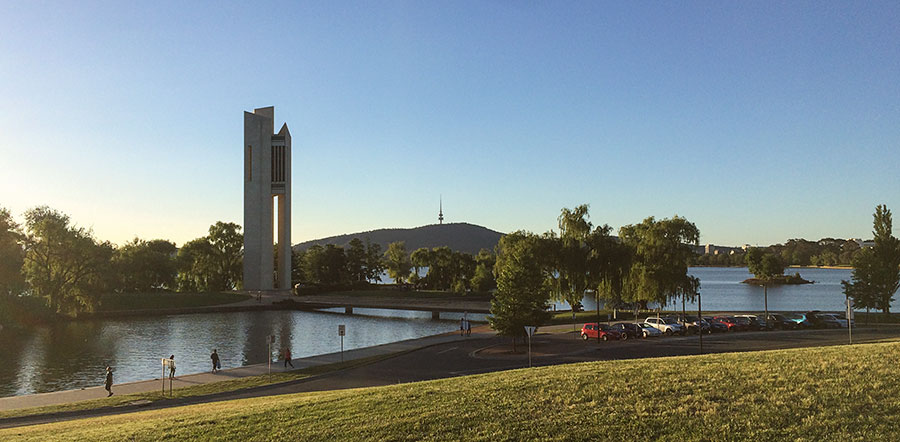
Having taken in the view and topped up our water bottles we headed back the way we had come, pausing only briefly to watch some Crimson Rosella parakeets in the trees around us and listen to a Kookaburra laughing in the distance. The day was rounded off with a lovely barbecue in the park by Lake Burley Griffin and as the sun went down we had lovely soft light over the National Carillon on Aspen Island. This is another iPhone shot, taken from by the Police memorial monument and you can see the Telstra tower on the hill in the distance.
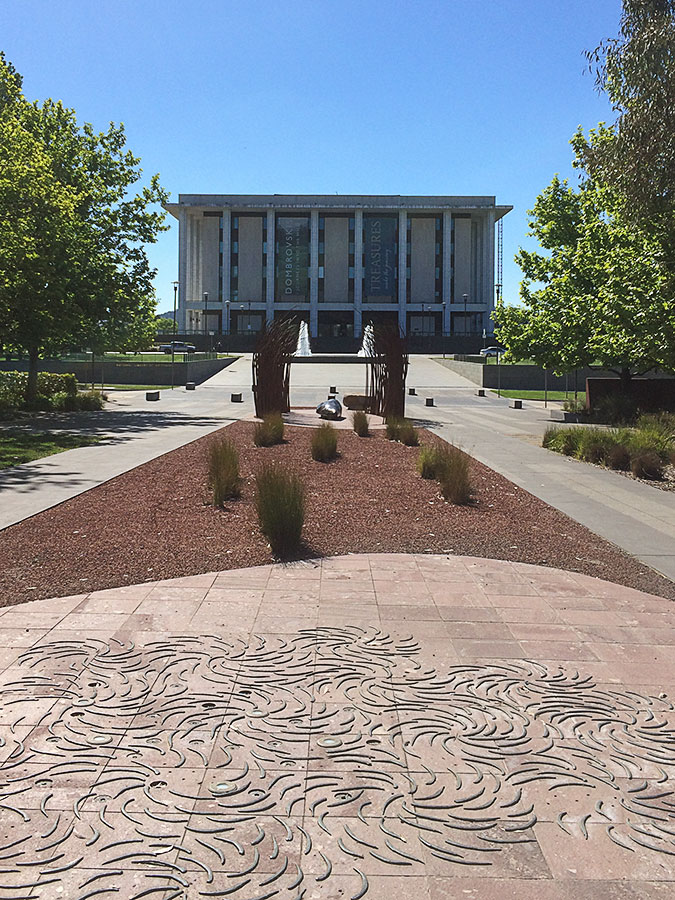
I will end with one last iPhone shot from the following day which we spent mostly in the Science museum, Questacon, with our niece. This though is the National Library just over the road, and we spent a short while wandering round a lovely exhibition of images by Peter Dombrovskis, a Tasmanian Wilderness Photographer. His work was beautiful, thought provoking and definitely inspired a desire to visit Tasmania in the future!
I hope that you have enjoyed our first few days in Canberra. Next time the journey continues with a trip to the Snowy Mountains!