Delphi: Autumn among the ruins
Once again this year I’ve found myself leading a Greentours autumn tour to Greece – what a treat to escape the gloomy British weather! This time, we were not travelling to the Southern Peloponnese but further north to the area around the historical site of Delphi. Having landed safely at Athens, we drove the couple of hours to the hillside town of Arahova where we were to base ourselves for the first few days. On the way, we marvelled at the volume of cotton being grown in the flat, fertile valleys, and more so at the quantity shed by the transporting trucks and trailers which left the roadsides marked by a continuous trail of white fluff. Having settled in to our hotel and watched bats flit around above us while the sun set over the mountains, we retired for the evening ready for the tour to begin in earnest the next day.
We woke the following morning to beautiful clear skies and set out for our first destination; the archaeological site of Ancient Delphi. Entering the ruins relatively early to try and escape the inevitable crowds that would arrive later in the day, we heard the distinctive chittering call of the Western Rock Nuthatch within moments of our arrival. Sure enough, looking up to locate the bird, we found one sitting atop a small column and it was quickly joined by a second. They chased each other around for some time and eventually came to rest on a wall where they were beautifully lit by the rising sun.
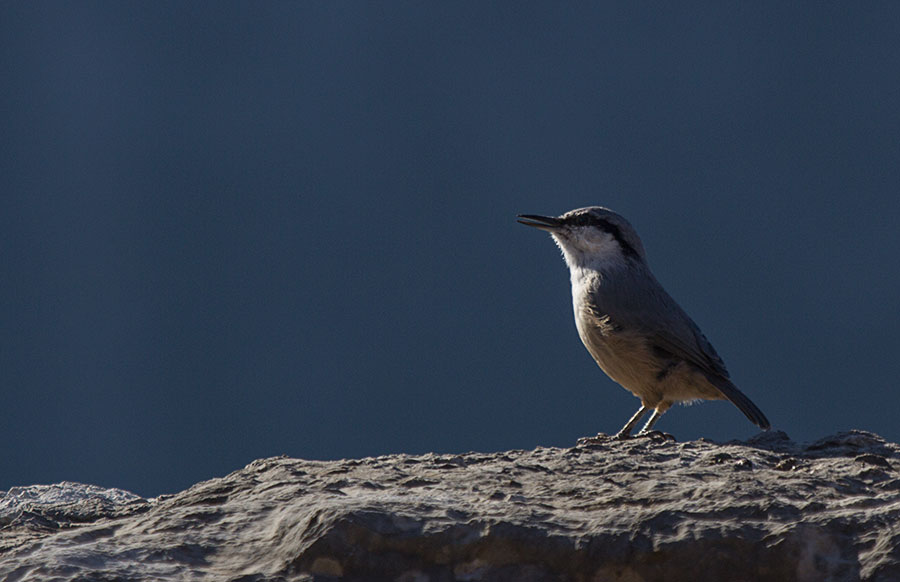
A lovely male Blue Rock Thrush watched on and we later found a female further up the hill. One of the more interesting sights in terms of birds was a flock of Crag Martins. They, in themselves, were a typical bird of this sort of habitat, particularly as the archaeology backs on to enormous cliffs rising to lofty peaks. Their behaviour was what drew my attention, they were gathering around the top of an Italian Cypress tree. I can only assume that they were after insects there but it was not apparent, even through binoculars, that there were many insects in the air, so either they were plucking them from the foliage or the prey was smaller than I would have expected. Either way, it made for interesting watching and a different shot.

Against the cliffs themselves we spotted a flock of Rock Doves settling on a ledge and soon we were finding our first flowers among the ruins. Verbascum sinuatum clung on in the dry conditions and near the Temple of Apollo we were particularly surprised to find a single flower spike of Asphodelus fistulosus which was either very early or exceedingly late as it usually flowers between March and June.

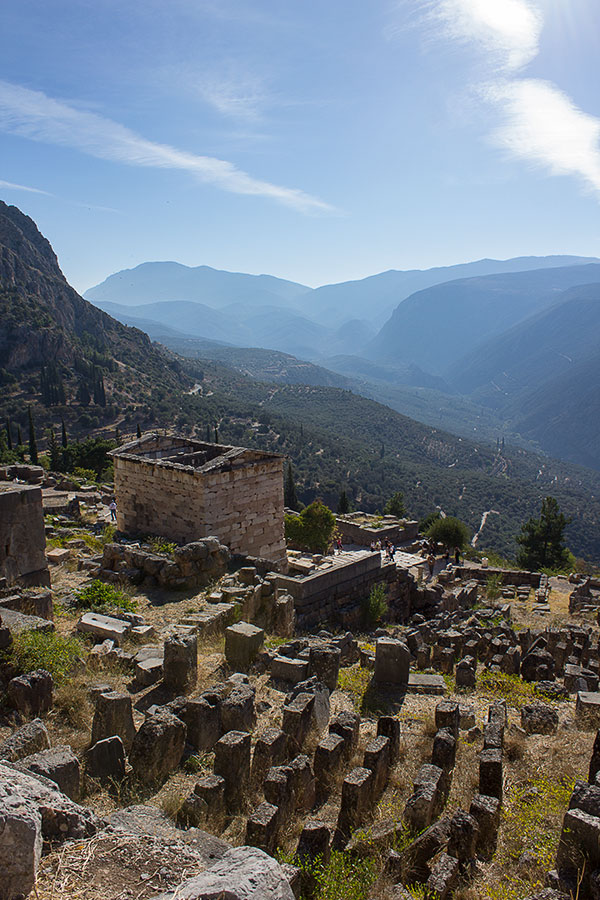
We could see a flock of birds in the distance too (in this image just a cluster of dots above the tallest pillar), we would later establish them to be Alpine Chough and Jackdaws. Here and there a few more flowers started to appear including the narrow leaved Centranthus ruber ssp. sibthorpii and lots of Calamintha nepeta which was a magnet for butterflies like Pigmy Skipper. These are a puzzle for me, I’d love to know why they were named “Pigmy” when they are much larger than our Small Skippers at home!

The most common butterfly was the Wall Brown which would continue to be so for the rest of the tour. They were joined by plenty of others though including Clouded Yellow with a good proportion of the pale helice form females and one that we don’t see in the UK much, Lang’s Short-Tailed Blue with it’s unmistakeable and very pretty underwing markings. They were mostly nectaring on Heliotropium hirsutissimum which you barely noticed until you got closer as the foliage was so dry and brown that it blended with its equally desiccated surroundings.

Continuing to climb, the views over the site and beyond got better and better. It really is a wonderful place to mix culture and history with nature and wildlife.

Above the amphitheatre we started to find clumps of Sternbergia lutea ssp. sicula in the shadier spots. There was a single Autumn Squill budding and growing in the gravel path beside the impressive stadium under the shade of a pine tree, we came across a couple of Colchicum cupanii.

It was soon time to head back down the hill and regroup for a picnic lunch in a shady grotto below the archaeological site. From here we had a good view of the Alpine Chough wheeling and turning as they played on the breeze. We found a large Jewel beetle and had a brief glimpse of a Common Swallowtail between feasting on the local delights and fending off the local stray dog.
Having packed up, we moved on to our afternoon stop a couple of miles down the hill below Dephi itself on a rough track clinging to the hillside below some slightly smaller cliffs. It was a lovely spot to while away the time in the sun with the calls of Rock Nuthatch echoing around us and lovely view of the Gulf of Corinth which brought a cooling breeze with it. We had more good views of Blue Rock Thrush as well as the Nuthatches and a dark coloured Rock Partridge. We also had some rather better views of Common Swallowtail butterflies and found an uncommon endemic plant, Daphne jasminea growing on the rock face.

The main highlight here though had to be the sheer volume of butterflies which were congregating around the large patches of Dittrichia viscosa, seemingly a magnet to them. There were a variety of species, including a few familiar faces like Common Blue and Small Copper…


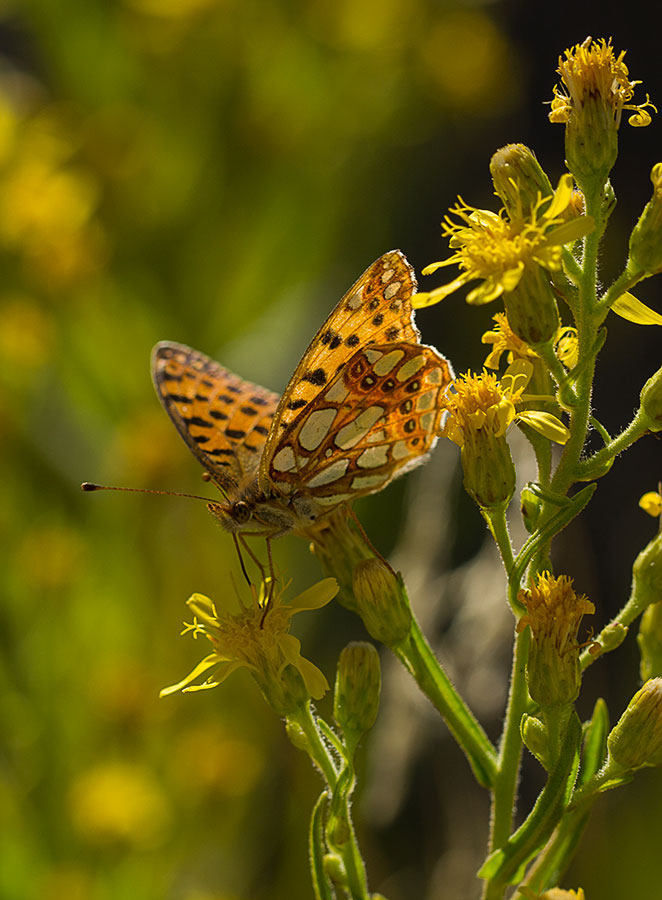
…there were a few more exotic species too though and one in particular which is always a joy to see; the Queen of Spain Fritillary.
There were also a couple of much smaller butterflies there, the smallest in Europe to be precise, the Grass Jewel which has a wingspan of just over a centimetre. Unfortunately for me, the only one that would stay still long enough for a photo was slightly tattered, but it’s always nice to see these tiny beauties!

Having enjoyed the butterflies we made our way back to the hotel and a few of us ventured out for a more local walk to a small chapel a little further up the road. Once again we were treated to a lovely sunset and delicious meal in good company. We went to bed a happy bunch after a long but thoroughly enjoyable day.
The following morning dawned sunny and I enjoyed a lovely view over the outskirts of town and the valley beyond which I snapped with my phone as I walked down from where I was staying to meet with the rest of the group in the hotel (I had forgotten to mention until now that unfortunately for me there were not enough rooms for us all and so I was put up in a very pleasant apartment about a mile away).
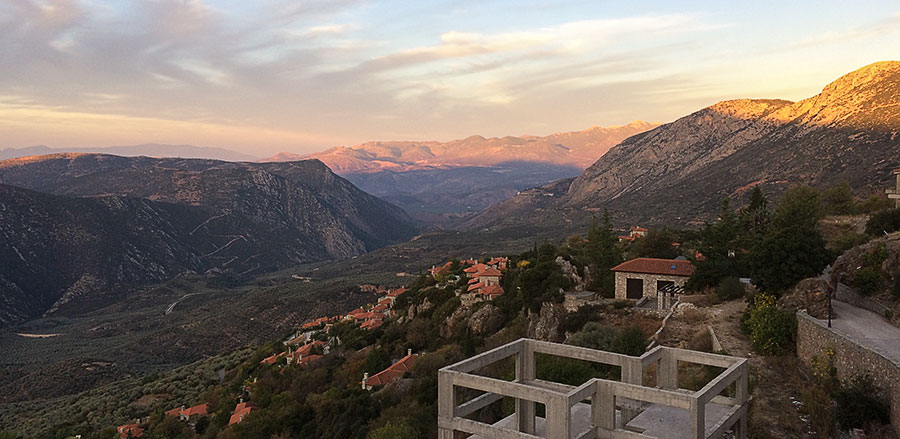
After another lovely breakfast we set out for the day, heading beyond Delphi to a spot on a hillside between the coastal towns of Itea and Galaxidi. Here, we were teaching among the dry scrubby landscape for more Colchicum cupanii like those we had seen the day before. They were tricky to find but eventually after much hunting around we came across a few very small specimens nestling in the shade of Sage and Spiny Burnet bushes. We also found a few rather lacklustre Autumn Squill and a small clump of Cyclamen but the lack of flowers was compensated by the view which I grabbed on my phone.

We did have a few birds to watch too, the so far ever present Rock Nuthatch was noisily going about it’s business and a Sardinian Warbler sung from the depths of a Kermes Oak tree up the bank. A star find though was a lovely spider, Argiope lobata, which is related to the Wasp Spider which we see in Britain, and equally striking although perhaps just a tiny bit larger.

From here we walked a short way down the hill to a spot near the bottom where we found the smelly but impressive Biarum tenuifolium and a few more cyclamen. On the way, we marvelled at more butterflies enjoying the Dittrichia viscosa on the roadside and came across an enormous and aptly named Handsome Cross Grasshopper.

Having made one more stop before rejoining the main road to see some particularly fine specimens of Sea Squill (which I neglected to take a photo of – d’oh!) we drove along the coast and up into the hills towards the Koutsourou Monastery, below which we would stop for a picnic under an ancient Plane tree. It was a lovely setting but once again the flowers were lacking. We found scant few of the Crocus hadriaticus which we had been hoping to find. Nevertheless, a Black Redstart buoyed our spirits and having spent some time happily exploring the bank we continued on. We drove part of the way round the Mornos Reservoir which made for an interesting change of scenery and we particularly enjoyed some spectacular autumn colours. Unfortunately, the spot where we stopped to look for Crocus robertianus was completely devoid of Crocuses although there were quite a few Cyclamen hederifolium and a Hummingbird Hawkmoth among the butterflies to keep us entertained. We also came across a rather lovely Jumping Spider which was on the roof of my hire car and which amused us greatly by jumping in and out of my lens hood!

Heading back to the hotel we had our best sunset yet (captured again on my phone) which rounded off the day with a good splash of colour over the tawny landscape. It seems the perfect way to round of this post too so if you want to find out what else we saw, you’ll have to tune in next week for the next instalment!


