Sunny Spring in Sicily: a floral wonderland
I’m a little late in writing this piece, but I hope you’ll agree better late than never! This week I thought I’d recall a wonderful tour which I led last spring and which I’m due to lead again this coming April (see the What’s On page for further information). The trip in question was a Greentours tour to Sicily.
Anyway, let me elaborate on my previous trip to this place. The primary focus was the numerous orchids and other wonderful wildflowers which grace the island in spring and we would not be disappointed.
Landing in glorious sunshine with a clear view of the smoking Mount Etna, we piled into our vehicles and started our journey. The first exciting wildlife was spotted only a couple of miles from the airport where a White Stork circled over the motorway. En route we spotted a few wildflowers which were recognisable even at motorway speeds, the Yellow Crown Daisy, Glebionis coronaria being the most noticeable with swathes adorning the field margins and road verges. There were a few patches of Wild Gladiolus and we had a good view of a Common Buzzard taking off from a low perch beside the road as we passed. As we pulled into the side road just above the hotel a few keen eyed passengers spotted some Naked Man Orchids in the shelter of a stone wall.

Glebionis coronaria
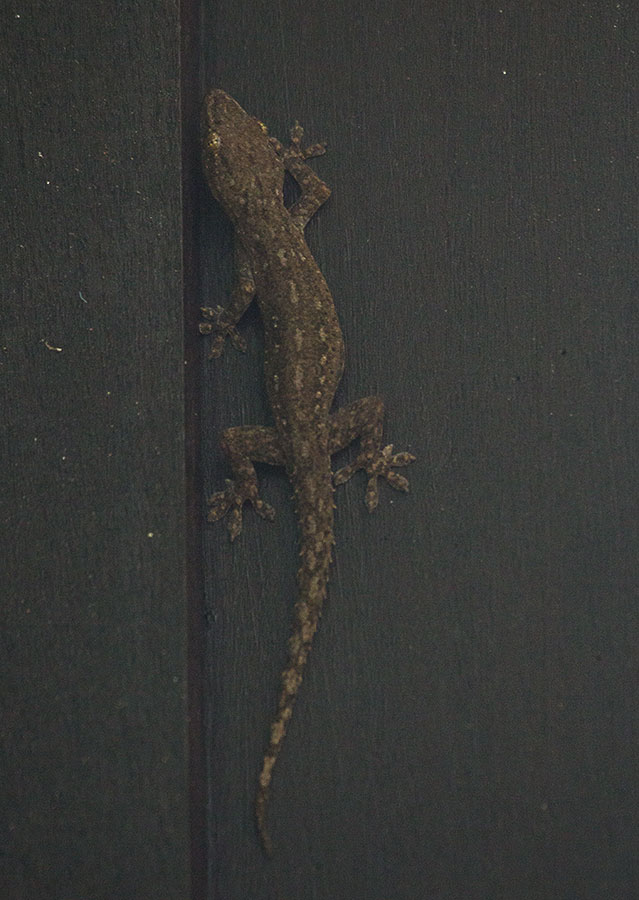
The following day started quite cool but with lovely bright sunshine and we enjoyed breakfast outside on the terrace. Before the day had fully begun, I found a beautiful juvenile Moorish Gecko upside down on the path outside her room, possibly injured by a potential predator, and was able to show it to the group before moving it out of harm’s way.Having fuelled up for the day ahead, we started out with a gentle walk from the hotel along the road which soon became a rough track as we headed towards a local quarry. As it was our first full day, almost everything we saw was new for the trip and so there was plenty to add to the list.

We began in a corner of the hotel car park where a rough grassy patch provided us with our first orchids of the day, Ophrys lutea, the Yellow Bee Orchid, and Ophrys incubacea. There were also a couple of spikes of Wild Gladiolus and Tassel Hyacinths. We were off to a good start!

Ophrys incubacea
Moving out of the grounds of the hotel there were lots more wonderful flowers. To name just a few: Fedia cornucopiae, a member of the Valerian family which we would go on to see regularly all week; Adonis microcarpa, the Yellow Pheasant’s Eye in it’s red form; Silene colorata, an abundant little pink campion; Salvia fruticosa, a large sage with a beautiful pale mauve flower which was visited by a plethora of insects; and Pisum sativum, a large wild pea with large blousy flowers with pink wings and a purple corolla. Alongside these were swathes of Glebionis coronaria, the Yellow Crown Daisy and lots of Corn Poppies (Papaver rhoeas).

Pisum sativum
There were plenty more orchids too including a tongue orchid known as the Plough-Share Orchid, Serapias vomeracea, Ophrys panormitana, Ophrys lupercalis, Orchis italica and Orchis tridentata just coming out. There were also a couple of spikes of Giant Orchid, Barlia robertiana which had gone over and some seed pods of Widow Iris. Among the floral wonders we found some butterflies too; Small Blue, Orange Tip and Cleopatra were joined by a flighty Swallowtail. All of this was enjoyed to a background of calling Cetti’s Warbler and Corn Bunting, the latter of which was eventually spotted atop a tree in the middle of one of the fields. Raven and Buzzard flew overhead alongside Swallows and Violet Carpenter Bees buzzed loudly from one flower to the next. There were quite a few Italian Wall Lizards sunning themselves on the dry stone walls too, including one which had a double tail, most likely caused by the original not fully dropping off but a new one growing regardless. It was certainly a fascinating sight.
We were soon retracing our steps up the track and passing the hotel entrance for a quick venture to the top of the road where we had spied those earlier orchids. As well as the Naked Man Orchids there were a few other beauties that had previously gone almost unnoticed including the Sawfly Orchid, Ophrys tenthredinifera, a lovely endemic species, Ophrys lunulata, and a lovely clump of Mirror Orchids, Ophrys speculum. There were also several more of the Serapias vomeracea and a couple of other new plants for the day including the attractive but diminutive Ground Pine, Ajuga chamaepitys.

Ophrys lunulata
Having thoroughly explored our local patch it was time for a bite of lunch and we returned to the hotel to enjoy a hearty pasta dish on the terrace. Of course, being outside, we continued our wildlife watching as butterflies flew past and Italian Sparrows chirped from the rooftops. One again sated, our afternoon began with a short drive down a local side road where we were to make two stops. The first was in a delightful sunny meadow where several new orchids awaited us. Alongside the Yellow Bee Orchids, we found the smaller flowered Ophrys sicula, and next to them some lovely Orchis longicornu, the Long-Spurred Orchid which were scattered across the site. Just near where we had parked we came across a single specimen of the Bumblebee Orchid, Ophrys bombyliflora, and a little beyond it Serapias lingua, followed swiftly by two closely related species, Ophrys oxyrhynchos and the paler Ophrys biancae, an endemic to the island. At the top of the slope were some fantastic examples of the previously seen Orchis italica and a short distance away some lovely Ophrys explanata which were growing in a natural rock garden in the mossy pockets of a large limestone outcrop. These new species plus several now familiar to us took the total orchid species count at this one little spot to a whopping thirteen.
Orchids were not the only flowers to be found of course and Gynandriris sysirinchium, Barbary Nut, were popping up through the grass to everyone’s delight. There were also some lovely pinky-purple Anemone hortensis and a good stand of Ruta chalepensis, Fringed Rue. A few butterflies were spotted too including Small Blue and Brown Argus but the star find was a Green Hairstreak looking resplendent in the sun.

Anemone hortensis
Moving on to our second stop for the afternoon, we pulled onto a grassy verge a mile or so down the road to find it covered with more of the Barbary Nut. Here we were exploring a section of limestone pavement which was slightly shadier in places and there were a few different flowers as a result. Just through the rickety home-made gate we came across Purple Toadflax (Linaria purpurea) in fine form and a short way beyond we found a nice Blue Hound’s Tongue (Cynoglossum creticum) flowering.

Cynoglossum creticum
The greatest surprise of the stop came a few minutes later when we almost literally stumbled over a tortoise! My co-leader, Stefano confirmed that it was a male Hermann’s Tortoise. We spent a little while waiting to see whether he would come out of his shell having been startled and eventually he did, taking quite a turn of speed followed by a tumble off the edge of the rock he was on and into a hiding place beneath some tufty grasses.

The next surprise was a splendid if rather difficult to locate Praying Mantis (Empusa pennata). Having all eventually managed to pick out the very well camouflaged insect, we went back to our plant hunting and found a few orchids, namely Pink Butterfly (Anacamptis papillionacea), Mirror Orchid (Ophrys speculum) and Yellow Bee Orchid (Ophrys lutea). There was also some lovely Cistus salvifolious and a heather, Erica multiflora. There seemed to be fewer butterflies here but an orangey Southern form of the Speckled Wood flitted past allowing nice views. Across the valley, we spotted House Martins coming and going round some farm buildings and just before getting back into the vehicles to return to the hotel a Red-Rumped Swallow was seen zipping overhead.

Empusa pennata
We were soon on our return journey to the hotel where we would spend a relaxing evening with more delicious food and retire to the sound of Tree Frogs calling from the quarry up the road.
The next day we set out equipped for cooler weather as we were heading up into the hills. Getting out of the vehicles at our first stop we realised that contrary to appearances from within it was rather windy on the hillside. Nevertheless, we donned coats and ventured out. There was quite a bit of Italian Sainfoin, Hedysarum coronarium, growing among the tall grasses, though only a few in good flower. Here and there, Anemone hortensis bloomed and a scattering of a new orchid were found on the bank, Ophrys garganica.
Retracing our steps slightly to navigate the steep bank, we continued down a rough track which skirted the hillside. In the shallow valley below a Corn Bunting sang from the top of a dead tree and we spotted a Common Whitethroat nearby. We enjoyed debating the species of several Hawthorn trees beside the track and found one orchid after another as we ambled down the slope. Yellow Bee Orchid and Mirror Orchid seemed the most common here although there were several Naked Man Orchids and some nice specimens of Ophrys incubacea too. We also found what would turn out to be our one and only flowering Widow Iris, Hermodactylus tuberosus, which was in a rather poor state on it’s way over.

Ophrys speculum
On the way back uphill we spotted a beautiful Brown Argus butterfly showing off the orange lunules around the edges of its wings as it sunbathed in the grass. I also found two lovely hairy caterpillars, one quite large and brown, the other much smaller and mostly yellow. Unfortunately I was unable to identify them and neglected to take photos in my excitement to show the group!
The next occurrence was rather unexpected when a group of cross country runners came past at high speed, quickly followed by another. It transpired that we had wandered onto a race route and there were approximately 200 competitors! We moved to the side and down into one of the small fields beside the track to continue our botanising in relative peace and allow them safe passage without having to circumnavigate us. It was evidently a fortunate turn of events as we soon found more orchids including a nice example of Orchis tridentata, the Toothed Orchid which we had previously only found in bud. The end of the race was signalled by the arrival of a chap on horseback bringing up the rear and we returned to the vehicles.
Our next stop was at the top of a mountain in a short grazed meadow which proved far more floristically rich than first appearances would have indicated. The far-reaching views across Sicily from the top were pretty spectacular too, especially if you don’t mind wind turbines! It was beautifully sunny up here but the wind was quite strong and gusty so coats were retained but we weren’t deterred.

Anacamptis papillioncea
We quickly realised that there were huge numbers of orchids to avoid treading on! The first was one of several extremely good examples of the Sawfly Orchid, Ophrys tenthredinifera, among more of the Long-Spurred, Pink Butterfly and Mirror Orchids that we had seen elsewhere. The next was another new species for the trip, the Milky Orchid, Neotinea lactea, which it was interesting to observe in a variety of colour forms with most showing typical pale pink colouring but some being almost completely white and others having a very dark pink lip.

Neotinea lactea
Whilst wandering and marvelling at the sheer numbers of these beautiful plants there was suddenly a call from a guest that he had found a Wryneck and the whole group were able to get a good view of this extraordinary bird once they had located its position camouflaged in a patch of scrub and brambles. A Stonechat was spotted atop another bush and we also saw a Pied Flycatcher. There were Woodlarks singing nearby too with a beautiful if slightly mournful descending tune. Having watched the Wryneck for a while, we separated to explore once more and I came across some lovely Saxifraga carpetana ssp. graeca with delicate white flowers being blown in the wind. Someone then called that they had found another orchid and the single spike was soon identified as Orchis provincialis, a beautiful creamy yellow orchid. There were a few scattered flowers of Romulea bulbocodium looking superficially a little like a crocus and by the vehicles, some fine examples of Echium plantagineum, the Purple Viper’s Bugloss.
We drove a short distance down the road to find a suitable and hopefully less windy spot for our picnic. We pulled in to an area of pine woodland and the group spent a happy few minutes botanising along the edge of the road while we prepared the lunch and fended off some stray dogs which thought they might like some too! We ate bathed in lovely sunshine with only the odd gust of wind and with Swifts screaming overhead, several pairs of Goldfinch passing, a Buzzard circling on a thermal and Small White butterflies zooming around.
Having eaten, we went for a short walk into the woods where we found yet more orchids. They were mostly species that we had seen in some numbers before but there were quite a few more of the Orchis provincialis blooming beneath the pine trees and perhaps more excitingly, a single spike of Ophrys subfusca ssp. laurensis, a fairly local endemic named after Monte Lauro. Moving further into the woods, we came to a small pool which was heaving with Pool Frogs, puffing out their cheeks as they called to one another. There was Water Crowfoot growing among the reeds and several Orange Tip butterflies flew round the glade while Italian Wall Lizards sunned themselves on the rocky edges. A Chiffchaff was heard calling from the depths of the wood, a first for the year for most of the group and somehow a joyous sound indicating that spring might have arrived by the time we return home.
Moving on for the afternoon, we made an impromptu stop beneath some Almond trees on the hillside above a small town for a spectacular specimen of the Italian Sainfoin, Hedysarum coronarium, which must have been nearly three feet tall and covered in splendid red blooms. There were some lovely patches of Calendula officinalis next to the vehicles as well as some Periwinkle, Vinca major and a good clump of Thyme Broomrape, Orobanche alba.

Orobanche alba
Having driven on through the little town, our next stop was on some terraces beyond by a small stream. Here we enjoyed some lovely Teucrium fruticans, a lovely Germander with a large pale mauve flower which was being visited by lots of insects. There was also a large Broomrape here which, interestingly, was being visited by a wasp and a White Spotted Rose Beetle, Oxythyrea funesta. There were plenty more of the plants we had been lucky to see so many of including Naked Man Orchid, Allium subvillosum, Borage, White Mignonette, Anemone hortensis and Blue Hound’s Tongue. There was a mint species growing underfoot in places too which made it a pleasant experience for all the senses.

As well as flowers, we were treated to a plethora of butterflies at this stop with both Small and Large White, Orange Tip, Common Blue, Brown Argus, Wall, Small Heath, Clouded Yellow and a Swallowtail all flitting around while we wandered through. There were a couple of dragonflies near the stream too of the Darter type, but none stopping long enough to get a positive identification.
We made one final stop on our way back by some farm buildings. Here we had nice views of Kestrel, Crested Lark and Spotless Starlings as well as numerous and noisy Italian Sparrows. There were a few flowers too, the most notable being some beautiful specimens of Serapias vomeracea, a patch of Pitch Trefoil, Psoralea bituminosa, the enormous leaves of Cardoon, Cynara cardunculus, and Weasel’s Snout, Misopates orontium.

Misopates orontium
With all the stops we had managed to fit in, it had felt like a longer day than it had been but we returned to the hotel a happy bunch.
The following day once again dawned cloudier than we might have liked but we were hopeful that it might burn off and after another hearty breakfast we set off towards the coast. On the way we spotted a Roller sitting on a telegraph wire and on arrival at Vendicari Marsh, we were soon aware that the list for the day would be a full one with plenty of birdsong around us and verges full of flowers. We admired a new plant before we had even entered the reserve, the large pink flowered Convulvulus althaeoides or Mallow-leaved Bindweed. Next, we paused to look at the map of the reserve before entering and were amused that one of the prohibited activities denoted appeared to be taking a Kangaroo for a walk… of course it was to imply that one shouldn’t introduce foreign species, but the picture was far more entertaining!
Our first port of call once inside the reserve were two new looking hides just a short way up the path. These gave us great views over one of the lagoons and we got our first sight of Greater Flamingos feeding. As we entered, a few of the group were just in time to see a Squacco Heron taking flight and we spent a good few minutes here taking in all the birdlife on and around the water. Among others there were Cattle and Little Egrets, Shelducks, Shoveler, lots of Coots and a Gull-billed Tern. A Marsh Harrier was also spotted quartering low over the reedbed in the distance.
As we walked on there were a few new plants to note. The first was Aristolochia rotunda, which was growing in clumps right outside the hides. As we rounded the corner onto the wooden boardwalk we saw the next, Great Bindweed, Calystegia silvatica. At the far end of the boardwalk we came across some rather lovely Buck’s Horn Plantain, Plantago coronopus and we got our first proper glimpse of the sea as we approached the beach. To either side of the path here there was suddenly a burst of colour with lovely cushions of Large Yellow Restharrow, Ononis natrix, patches of pale pink Sea Stock, Matthiola sinuata, studded with darker pink Silene colorata, and tiny white annual Daisies, Bellis Annua plus the impressive deep pink Centaurea sphaerocephala, all amongst beautiful Hare’s Tail Grass, Lagurus ovatus with its wonderfully fluffy flower heads.
Another, slightly more unusual plant of note consisted of washed up brown matted balls which littered the shore like the remnants of a child’s ball pit. These were the fibrous remains of a sea grass, Posidonia oceanica, which is endemic to the Mediterranean and has been found to be one of the world’s oldest living organisms.

Posidonia oceanica
Continuing on our way we spotted a few more lovely plants including the Annual Asphodel, Asphodelus fistulosus, and Yellowwort, Blackstonia perfoliata. There appeared to be a mass of insects following us along the path too and these turned out to be rather flighty Tiger Beetles which, when they paused long enough to be admired, were rather attractive shiny brown with hints of green and a pattern of white spots. The fences either side of the path held numerous Italian Wall Lizards soaking up every last second of sunshine before darting out of harm’s way as we approached.

Calomera littoralis
Reaching the next hide we were delighted with views of a Black-winged Stilt and a Black-necked Grebe as well as Great Crested and Little Grebes. There were a few ducks too including Pochard and Teal plus more Shoveler. There was also a rather charming if somewhat noisy Fan-Tailed Warbler which appeared to be nesting just in front of the hide and gave us good views. We all agreed that Zitting Cisticola was a far more descriptive name as it “zitted” loudly overhead!

On our way back along the path, a few of us stopped to watch a solitary bee remove sand from a snail shell in order to use it as a nest chamber. Further on we had nice views of a pair of Crested Lark on the path and a Linnet posed wonderfully atop a nearby shrub. We found a nice patch of Serapias parviflora, the Small-flowered Serapias growing beside the path and were surprised to note a spike of Barlia robertiana here too although it was over. As we rounded the corner near the disused factory we were treated to a great view of a Spoonbill feeding in the shallows quite close. Unfortunately the hide which would have given us an even clearer view was yet to be opened.

Serapias parviflora
Continuing on, we passed an ancient species known as a Joint Pine, Ephedra fragilis, which was growing over a low wall and Squirting Cucumber, Echballium elaterium, one flower of which held a yellow crab spider, although despite my best efforts it was not ready to give up the secret of how it got its name.

Echballium elaterium
Wandering back through the ruins of the Tonnara we spotted a Tree Sparrow atop a column and found Caper bushes growing through the stonework as well as the lovely creamy Antirrhinum siculum flowering from seemingly every crevice. A Six-spot Burnet moth was seen nectaring on the Centaurea sphaerocephala as we retraced our path.
Our lunch spot was only a couple of miles down the road and was most notable for the quantity of Small White butterflies flapping over the arable fields around us. There was the familiar “Zit” of Fan-tailed warblers and Small Tree Mallow, Lavatera cretica, was scattered through the verge while a type of Darkling Beetle was an unexpected find as it wandered across the road.
Having eaten we headed out for another short journey to the other end of the marsh. Here we had a rather different habitat with rough meadows, shrubby maquis and stony paths as opposed to boardwalks across reedbeds and sandy shoreline. Almost as soon as we were out of the vehicles we were finding things of interest. Marie came across a splendid and large beetle, Buprestis cupressi for which, although not an endemic species, records are limited to Vendicari on Sicily. The larvae feed on Prickly Juniper, Juniperus oxycedrus, which we also saw and which is much more common here than elsewhere on the island, largely thanks to the conservation of the reserve.

Buprestis cupressi
There were lots of butterflies, particularly in the grassy and flower-rich meadow near the entrance. Notable were Swallowtail which is always lovely to see and an Eastern Dappled White. They were joined by at least half a dozen other common species too. Wandering on, we found lots more flowers to look at as well, mostly more of what we’d found previously but a few new ones sneaking in such as Love-in-a-Mist, Nigella damascena, the small, pale-flowered Sideritis romana and, in the pockets of rockier sections, Sedum caeruleum, with attractive tiny blue flowers set against red leaves. Among them, the white flowers of Bellardia trixago joining the Yellow Bartsia, Parentucellia viscosa and smaller pinkish Parentucellia latifolia, all three of which are semi-parasitic.

Sedum caeruleum
At the top of the hill we were rewarded with fabulous views over the bay back where we had walked that morning. We enjoyed the sunshine for a few minutes, a few of us taking the opportunity to explore further in the immediate surroundings before heading back to the vehicles. Our last stop of the day was not for wildlife but for ice cream – a visit to Sicily wouldn’t be complete without it – a nearby village provided us with a perfect harbourside spot for gelato before we returned to the hotel.
The following day we headed for the Anapo Gorge. We began our walk and had barely left the carpark when we started to see all manner of birds and flowers. Among the first birds spotted were Firecrest and Subalpine Warbler whilst Wren and Chiffchaff called from the woods around us. As we continued along the disused railway track there were plenty of flowers to look at and many, such as Pitch Trefoil, we had seen before but not in such numbers. There was a lot of White Campion, Silene latifolia, which was rather unusual as it appeared to have an inflated calyx tube like a Bladder Campion which was more noticeable when in seed. Another new plant for the trip was Convulvulus elegantissimus which a subspecies of the Mallow-leaved Bindweed from the previous day with very narrow, lobed silvery leaves.

Convolvulus elegantissima with a Bush Cricket Nymph
In the valley bottom, a short way down the track was a particularly attractive meadow full of Crown Daisies, Poppies and Borage. As we were photographing it, three Mallard got up from the river and flew overhead. Back on the main track there were yet more lovely plants to look at including Shepherd’s Needle, Scandix pecten-veneris, Oriental Bugle, Ajuga orientalis, and the seemingly ever-present Honeywort, Cerinthe major. A little further on there were lots of rather impressive Silybum marianum, Milk thistles with impressive spiky bracts and beautifully white-veined leaves.

Cerinthe major
Nearby, I found a Longhorn Bee asleep in a Marigold and elsewhere there were masses of Bush Cricket nymphs sitting nicely for photographs in a variety of flowers.

Longhorn Bee, Eucera longicornis
We also found a different pea, Vicia narbonensis which had a very dark purple flower and nearby we came across some Man Orchids, Orchis anthropophorum which were a new species for the trip. There were masses of Yellow Bee and Naked Man Orchids too plus a good scattering of Toothed, Mirror, Pink Butterfly and Ophrys incubacea.

Vicia narbonensis
Eventually it was deemed that we should turn around and head back but before we did so, we stopped for a light snack and were able to enjoy views of a Peregrine Falcon on the rock face above us, while Scorpiurus muricatus and Coronilla valentina were noted as new plants around us.
Returning to the vehicles we drove to a suitable spot for lunch where there were Corn Buntings and Crested Larks singing nearby as Swallows flew low over the crop in a neighbouring field.
Continuing on, we stopped at the incredible pre-Roman necropolis of Pantalica for the afternoon. From here we had wonderful views down into the valley and were able to follow a path round to some fascinating caves which had been an early settlement and even a small church. There were a few interesting plants here too of course including Tree Spurge, Euphorbia dendroides, Small-flowered Catchfly, Silene gallica, and Woolly Trefoil, Trifolium tomentosum. We were also able to get a good comparison between Membraneous and Roman Nettles which were growing next to one another and there was absolutely masses of Fringed Rue growing everywhere. There were plenty of intriguing insects too including a pink coloured Squash bug of sorts, an endemic bush cricket and a large yellowish weevil.

Haploprocta sulcicornis

Sicilian Striped Bush Cricket
We were lucky to get another view of Peregrine Falcon, possibly even the same individual as earlier in the day and a Kestrel too, perched in a tree on the top of the hill. There were also several species of butterflies including a new one for the trip, the Green-underside Blue as well as Small Heath, Small Copper and Swallowtail.

Green-underside Blue
The next day dawned brighter than previous days but still chilly as we set off for another local destination, Noto Antica. The huge walls were certainly impressive as we drew up and we were greeted with lots of lovely birdsong in the trees around us. Entering the ancient walled town, we found that nature was doing its best to reclaim the surviving stonework.
As we explored a rocky patch looking for flowers we heard a Turtle Dove calling from the hillside opposite and our search paid off with Mirror Orchid and Serapias lingua being found along with Branched Broomrape, Orobanche ramosa. Climbing the steps to the Royal Palace, we found Osyris alba growing from a crack in the wall and reaching the top we were greeted by a wall topped with wonderful carpet of Starry Clover, Trifolium stellatum studded with Yellow Bartsia, Parentucellia viscosa.
Wandering on along the main path through the historic site, we found the usual suspects of Yellow Bee Orchid and Naked Man Orchid plus Ophrys incubacea. There was quite a lot of rather lovely Salvia fruticosa blooming beside the track as well as Lathyrus ochrus, Lathyrus annuus and Lathyrus clymenum. A Green-underside Blue butterfly posed obligingly for photos and a Small Copper zipped past while a Nightingale sang from the trees nearby. I also found some Six Spot Burnet Moth caterpillars on a rock and an Egyptian Grasshopper.

Lathyrus annuus
Retracing our steps we marvelled at how one can overlook things that are far more obvious from the other side. I came across a lovely jumping spider too which I can never resist photographing, I find them so charismatic!

Pellenes chrysops
We were a little surprised to find that the local shepherd had moved his flock into the ruins and commented that our timing had been perfect as we had enjoyed the flowers before they had been grazed off. Not only that but we were able to enjoy the comical sight of the sheep climbing the same stairs that we had to reach the castle tower!

Returning to the vehicles we had excellent parting views of a Sardinian Warbler but we were soon moving on to our next stop where we were once more wondering where to put our feet as we found ourselves surrounded by Mirror Orchids, Tassel Hyacinths and all sorts of other floral delights. Again, the birdsong here was delightful with Nightingales, a Song Thrush and Robin all singing at once from the wooded valley and a Great Spotted Woodpecker drumming in amongst them.
Further into the field we came across some rather large and superb specimens of Serapias vomeracea as well as Gladiolus italicus and Asphodeline lutea which seemed to have been opening more by the day and were beginning to look really good. A few of us had great views of a Western Whip Snake beneath a bush and a variety of now familiar orchids were recorded.

Gladiolus italicus
A few of the group ventured down to the river and in doing so found a superb specimen of Sawfly Orchid, Ophrys tenthredinifera, as well as a Collared Flycatcher. There were also tadpoles of the Green Toad in the gentle flowing water.
Our next stop would be for lunch and whilst I was preparing it the group found some lovely flowers here including Barbary Nut which seemed almost to open before our eyes, lots of Wild Clary, Salvia verbenaca, and a few orchids to boot. There were a few passing passerines including a Serin which sang briefly from the Telegraph wire overhead before moving on. We moved on too, only a short hop down the road to enjoy refreshments (mostly the super-thick and delicious hot chocolate!) at a cafe on the edge of the Cava Grande di Cassibile, an enormous and impressive gorge with a series of deep river pools at the bottom and a staggering cave dwelling on the opposite wall.
Rather than venture into the depths of the gorge, appealing though it looked, we stuck to a track that led along the top edge. Here we found plenty to delight us with the first discoveries being of the orchid persuasion! Alongside the familiar Yellow Bee Orchid we found once more the smaller variety, Ophrys sicula and amongst the long grasses, Ophrys oxyrhynchos and Ophrys panormitana. There was also a near perfect specimen of Ophrys lupercalis as well as more of the Pink Butterfly Orchid, Mirror Orchid and Naked Man Orchid. As well as the common Serapias vomeracea, we found the smaller Serapias lingua and lots of Tassel Hyacinths.

Ophrys lupercalis
There were a number of new and mostly diminutive plants too including Evax pygmea, Teucrium polium, the tiny Felty Germander and Malva cretica, a rather pretty little Mallow. Among these, we saw a nice variety of butterflies too with Small Heath, Small Copper, Brown Argus and Orange Tip joined by the more elusive Eastern Dappled White and the blousy Swallowtail. Overhead a Woodlark sang whilst Meadow Pipit, Raven and Peregrine Falcon were also spotted. A particularly keen birder in the group was then successful in finding a Blue Rock Thrush and some Crag Martins.
A few of us were delighted to see a pair of Hoopoe get up from the middle of the road on the way back to the hotel for the evening.
Our penultimate day began with sunshine and breakfast on the terrace once more. Having enjoyed the wonderful spread, we set out in good spirits for the other end of the Anapo Gorge. On arrival some enjoyed views of Turtle Dove in the carpark which flew as we drew up, meanwhile others had nice views of a Grey Wagtail and a Jay instead.
As we set off we passed under a new tree for the trip, the Nettle Tree, Celtis australis which had flowered earlier in the year and was already developing fruit. It was only a few feet to the first of several tunnels on the disused railway track, the entrance cutting to which sheltered Maidenhair ferns. The tunnel navigated, we emerged onto a bridge over the river where an Elder stood beneath us in full bloom and birdsong rang loudly from the trees against the water. Among the new plants was Aristolochia altissima, alongside which several more ferns were discovered though not all identified. Once again we found masses of Naked Man and Yellow Bee Orchids. The Manna Ash, Fraxinus ornus, was in bloom and a good stand of Osyris alba produced a lovely honey-like scent.

Aristolochia altissima
There were quite a few butterflies on the wing with Southern Speckled Wood and Green-underside Blue being notable. There was also a lovely damselfly, a Copper Demoiselle which perched perfectly on a bramble leaf for the group to photograph. A short way further on a Sardinian Warbler was spotted nesting just below the track and a few stopped to watch the adults come and go with food for their young.

Southern Speckled Wood
We were soon at the second tunnel of the day which was slightly longer. Alongside the almost obligatory ferns at the entrance were some wonderful specimens of another new orchid, Ophrys subfusca ssp. archimedea. Inside the tunnel, nearer to the far end, some observant members of the group found a large Tegenaria sp. spider.

Ophrys subfusca ssp. archimedea
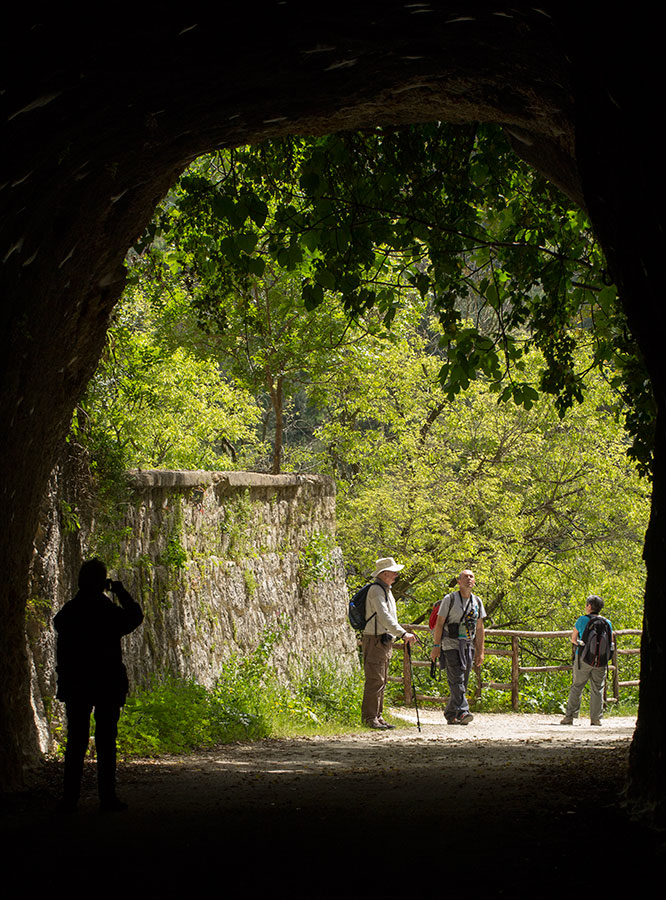
Once out in the light the other side we continued to find more flowers. There was a superb specimen of the endemic Ophrys lunulata and shortly afterward a very good specimen of Ophrys bertolonii which was also new for the trip. A pair of Blue Rock Thrushes were spotted high up on the opposite wall of the gorge and subsequently admired again on the return journey.

Ophrys bertolonii
Continuing on, several large Egyptian Grasshoppers (and one juvenile) were found and one stayed put very well for photographs on the lower branch of a Hazel tree. A little way further down the track and we once again crossed the river. Taking a left immediately after the bridge allowed us access to a small pebbly “beach” beside the water which looked wonderfully inviting.

We stopped for a quick snack and watched several Grey Wagtails fly over and a Robin in the nearby trees. A freshwater crab, Potamon fluviatile was spotted in the shallows and some fish in the deeper parts though we weren’t able to get a clear enough view to identify them.
On the way back we marvelled at the sheer numbers of lizards basking on almost every section of wooden fencing, both the more widespread Italian Wall Lizard and the endemic Sicilian Wall Lizard. We heard a Tawny Owl call which seemed almost alien in the middle of such a bright, sunny day and a Peregrine circled overhead.

Italian Wall Lizard, Podarcis siculus

Sicilian Wall Lizard, Podarcis waglerianus
Once back at the vehicles we moved on a short distance to a lunch spot where Turtle Doves called but couldn’t be seen and a Swallowtail flew past time and again. There was a False Acacia blooming nearby and swathes of the fluffy flowered thistles, Galactites tomentosa, which one could be forgiven for thinking were something far more exotic.
We made two stops on the way back to the hotel, the first at what appeared to be a standard meadow but turned out to be one of the most orchid-filled places you could imagine. Taking a step in any direction could prove tricky with more Ophrys lutea, possibly than we had seen on the rest of the trip combined! There were plenty of Ophrys speculum and Serapias vomeracea too, including one pale, creamy coloured example. Along with these were more Naked Man, Sawfly, Toothed and Pink Butterfly Orchids as well as Serapias parviflora, Ophrys bertolonii.
Of course, orchids weren’t the only flora, but they were probably the most spectacular. Among Silene colorata, Bird’s-foot Trefoil and Tassel Hyacinth they were only a part of the carpet of colour. All of this was topped off with noisy song from Fan-Tailed Warbler and Spotless Starling in the background. On the way to our next meadow, a few of us were treated to a wonderful clear view of a male Pallid Harrier which flew over the road to land in an adjacent field.
Our final stop was at a terrace above a river where we found yet more orchids, including a spectacular clump Ophrys biancae. There was also a lovely Ophrys oxyrhyncos or two and some very white Serapias vomeracea as well as the usual orchid suspects which we had grown to know and love. Crossing the road as we walked back up to the vehicles we were treated to a fantastic display of Orchis italica as a last hurrah.
Our final evening was spent enjoyably with another lovely meal and a final rundown of the checklists to which we had been adding all week. A Nightingale sang in the hotel grounds as we retired for the night.
The final day dawned bright and we were rather sad to be leaving beautiful sunny Sicily with the thought of a return to dreary weather in the UK. It was not all as bad as it could have been though as there were Turtle Doves on the telegraph wires outside the hotel and as we approached the airport we spotted a number of White Storks nesting on top of small pylons. It was a wonderful week and we had plenty to reflect on during our onward journeys.