Autumn sunshine in Greece
Following on from last week’s post, this week I’m sharing the rest of my autumn trip leading a tour for Greentours to sunny Greece. Our first couple of days had been most enjoyable and there was plenty more to come. We piled into vehicles after yet another delicious breakfast and set off for our third full day of exploring. This time, we headed uphill, through the town and up to the higher slopes of Mount Parnassus.
Our first stop was near the ski resort and for the first time on the trip, we were glad of our jumpers as the morning air was quite crisp and cool. There were a few birds in the trees around us, mostly Coal tits and Great tits but a Treecreeper was spotted too and a Robin was singing somewhere nearby. It was here that we had our first glimpse of a lizard – it was far too quick for us to get a good look as it darted back into the undergrowth from its basking spot but it was encouraging nevertheless. I had been surprised not to have found them at Delphi. Anyhow, the reason for our stop here was Crocus cancellatus ssp. mazziaricus which we found in small numbers and a possibility of finding Sternbergia colchiciflora which is harder to find. We were successful though with 3 good specimens and a couple going over. We moved on in energetic spirits and continued uphill.
Our next stop was at the tiny woodland chapel of Agios Nikolaos where we wandered for a while among pine trees covered in mistletoe (Viscum album ssp. abietis). In the clearing by the chapel we found Colchicum bossieri alongside leaves of Digitalis ferruginea and Helleborus cyclophyllus. We found a Common Earth Star fungus in perfect condition nestled among the pine needles too and, here and there, remnants of summer flowers as well as emerging cyclamen. There were lots of birds here too with Jays and Green Woodpeckers being particularly noisy and the trees were full of foraging Blue tits and Coal tits. The highlight was a flock of six Hawfinches flying over.

We made another stop nearer the top of the mountain to look at the Colchicum boissieri which were flourishing here in larger numbers and being visited by Wall butterflies while Linnets chattered as they flew overhead. Moving on once more we made an unscheduled brief stop to look at some lovely examples of Campanula versicolor growing on a rock face by the road.

Our next stop was for a picnic lunch by the delightful chapel of Agia Marina above the town of Amfikleia. There were some good clumps of Cyclamen hederifolia under the trees of a walnut grove on the opposite side of the road. The Calamintha nepeta which adorned the roadside was covered in insect life and we got a brief glimpse of a Large Tortoiseshell butterfly as it came to take sap from a tree trunk.
Suitably replete, we drove on to a roadside spot just outside the village of Stromi where we found Colchicum bivonae. Interestingly the best specimen was growing up through the gravel almost on the road but the beautifully patterned petals looked resplendent in the sunshine regardless of its location.

Clambering further up the verge, we were rewarded not only with a lovely view across the mountains, but with a good number of Spiranthes spiralis, the Autumn Ladies’ Tresses Orchid.

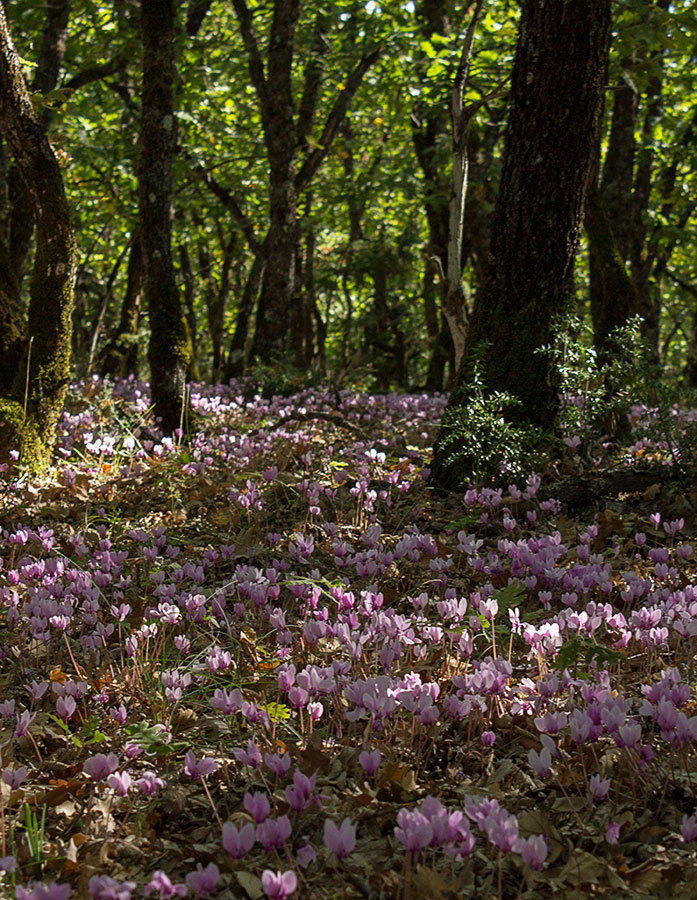
We were debating which route to take back when one of my co-leader’s mentioned that we had passed some lovely cyclamen in the woods and our path was decided for us. We turned around and headed the short distance back to where they had been spotted. This turned out to be the absolute highlight of the day for me. I could not possibly have imagined the sheer volume of Cyclamen hederifolium that we would see in one place. The floor of this beautiful oak wood was carpeted with them, much like an English Bluebell wood and it turns out that the equivalent in Greece is just as good! They stretched almost as far as the eye could see on both sides of the road and the air was thick with their delicate scent.
Needless to say, the journey home to our hotel was undertaken with a buzz of chatter about the wonderful spectacle we had witnessed and the talk continued on around the dinner table that evening.
The next morning we were departing our lovely hotel for a new base and having said our farewells to the wonderful proprietors we set out. The first part of our journey was slightly contrary to our intended direction as we wanted to visit Hosios Loukas Monastery before leaving the area. I took this phone snap before we went through the small archway into the courtyard complex to explore further.
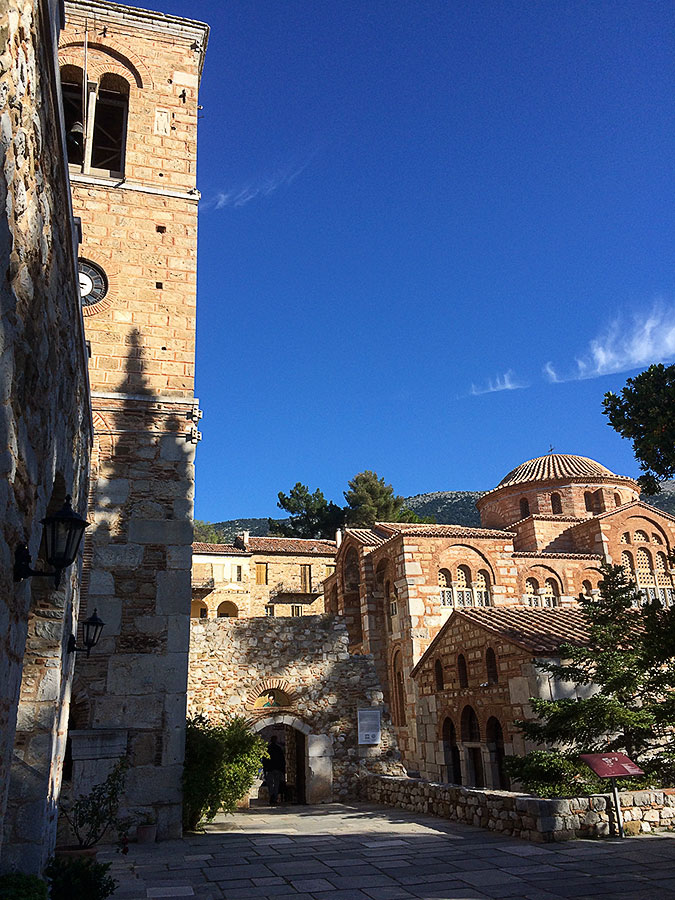
The monastery is one of the best surviving examples of middle Byzantine art in the form of mosaics. We were given a taster as we entered with this little restored piece above the archway.

The main church there is quite extraordinary. It reminded me a little of the interior of St. Mark’s Cathedral in Venice – lots of scenes on a gold ground, mostly depicting pertinent saints and parts of the story of Jesus’ life. It was a beautiful and very serene space, quite a change to what we had been seeing over the previous days.

Needless to say, some parts were in better condition than others, clearly a few of the mosaics had received some extensive TLC but the overall effect was stunning. The crypt was equally decorated but with less of the gold hues.

I also came across a monk doing some watering and asked if I could take his photo. He was very obliging and I was quite pleased with the result as the architecture was lovely on it’s own but adding a figure to the image gives the whole thing a sense of scale and reverence.

Having done my degree in Art History (and thoroughly enjoyed it) before realising that it was nature and photography that I was passionate about, Hosios Loukas was a delightful interlude. There was plenty more to see there too. In the orchard by the car park there were Cirl Buntings singing and Colchicum cupanii flowering under the trees. Walking the short distance to another outlying chapel we found the small churchyard to be absolutely full of Sternbergia lutea ssp. sicula in prime condition. There was a juvenile Balkan Whip Snake there too and a Greek Stream Frog sheltering in the shade of a small spring.

In addition to this, there was a huge Rosemary bush flowering which absolutely hummed with life including Hummingbird Hawkmoth, Lang’s Short Tailed Blue, Krueper’s Small White and various other butterflies. Several types of seed bug joined the mix and a loud, deep buzz warned of an incoming Violet Carpenter Bee.

We were reluctant to leave this haven but eventually had to and so we were back on the road once more. We drove West along the coast to the small coastal town of Galaxidi where we stopped for lunch in a waterside restaurant. Of course, this didn’t mean that we would stop watching the world around us and we watched Yellow Legged Gulls flapping lazily over the water and a White Wagtail catching insects from the sea wall. The most interesting thing though was the number and variety of small fish in the water which was crystal clear. You could be forgiven for thinking that the next photo was taken at an aquarium but this is a phone grab looking straight down into the waters of the harbour!

The afternoon was spent travelling towards Diakopto on the Northern shore of the Peloponnese. The route took us along the coast to Rio Antirrio, past masses of Sea Squill and with odd glimpses of birds like Goldfinch and Crested Lark, to the bridge over the Gulf of Corinth. The last part of our journey was less interesting being on the motorway but we were soon checking into our new base for the rest of the trip before heading to dinner in a local restaurant.
Another clear sky greeted us the next day and we set out away from the coast following roughly the direction of the rack railway which runs from Diakopto to Kalavryta. We paused briefly on the way to look at Crocus hadriaticus and Crocus cancellatus ssp. mazziaricus growing together in the verge. Passing through Kalavryta we headed up to the ski centre on Mount Chelmos. Here we would spend a couple of hours exploring and enjoying the sunshine with spectacular views over the valley of the River Styx. There were quite a lots of birds around even at this high altitude; Ravens crocking above, Linnets gathering in large flocks in the trees by the car park as well as Northern Wheatear, Black Redstart and Sombre Tit flitting about between the pine trees. We found good numbers of Crocus cancellatus ssp. mazziaricus growing among the wiry grasses and a couple more Sternbergia colchiciflora. There was also a new butterfly for the trip in the shape of a Mountain Small White which has a rather weak and flimsy flight, somewhat reminiscent of the Wood Whites back home.
After a lovely picnic up here, we returned to Kalavryta and stopped for a lovely stroll round town and a coffee on the town square. Continuing on downhill, some of the group chose to return to the hotel while the rest of us took a short journey back out of town to walk up a steep track to look for Colchicum peloponnesiacum. There was lots of Coridothymus capitatus flowering in the track and we found a few lovely Praying Mantis in the low growing shrubs to either side but to begin with we were not seeing any of these endemic bulbs. Nearing the top, we finally found one growing on the edge of the track and reaching the top we were rewarded with fantastic views back towards Mount Parnassus – you could just make out Delphi and Arahova. On the way back down, our luck changed further as I found a whole lot more of the little Colchicums and we returned to the hotel to cool down a happy bunch.
The next day we took a similar route out of town but this time we followed the Kerenitis river valley. Our first stop was another rock face where there were more lovely Campanula versicolor but the most surprising thing there greeted us as soon as we stepped from the vehicles. In the middle of the road was a freshwater crab which took one look at us and went for cover – initially under my walking boot (which I was wearing!) and then under my car tyre. Not wanting it to get squashed I carefully moved it to the verge.
Our next stop was by another chapel, Agios Georgios, which had beautiful views over the hills which were blanketed in vineyards rich with autumn colours. Here we found lots more Crocus cancellatus ssp. mazziaricus.

There were also quite a few dung beetles here, demonstrating perfectly how the pack their prize into a neat ball before rolling it away, making sure to stop and stand on top to gauge the direction periodically. It was fascinating to watch.
After lunch, we made another afternoon coffee stop, this time in the village of Plataniotissa which is home to the most incredible church inside an ancient Plane Tree with the church bells hung from the branches. I snapped a couple of photos on my phone so you can get an idea of scale.

There is a little stained glass door leading into the tree and once inside there is space for several people to sit and stand around a tiny altar. It is a very unusual, beautiful place and very tranquil too.

Having enjoyed our coffee we meandered back down the hill making a couple more roadside stops along the way to investigate different flowers that we had spotted. It was a leisurely trip back to the hotel where, having packed our bags ready for the morning, a few of us decided to take a wander down to the sea front. In the low afternoon light it was another tranquil spot and a lovely walk to end the day.


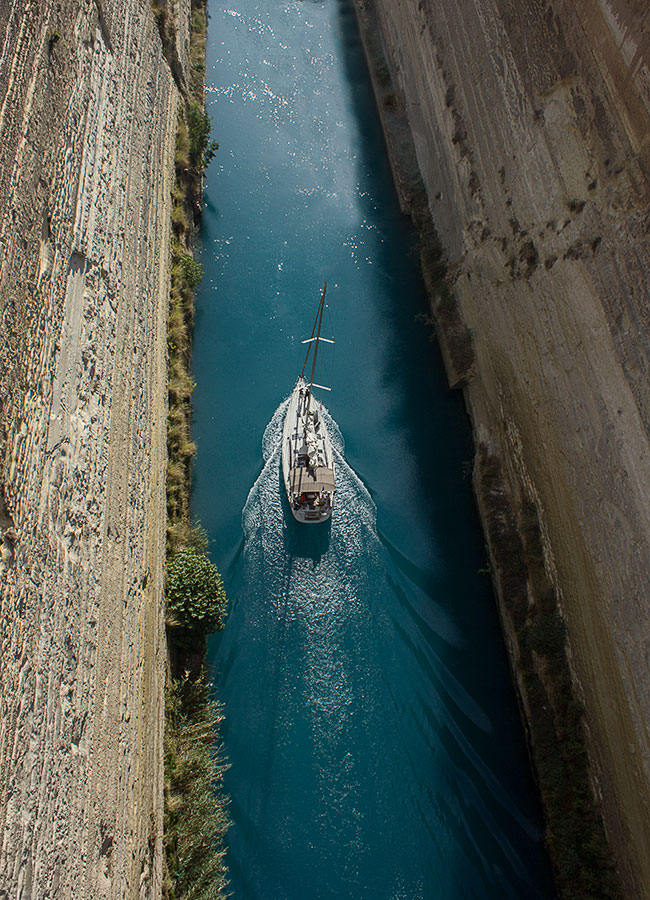
The following morning it was time to head back to Athens for our flight home. We made one last stop on the way to marvel at the Corinth Canal, an impressive piece of engineering that was dug by hand at the end of the nineteenth century.
We had had a wonderful week in gloriously sunny Greece, it was time to go home and hope that the British weather would not be too unkind on our return.